





 Portuguese
  English
  Spanish
  4 min of reading
  9 comments


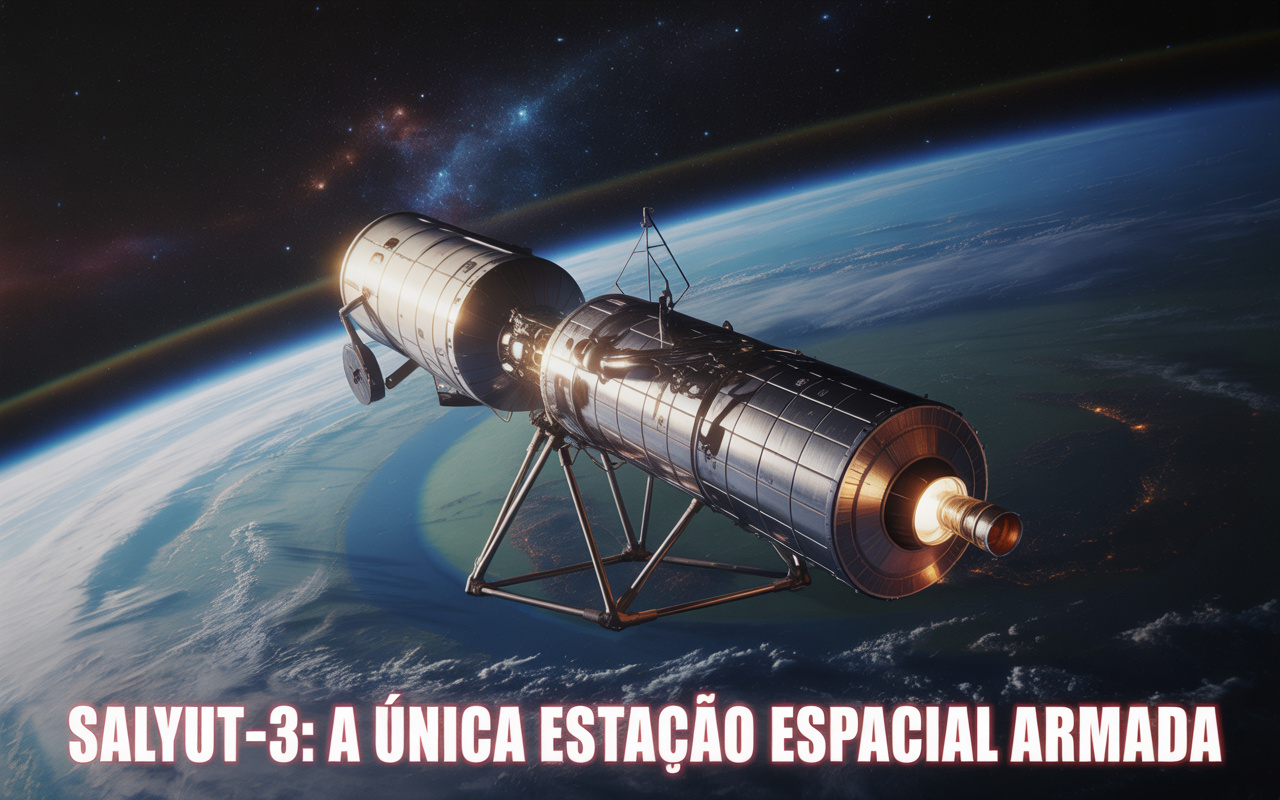


With 19 Tons, Orbiting at 220 km from Earth and a 23 mm Cannon Actually Fired in Space, the Soviet Program Almaz Created the Only Armed Military Space Station in History.
During the height of the Cold War, when the United States and the Soviet Union were competing not only on Earth but also in space, Moscow took orbital militarization to a level that would never be repeated. In absolute secrecy, the USSR developed the Almaz program, a series of crewed space stations with exclusively military purposes, designed for strategic espionage and, for the first time, armed for combat in orbit.
The Almaz was not a theoretical concept or a futuristic delusion: it existed, was launched, received human crews, and even tested a real weapon in space, something no other power has done since.
The Military Logic Behind Almaz
In the 1960s and 1970s, automatic satellites still had significant limitations. The Soviet Union believed that human crews in orbit could identify targets more accurately, react in real time, and make strategic decisions impossible for the automatic systems of the time.
-
Goodbye iron: new technology from Xiaomi promises to revolutionize the way we iron clothes with 500 kPa steam, continuous flow of 120 g/min, heating in 65 seconds, and six smart modes for different fabrics.

-
Rio Pardo, the most mysterious city in Rio Grande do Sul: untouched Pampas castle, the missing treasure of the Devil Boy, bride’s saint, invisible tunnels, and a 200-year curse today.

-
China retires the J-7 fighter after years of military protection and can now transform military items into drones, following more than 60 years of operation of the J-7, derived from the MiG-21, with thousands of units produced and strategic use in the PLAAF and PLANAF.
-
Volunteers are sought to live in the mountains for a month: a study pays people to stay at 2,500 meters, with 24-hour monitoring of sleep, metabolism, and blood pressure.


Thus, Almaz was born, a project conceived from the start as a military orbital surveillance platform, capable of observing enemy installations, missile bases, and strategic movements directly from space.
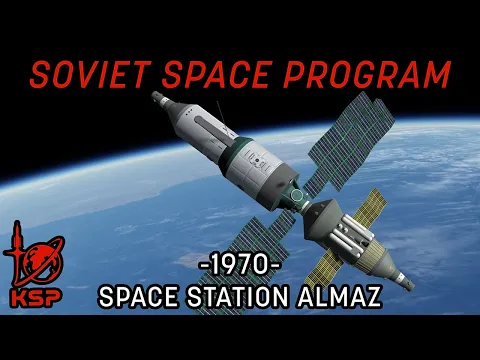

To disguise its military nature, the stations were launched under the civilian designation Salyut, confusing Western analysts for years.
Dimensions and Characteristics of the Station
The Almaz stations were about 14.5 meters long, with an approximate mass of 19 tons, and operated in low orbits, between 220 and 270 kilometers in altitude. This choice was not casual: lower orbits allowed for higher resolution images, essential for espionage.
Aboard, the cosmonauts operated advanced optical systems for the time, capable of photographing strategic targets with a level of detail superior to that of the automatic satellites then available.
The Weapon That Took War to Space
The most controversial and historic element of the Almaz program was its orbital weapon. The Salyut 3 (OPS-2) station was equipped with a 23 mm automatic cannon, adapted from systems used in Soviet military aircraft.
The purpose of the armament was clear: to defend the station against potential attacks from enemy satellites, orbital interceptors, or even attempts at space sabotage, a real fear during the tensest years of the space race.
What is most impressive is that the cannon was not just on paper. After the crew left, the weapon was remotely tested, firing about 20 projectiles in the vacuum of space before the station’s deorbit. It is the only confirmed case of a crewed weapon tested in orbit in human history.
Firing a weapon in space is not trivial. Without an atmosphere, each shot generates an equal and opposite reaction, potentially altering the station’s orbit.
To compensate for this, Almaz needed to integrate its attitude control systems with the armament, ensuring stability after the shots.
This detail illustrates the level of sophistication and risk involved in the project.
Real Missions, Limited Results
Despite the technological advancement, the program faced issues. The missions were short, complex, and expensive. Maintaining crews in orbit solely for espionage proved less efficient than the rapid advancement of automatic satellites, which began to offer better resolution, longer operational time, and lower costs.
Additionally, the political risk of an armed incident in space, involving human crews, was enormous. An orbital confrontation could quickly escalate into a global conflict.
After three launched stations, the Almaz program was terminated. The Soviet Union chose to concentrate efforts on automatic satellites and scientific space stations, such as Mir.
Orbital armament, while technically feasible, was deemed strategically unnecessary and politically dangerous.
A Precedent That Was Never Repeated
Since Almaz, no nation has placed conventional crewed weapons on space stations again. International treaties, such as the Outer Space Treaty, and the very evolution of technology have made this path unattractive.
Still, Almaz remains an extreme milestone of the militarization of space, demonstrating how far the logic of the Cold War was able to go.
Today, when talking about space warfare, the focus is on satellites, electronic interference, and anti-satellite weapons. Almaz serves as a reminder that, at another historical moment, space was dangerously close to becoming a new battlefield with humans on board.
It never fired at a real enemy, but its existence proves that the final frontier has indeed been considered as full military territory.









História muito interessante, mas dai acreditar que nenhuma nação tenha colocado armas em órbita?Duvido muito. A diferença é que ao invés de canhões, nada me faz acreditar que não haja uma infinidade de mísseis atômicos apontados para terra, esperando um dedo nervoso apertar um botão e extinguir um continente inteiro. E se um dia uma coisa dessa for descoberta e denunciada, com certeza, por alguns instantes, vão apontar os tais mísseis para o espaço e dizer que se trata de armas contra inimigos externos, como foi “demonstrado” no filme Armargedon , sem Bruce Willis, é claro
Na proxima guerra mundial que tiver a russia perde a siberia para os chineses e stanilingrado tem os dias contados
Alem de ter uma forca armada de soldados despreparados