





 Portuguese
  English
  Spanish
  4 min of reading
  6 comments


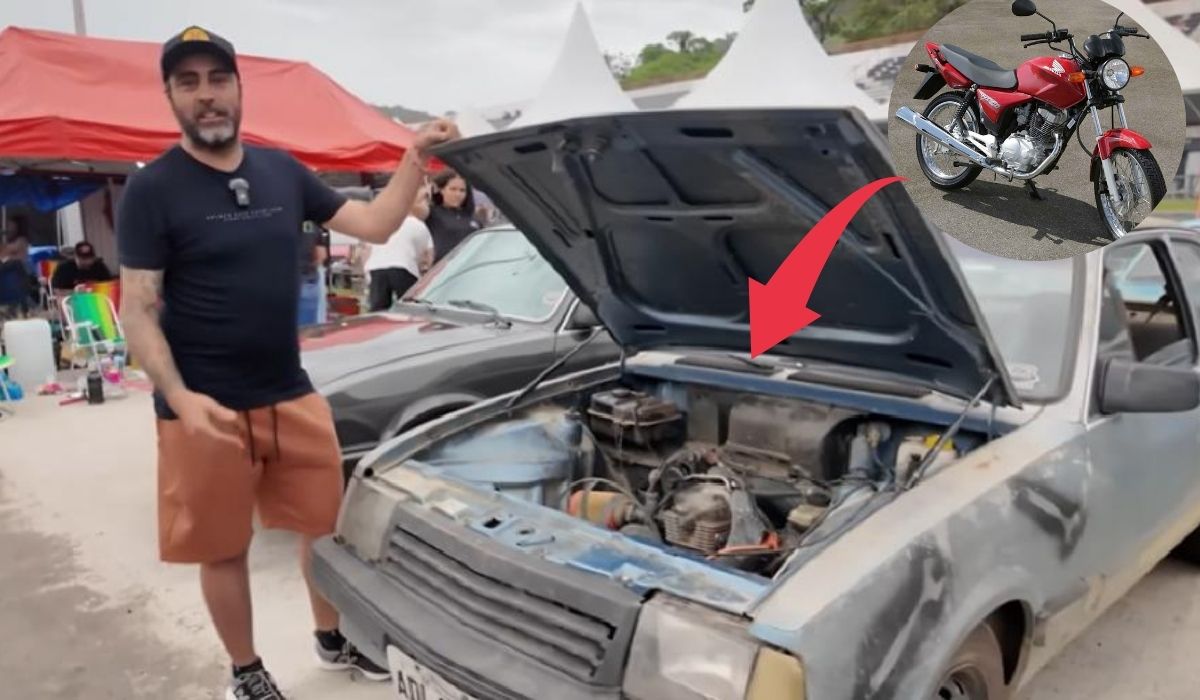


A Chevette adapted with a motorcycle engine and an unusual transmission system went viral on social media by combining handmade solutions, repurposing parts, and questions about functioning, performance, and legalization, highlighting the technical and legal limits of automotive modifications in Brazil.
A Chevette adapted to run with a motorcycle engine and a transmission setup that, according to the creator, adds up to 30 gears, gained traction on social media in recent months.
The project is attributed to Fagner, the owner of the Fagner Motos Preparações workshop, located in Camboriú (SC), who claims to have combined car and motorcycle components to make the vehicle functional.
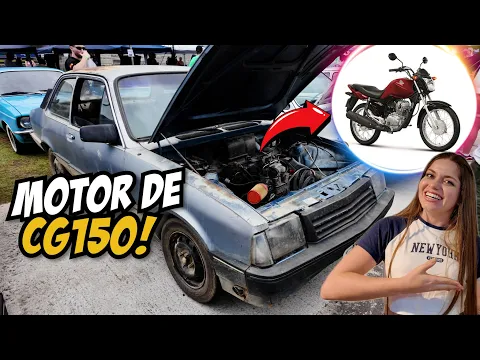
According to the person responsible for the adaptation, the car received a Honda CG Titan 150 engine and began operating with two gearboxes at the same time: the original Chevette one and the motorcycle one.
-
Goodbye iron: new technology from Xiaomi promises to revolutionize the way we iron clothes with 500 kPa steam, continuous flow of 120 g/min, heating in 65 seconds, and six smart modes for different fabrics.

-
Rio Pardo, the most mysterious city in Rio Grande do Sul: untouched Pampas castle, the missing treasure of the Devil Boy, bride’s saint, invisible tunnels, and a 200-year curse today.

-
China retires the J-7 fighter after years of military protection and can now transform military items into drones, following more than 60 years of operation of the J-7, derived from the MiG-21, with thousands of units produced and strategic use in the PLAAF and PLANAF.

-
Volunteers are sought to live in the mountains for a month: a study pays people to stay at 2,500 meters, with 24-hour monitoring of sleep, metabolism, and blood pressure.


The combination drew attention due to its unusual nature and the claimed number of gear ratios, contributing to the virality of the content.
How The Adapted Transmission System Works
According to the owner’s account, the engine transmits motion to two interconnected gearbox systems, allowing different gear combinations.
The described logic is that each gear of the Chevette gearbox can be used in conjunction with the gears of the motorcycle gearbox, multiplying the possible ratios.
Based on this configuration, Fagner claims that the car now has 30 combinations, with five reverse gears and the others geared for forward movement.

The figures, however, are presented by the creator himself, without public disclosure of independent technical tests or certified measurements.
In addition to the transmission adaptation, the owner reports having made internal modifications to the engine, such as changes to the camshaft and cylinder head, as well as increasing the displacement.
He claims that the capacity would have reached 190 cm³, which would help handle the vehicle’s weight.
According to the information provided by the owner, the Chevette would reach speeds of up to 100 km/h and have a consumption of up to 36 km/l, always based on his own measurements.
Origin of the Project and Daily Use
The person responsible for the adaptation claims that the initial motivation was not to create an experimental or display project.
He reports that during a move to a rural town, he needed a vehicle to drive on unpaved roads, avoiding wear on another car.
In this context, Fagner says he received a Chevette without an engine as part of the payment for a service rendered.
Since he already had a CG Titan, he chose to adapt the motorcycle mechanics to the car, seeking more interior space and some comfort for daily commutes.
In statements reproduced in interviews, the owner also comments that the project was developed in a handmade manner.
“Everything is done in a homemade way.
In my car, I used parts that were left over both from the Chevette and from the motorcycle,” he stated, explaining that there was no mass production or use of industrial solutions.
When asked about the possibility of repeating the modification for clients, he declared that he would consider the work.
At the same time, he emphasized that each case would require specific adaptations, given the particularities of this type of conversion.
What Legislation Provides for Modified Cars
In Brazil, structural alterations to vehicles, especially when they involve engine and gearbox swaps, are subject to specific rules of approval and regularization.
The National Traffic Department provides for the issuance of the Traffic Legislation Adequacy Certificate (CAT) for vehicles that undergo processes of handmade manufacturing or deep transformations.
According to the National Traffic Council’s rules, vehicles manufactured or modified uniquely must meet safety and vehicle construction requirements.
The process usually requires a technical project signed by a qualified engineer, as well as analyses that allow the creation of a specific code for make, model, and version for registration in Renavam.
Traffic law specialists point out that without this set of documents and approvals, the vehicle cannot legally circulate on public roads.
Compliance with the requirements is essential to enable licensing with the state Detrans.
Repercussion and Unconfirmed Information
The adaptation of the Chevette gained prominence mainly due to the unusual nature of the mechanical solution and the creativity involved in repurposing components.
At the same time, some of the information disseminated remains based solely on statements from the creator himself, without confirmation by independent technical reports.
Among the points that still lack public validation are the consumption data, maximum speed, and the detailed functioning of the transmission system in continuous use.
With the repercussion of the case and the technical questions involved, the episode reignites the debate about how far handmade adaptations can go without conflicting with legal and safety requirements for circulation on public roads.







O cara pega estrada de barro sem um mínimo de asfalto e estão preocupado com o licenciamento do carro ao invés da condição deplorável da via. Isso é Brasil 🇧🇷
Toda inovação pode ser bem vinda se for pra melhor, mas deve ser submetida a testes.
A força do motor não é compatível com o peso do carro, funciona mas sem nenhuma força, projeto pé de galinha 🐔🐣