Portuguese
  Spanish


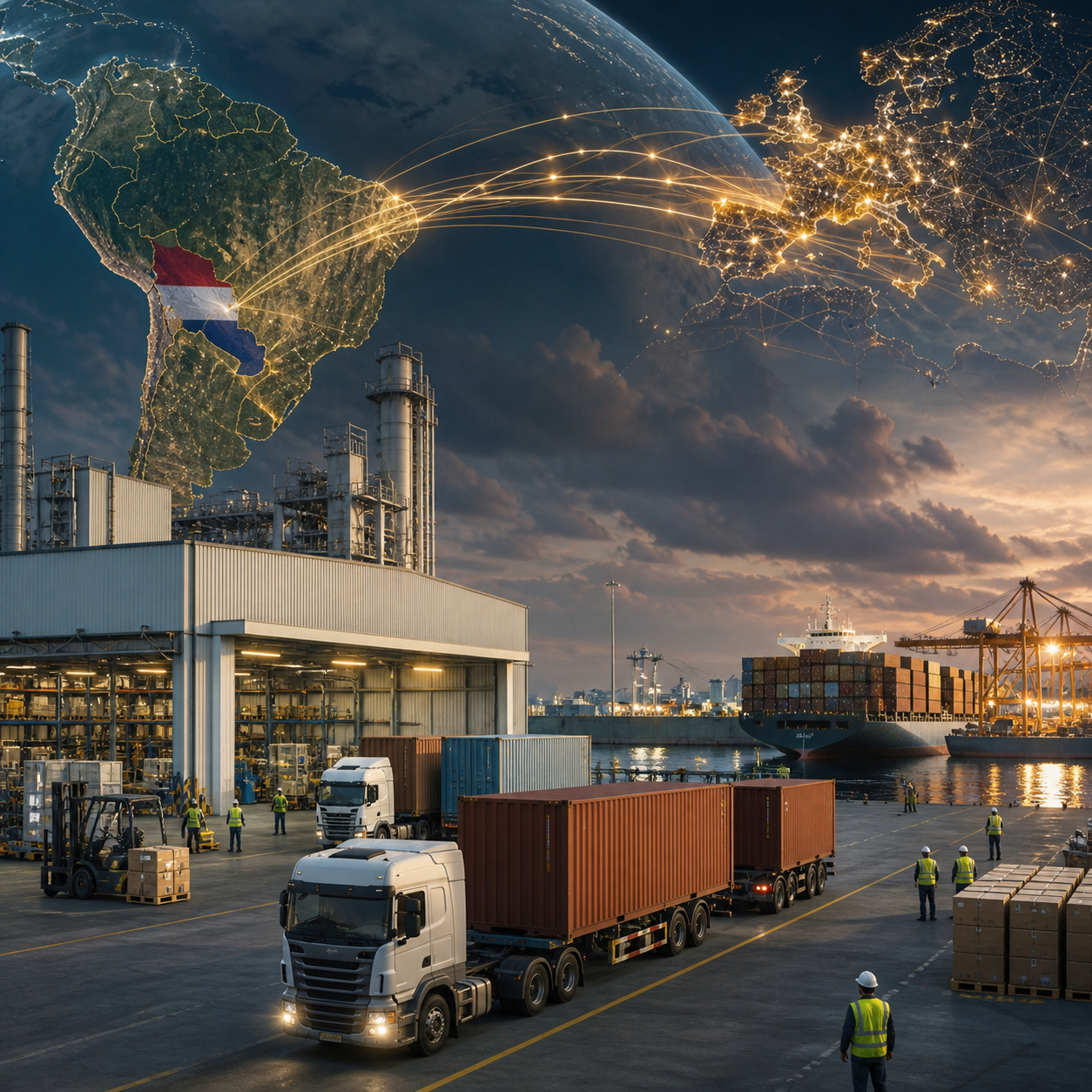

EU-Mercosur Agreement could accelerate migration of Brazilian companies to Paraguay, where lower taxes increase export competitiveness.
In 2026, with the expected entry into force of the agreement between Mercosur and the European Union, a silent movement gained strength in the industrial sector: Brazilian companies began to look to Paraguay as a strategic production base to export to the European market with lower costs. The treaty, negotiated for over 25 years, creates one of the largest free trade zones in the world, connecting approximately 718 million people and significantly expanding access to international markets.
The central point of this change lies in the combination of two factors: tariff reduction in trade with Europe and a much lighter tax environment in Paraguay. This opens up a concrete possibility for increased competitiveness for companies that produce outside Brazil, but within Mercosur.
Continue reading below to understand why Paraguay has entered the radar of Brazilian industries, how the agreement with the European Union changes the game, and what the real impacts of this movement are.
-
As Brazil Expands Social Welfare, Survey Reveals 40% Blame Poverty on Laziness, While 58% Cite Lack of Opportunities

-
China Tightens Control on Antimony, Driving Prices from $22,000 to Nearly $40,000 per Ton as U.S. Rushes to Bolster Strategic Reserves

-
BlackRock Freezes $1 Billion in Brazilian Renewable Energy, Impacting 1.5 GW of Planned Projects and Highlighting Investor Concerns Over Infrastructure Bottlenecks Cutting Up to 25% of Solar and Wind Generation
-
Labor Shortage: Despite Record Average Salary, 90% of Brazilian Bar and Restaurant Owners Struggle to Hire Key Roles Like Sushi Chefs and Head Cooks


EU-Mercosur Agreement eliminates tariffs and expands access for South American companies to the European market
The agreement between Mercosur and the European Union provides for the reduction or elimination of tariffs on a wide range of products exported to the European bloc.


In practice, this means that companies established in Mercosur countries will be able to sell to Europe with fewer trade barriers, increasing their competitiveness against products from other regions.
Furthermore, the treaty also includes rules that increase regulatory predictability and reduce operational costs, creating a more favorable environment for exports and investments.
This scenario transforms Mercosur into a strategic export platform, especially for industries that rely on tight margins.
Paraguay emerges as an alternative due to a much lower tax burden than Brazil’s
One of the most decisive factors in this movement is Paraguay’s tax system. The country adopts the so-called “10-10-10” model, with:
- 10% corporate income tax
- 10% value-added tax (IVA)
- 10% personal income tax
This level is significantly lower than in Brazil, where the corporate tax burden can exceed 34% in income tax alone, not counting consumption taxes.
Furthermore, specific regimes such as the Maquila Law allow companies to pay approximately 1% on the exported added value, making the country even more attractive for production aimed at export. This differential creates a direct advantage in the final pricing of exported products.
Maquila regime allows importing inputs tax-free and exporting with minimal burden
The maquila regime is one of the main instruments attracting Brazilian companies.
It allows industries to:
- import raw materials and equipment tax-free
- carry out production in Paraguay
- export paying only a reduced fee
This model was designed precisely to attract foreign investment and boost exports. In practice, it functions as a production structure exclusively focused on the external market, with significant cost reduction.
Mercosur rules of origin allow exporting with tariff exemption within the bloc

Another essential point is the functioning of Mercosur’s rules of origin. For a product to be considered “originating” from the bloc and gain access to tariff benefits, it needs to meet criteria such as:
- minimum percentage of regional content
- relevant productive transformation within Mercosur
Currently, a product can have up to 45% of inputs imported from outside the bloc, provided that at least 55% is produced within Mercosur.
This allows companies to produce in Paraguay, comply with the rules, and export with advantages both within the bloc and to partners such as the European Union.
More than 200 Brazilian industries have already crossed the border in search of lower costs
The movement is not theoretical. It is already happening. Reports indicate that more than 200 Brazilian industries have already settled in Paraguay, attracted by lower costs, tax incentives, and less bureaucracy.
This flow includes sectors such as:
- textile
- footwear
- food
- auto parts
- electronics
The trend is that the agreement with the European Union will accelerate this process by increasing the export potential of these operations.
Cost difference between Brazil and Paraguay increases competitive advantage in exports
The so-called “Brazil cost” is often cited as one of the main factors limiting the competitiveness of national industry. This cost involves:
- high tax burden
- bureaucracy
- labor costs
- infrastructure
By transferring part of their production to Paraguay, companies can significantly reduce these costs, increasing their competitiveness in the international market.
With the EU-Mercosur agreement, this difference becomes even more relevant, as it directly impacts the ability to compete in Europe.
Not all companies are prepared to take advantage of the new scenario
Despite the opportunities, adaptation is not automatic. Exporting to the European Union requires compliance with rigorous technical standards, sanitary and environmental certifications, adherence to quality standards, and efficient international logistics.
Furthermore, rules of origin must be respected to ensure access to tariff benefits.
This means that many companies are not yet ready to fully take advantage of the agreement, even with tax benefits.
Movement raises debate about industrial loss and regional competition within Mercosur
The migration of companies to Paraguay also raises concerns in Brazil. Among the main points discussed are the possible loss of industrial jobs, reduction in revenue, and displacement of production chains.
At the same time, proponents of the model argue that this regional integration can strengthen Mercosur as a globally competitive bloc.
Agreement could redefine the logic of industrial production in the Southern Cone
The emerging scenario is one of production reorganization within Mercosur itself. Companies may start dividing their operations between countries, choosing locations with the best combination of costs, logistics, and market access.
In this context, Paraguay emerges as a low-cost industrial platform, while Brazil can maintain strategic functions such as a consumer market and input base.
Now the direct question is: will the agreement between Mercosur and the European Union strengthen Brazilian industry as a whole or accelerate the migration of production to countries with lower tax burdens within the bloc itself?