






 Portuguese
  Spanish


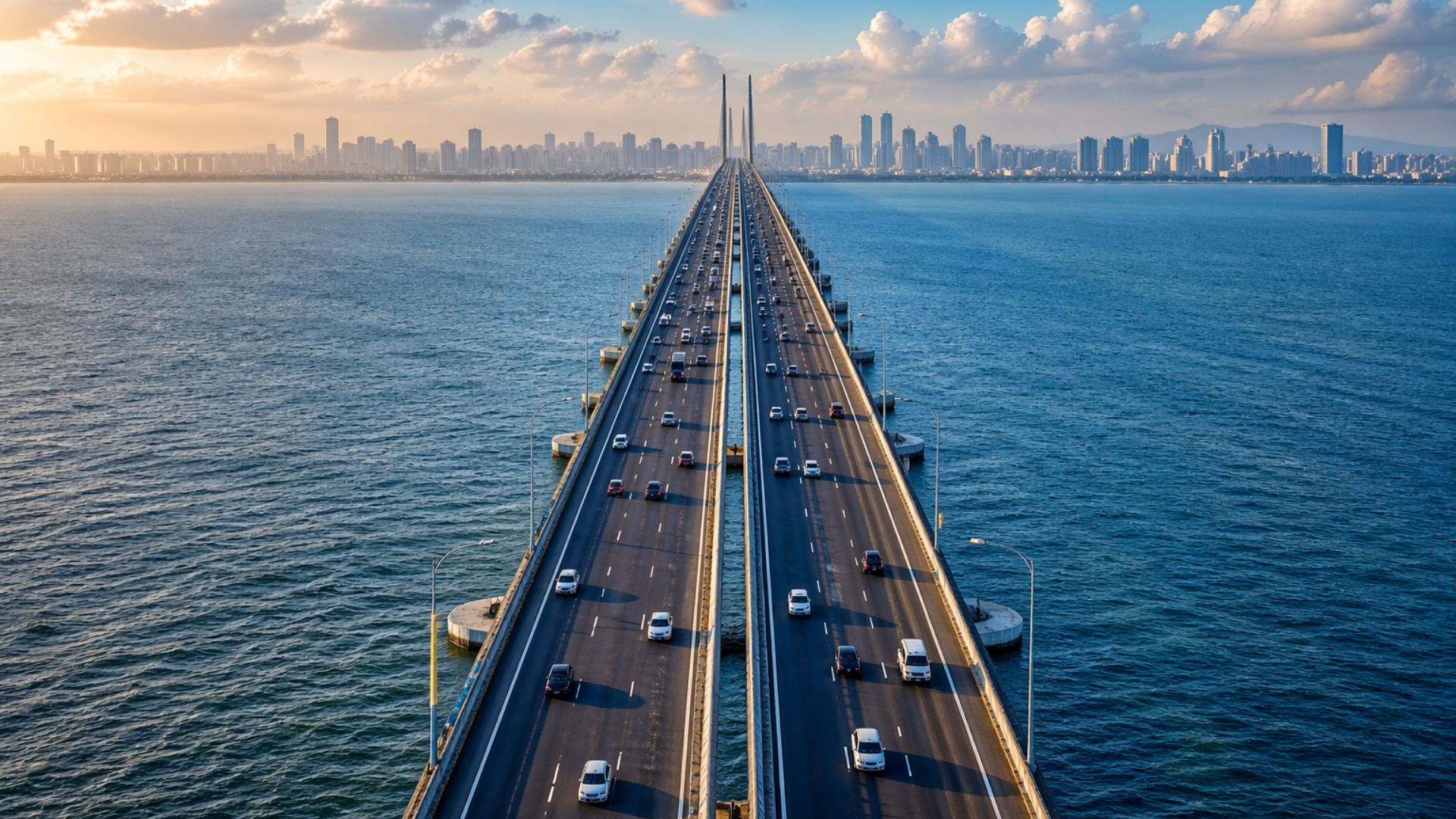


Sea crossing drastically reduces travel time between two of India’s most strategic areas, by creating a direct link that alters urban flows, regional logistics, and the growth dynamics of one of the world’s largest metropolises.
India inaugurated the Atal Setu, the official name of the Mumbai Trans Harbour Link, connecting Mumbai to Navi Mumbai via a 21.8-kilometer crossing, which reduced a journey that could take up to 120 minutes to about 20 minutes under normal conditions.
Connecting Sewri, in Mumbai, to the Nhava Sheva region, in Navi Mumbai, the structure has become recognized as the country’s largest sea bridge, consolidating a direct link across the bay that significantly alters local urban mobility.
Sea bridge changes travel between Mumbai and Navi Mumbai
Designed to relieve one of the metropolitan region’s most strained corridors, the project addresses a historical limitation, as circulation between the main island and the mainland relied on long routes, frequently affected by intense congestion.
-
Giant Robots Build Entire Neighborhood of 100 3D-Printed Homes in the U.S., Showcasing Technology’s Impact on Construction Industry

-
Helsinki Residents Receive Water That Travels 120 Kilometers Through a Hidden Rock Tunnel from a Lake Before Treatment

-
Brazil’s Sertão Region Nears Completion of Latin America’s Longest Artificial River, Transforming Water Access in Drought-Prone Ceará
-
Pre-mixed stabilized mortar set to revolutionize construction in 2026: extends usability to 36 or 72 hours, boosts productivity, and minimizes waste in building projects.



With the opening of the new link, drivers now have a direct route over the water, reducing reliance on indirect paths and creating a more predictable alternative for daily commutes between the two urban centers.

21.8 km, six-lane structure expands road capacity
According to the Mumbai Metropolitan Region Development Authority, MMRDA, the project was executed with six lanes, three in each direction, combining approximately 16.5 kilometers over the sea and about 5.5 kilometers on land, forming a continuous high-standard corridor.
This configuration positions the crossing as a metropolitan mobility axis, going beyond the traditional urban bridge concept, by allowing a constant flow of vehicles in a section that previously concentrated significant bottlenecks in regional circulation.
By connecting Sewri and Nhava Sheva without the need to bypass densely populated areas, the route shortens distances and reduces typical urban traffic interferences, contributing to greater predictability in daily commutes.
In practice, the Atal Setu redistributes part of the flow that previously overloaded internal roads, creating a more efficient alternative for both passenger transport and logistical and commercial activities.
According to the MMRDA, construction began in March 2018 and was completed on January 5, 2024, within a schedule that involved multiple engineering fronts along the bay.

The inauguration took place on January 12, 2024, in a ceremony led by Prime Minister Narendra Modi, marking the operational launch of one of the country’s largest recent road interventions.
Billion-dollar investment and impact on regional mobility
The total approved cost was 17,843 crore rupees, according to official data from the metropolitan authority responsible for the project, reflecting the technical complexity and scale of the implemented infrastructure.
Planned as part of a broader regional connectivity strategy, the bridge is integrated into the context of Navi Mumbai’s expansion, an area that has for decades appeared as an alternative to redistribute the region’s urban growth.
In addition to facilitating access to the future Navi Mumbai International Airport, the link also benefits industrial, port, and development zones, reinforcing its function as a structuring axis of regional mobility.
In this way, the crossing integrates territories with distinct dynamics, connecting densely populated regions to areas planned to absorb new investments and population expansion.
The choice for a direct link over the sea is associated with Mumbai’s geographical limitations, whose territorial configuration restricts expansion and intensifies pressure on its road network.

In contrast, Navi Mumbai emerges as a space for planned growth, making the connection between the two areas a central element for reorganizing urban and economic flows.
Technology and environmental measures in bridge construction
Beyond its impressive scale, the Atal Setu incorporated engineering solutions aimed at road safety, crossing stability, and mitigating environmental impacts throughout its implementation.
Among these solutions, the use of sections with Orthotropic Steel Deck stands out, a technology that allows greater structural efficiency and reduces the need for interventions in environmentally sensitive areas.
The region crossed by the bridge includes mangroves and areas frequented by flamingos and other migratory birds, which required specific adaptations in the project to reduce impacts on these habitats.
In response, acoustic and visual barriers were installed at certain points, with the aim of minimizing noise and interference with the behavior of species present in the area.
Although the environmental debate about large road works remains present, the adoption of these measures indicates an attempt to reconcile large-scale infrastructure with ecological preservation requirements.
In a coastal urban scenario, the integration between mobility and environmental protection became part of the same planning, influencing technical decisions throughout the project’s execution.
Bridge reduces travel time and reorganizes urban dynamics


The most immediate impact perceived by users is the reduction in travel time, which went from up to two hours to about 20 minutes under normal traffic conditions.
As a result, the routine of those who travel between Mumbai and Navi Mumbai for professional, commercial, or service reasons tends to become more predictable and less subject to variations caused by congestion.
For the metropolitan region, however, the effects go beyond individual time savings, reaching the organization of flow between strategic areas of the local economy.
The link facilitates access between India’s financial capital, port areas, industrial hubs, and new vectors of urban growth, reinforcing its role as strategic infrastructure in regional planning.
More than just shortening distances, the Atal Setu consolidates a transformation expected for decades, by replacing fragmented travel with a continuous and direct crossing over the sea.
With the new connection in operation, the relationship between Mumbai and Navi Mumbai now operates at a different pace, supported by an infrastructure that alters both travel time and the metropolis’s operational logic.







7 days gone after confirming order-no sign of delivery.
Receiving alerts from courier service since last 3 days and the result is same-NO SIGN