






 Portuguese
  Spanish


One of the Greatest Astronomical Discoveries Ever Recorded Reveals a Gigantic Reservoir of Water Vapor Around a Quasar 12 Billion Light-Years from Earth.
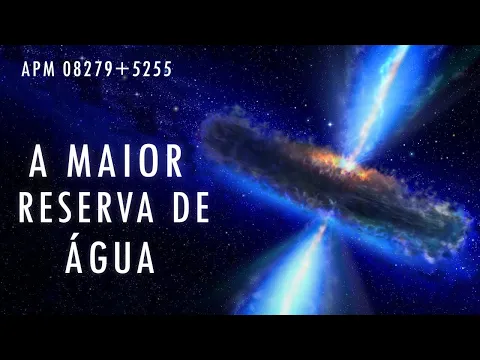
In 2011, an international team of astronomers made a revelation that seems straight out of a science fiction script: the existence of a colossal reservoir of water in space, about 140 trillion times greater than all the oceans of Earth combined. The discovery was made around the quasar APM 08279+5255, located in the constellation Lynx, over 12 billion light-years away.
This finding is not only impressive due to its magnitude, but it also redefines what we know about the abundance of water in the primitive universe, as this quasar existed when the cosmos was only 1.6 billion years old after the Big Bang.
What Is a Quasar?
Quasars are extremely luminous objects located at the center of distant galaxies. They are powered by supermassive black holes that consume huge amounts of gas and dust, releasing energy equivalent to trillions of suns.
-
China Develops Custom 140-Ton Electric Mining Truck with 770 kWh Swappable Battery, Deploys 290 Units in Xinjiang’s Largest Zinc Mine

-
Meta to Launch Arena, a New Prediction App Targeting 3.56 Billion Users, Competing with Polymarket and Kalshi

-
Scientist Challenges Famous Human Evolution Theory, Argues Homo Sapiens Evolved Gradually Over Thousands of Years
-
15-Year-Old American Builds Ocean Generator with PVC Pipe and 3D-Printed Propeller for $12, Wins National Prize, Presents at White House, and Makes Forbes 30 Under 30 List




In the specific case of APM 08279+5255, it is estimated that the black hole at its core has about 20 billion times the mass of the Sun, emitting heat and light on scales difficult to imagine.
It is around this cosmic monster that the gigantic reservoir of water vapor was detected, in a region heated by the intense energy emitted by the quasar.

How Was Water Detected in Space?
The discovery was made possible through observations in millimeter and submillimeter wavelengths, using equipment such as the Z-Spec at the Caltech Submillimeter Observatory (Hawaii), CARMA (in California), and the Plateau de Bure Interferometer in France.
These instruments allowed the measurement of radiation from water vapor, identifying its presence even at such colossal distances. The vapor found has a temperature of around –53 °C — extremely cold for us, yet still five times warmer and up to 100 times denser than typical gas found in the Milky Way.
The Size of the Discovery
The number is impressive: the amount of water vapor is equivalent to 140 trillion times the total volume of Earth’s oceans.
To put this in perspective, if this water could be transported to our planet, it would be enough to fill countless Earth-like planets. It is the first time such a colossal amount of water has been observed in such a distant region of the universe.
This discovery demonstrates that water was already present in abundance when the universe was very young, suggesting that the essential ingredients for life may have been more common than previously thought.
What Does This Mean for Science?
The presence of water in vapor form around a quasar opens the door to various reflections:
- Cosmic Abundance of Water: confirms that water is not rare in the universe and may have existed since the early stages of galaxy formation.
- Boost for Astrobiology: if water is one of the fundamental elements for life as we know it, this discovery strengthens the hypothesis that conditions for life may be much more universal.
- Cosmic Evolution: indicates that complex chemical processes were active in the universe just 1.6 billion years after the Big Bang.
The Importance for the Future of Astronomy
Although the detected water is in vapor form and not in liquid oceans like on Earth, its presence in such massive quantities suggests that the universe may be much “wetter” than previously thought.
This has profound implications for future research. With more advanced telescopes — such as the James Webb Space Telescope (JWST) — scientists hope to identify other reservoirs and understand how these elements were distributed over cosmic time.
The discovery of the immense reservoir of water around the quasar APM 08279+5255 is a powerful reminder that the universe holds surprising secrets. Knowing that water, the basis of life on Earth, exists in such absurd volumes billions of light-years away broadens our view of the potential for life beyond our planet and reinforces the idea that we are still just scratching the surface of cosmic knowledge.






