
Lynas weighs rare-earth refinery in Minas Gerais, seeks financial incentives and negotiates acquisition of R$3.5 billion mineral project.
Australian miner Lynas Rare Earths faces a decision that could bring a new rare-earth industry to Minas Gerais. The company is negotiating to acquire a mineral project valued at R$3.5 billion in the Poços de Caldas region and is considering building a refinery to separate elements used in electric motors, turbines and industrial equipment. Before moving ahead with the plant, however, the company wants to assess the financial incentives available in Brazil and compare costs with its facilities in Malaysia.
A November 25, 2026, report by CNN Brasil said Lynas told shareholders at its annual meeting in Australia that building the refinery would depend on its economic viability. The company is one of the leading producers of separated rare earths outside China and announced an agreement in September to buy Meteoric Resources, which owns the Caldeira Project. The project has estimated mineral resources of 1.63 billion metric tons, but the Brazilian industrial facility has not yet received investment approval or an official construction schedule.
Lynas puts Minas Gerais refinery plans under financial review
At the November 25 meeting, Lynas board chairman John Humphrey said the company hopes to find favorable financial conditions for investing in rare-earth processing in Brazil.
-
Lithium miner increases recovery by 23% with unchanged ore volume in Minas Gerais, recovers tailings and prepares 2027 industrial expansion

-
India boosts copper purchases from Pará by 850%, driving US$1.037 billion in sales in 10 months and overtaking traditional markets as the state’s second-largest buyer

-
Brazil prepares 12 new mining projects valued at US$5.9 billion for 2027, with construction spanning iron ore to rare earths and intensifying competition for strategic minerals
-
Billion-Dollar Mining Project in Piauí Aims to Produce 27,000 Metric Tons of Nickel and 900 Metric Tons of Cobalt Annually to Supply Industry

The executive said the decision will depend on available incentives and the expected return on invested capital. The miner plans to assess costs before committing to new industrial facilities.
The company already has experience separating these minerals. However, building a refinery in another country requires equipment, suppliers, energy and infrastructure capable of operating for many years.
R$3.5 billion acquisition could give Lynas control of the Caldeira Project
Lynas’ entry into Brazil is tied to its planned acquisition of Australian company Meteoric Resources, owner of the Caldeira Project in southern Minas Gerais.

The deal was announced on September 30, 2026, and values Meteoric at approximately R$3.5 billion. The transaction would acquire all of the company’s shares through an exchange of equity interests.
Under the announced terms, Meteoric shareholders will receive 0.0207 Lynas shares for each share they own. The deal is expected to close in the first quarter of 2027, subject to corporate and regulatory approvals.
Mining deposit contains 1.631 billion tonnes of mineral resources
The Caldeira Project has an estimated 1.631 billion tonnes of mineral resources, with an average grade of 2,317 parts per million of total rare earth oxides.
The deposit is associated with ionic clays, materials that may contain elements of industrial interest. Lynas sees Caldeira as an opportunity to expand its access to raw materials.
Identified minerals include neodymium and praseodymium, which are used to make permanent magnets. Dysprosium and terbium are also present and are used in technologies that need to operate at high temperatures.
The estimated resources include different levels of geological confidence. This does not mean that all the material can be commercially extracted.
Project calls for initial investment of US$498 million to develop the mine
Even before the deal with Lynas, Meteoric had presented a definitive feasibility study for Caldeira. The document calls for approximately US$498 million in initial investment to develop the mining operation and the facilities needed for the project.
The estimated mine life is 23 years, with projected average annual production of 12,500 tonnes of total rare earth oxides. Expected products include materials containing neodymium, praseodymium, dysprosium and terbium.
Refinery could turn intermediate material into industrial products
The first phase of Caldeira is expected to produce a mixed rare-earth carbonate, a material that combines different chemical elements in a single product.
To use these minerals in certain industrial applications, they must be separated. This process requires facilities capable of producing products with specific characteristics and purity levels.
A rare-earth refinery carries out these processing steps. The resulting material can then be sent to other factories, which produce metals, alloys and magnets.
Without separation, a significant part of the processing must take place at other industrial facilities. Building a plant in Brazil would make it possible to carry out this step in the country, if the project is deemed viable.
Malaysia emerges as leading alternative for processing Brazilian ore
The main obstacle to a Brazilian refinery is competition from the infrastructure Lynas already has in Malaysia. The company operates a rare-earth separation facility there. Interim CEO Pol Le Roux said the facility offers more competitive conditions for expanding processing capacity.
The mining company is considering sending material produced at Caldeira to its facilities in Asia.
This alternative would allow the company to use equipment and industrial expertise already available, without the immediate need to build a new refinery.
Le Roux also said a Brazilian plant would make more economic sense if industrial customers were developed in the country.
Electric motor production could influence decision on the plant
The future of the refinery is tied to demand from companies that use rare earths in their products. Neodymium and praseodymium are important in the production of high-performance permanent magnets. These components are used in certain electric vehicle motors, industrial equipment and wind turbines.
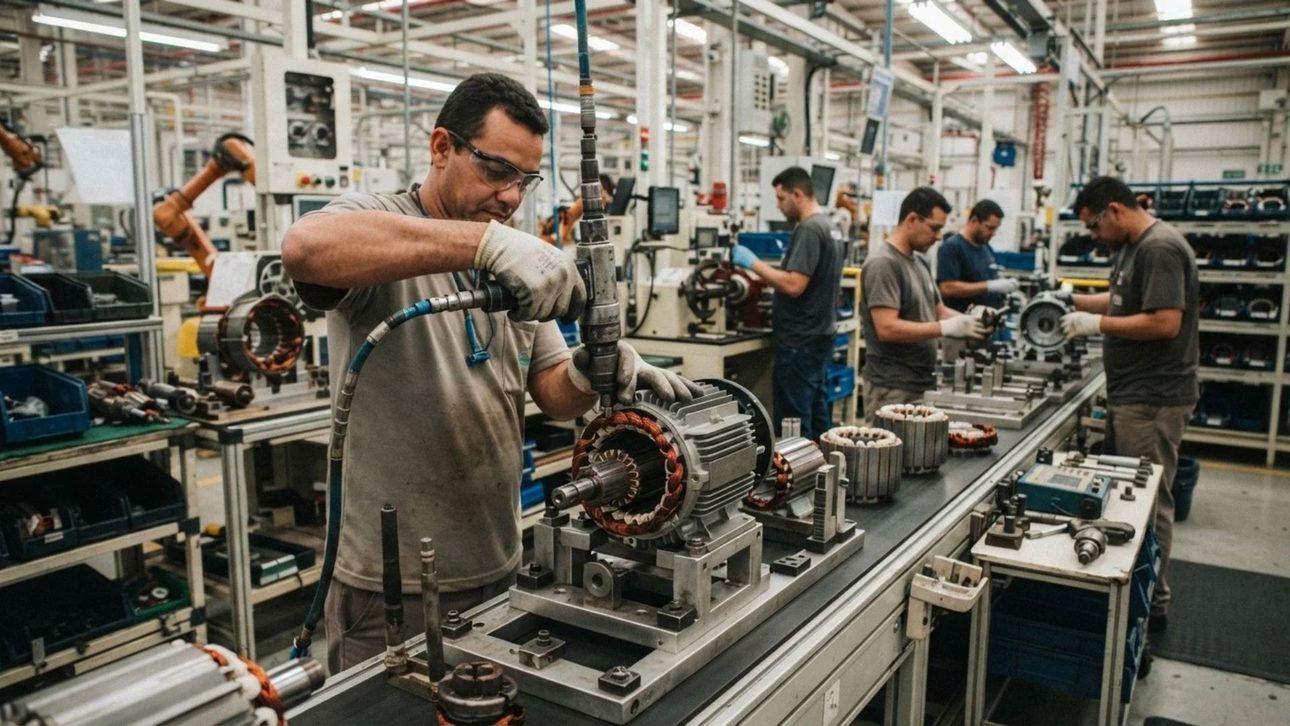
Dysprosium and terbium can also be used to improve the performance of magnets exposed to high temperatures. Lynas believes that having an industrial customer in Brazil could justify local processing.
Brazilian officials review proposed acquisition of Australian company
The purchase of Meteoric is subject to approvals required for transactions involving exploration rights to minerals deemed strategic.
Brazil’s 2026 legislation established review mechanisms for changes in control of companies that own certain mineral assets. In this context, federal government representatives are monitoring the deal and the possibility of building processing facilities in Brazil.
In October, Mines and Energy Minister Alexandre Silveira told CNN Brasil that the companies had submitted a proposal involving a separation plant in the Poços de Caldas region.
The official statement concerns a project submitted for review. Lynas, meanwhile, has made its investment decision contingent on feasibility studies.
Executives to visit Brazil to discuss incentives and future investments
Lynas said company representatives are expected to visit Brazil the week after the November 25 meeting. The schedule includes meetings with federal officials to discuss industrial plans and conditions related to the Caldeira Project.
The discussions are expected to cover the acquisition of Meteoric, domestic processing opportunities and available financial incentives.
The company will also need to assess the growth of Brazilian demand for refined rare earth products.
Refinery construction will depend on final investment decision
The Caldeira Project already has technical studies and an estimate of its mineral resources. The acquisition of Meteoric could bring the project into Lynas’ international portfolio.
The refinery, however, remains at an earlier stage. The company must decide whether to build a facility in Brazil or use its existing capacity in Malaysia.
Next steps include securing approvals for the acquisition, assessing incentives and negotiating potential sources of financing.
The company is pursuing an international expansion strategy through 2030, but has not set an opening date for the Brazilian facility.