





 Portuguese
  English
  Spanish
  3 min of reading
  0 comments


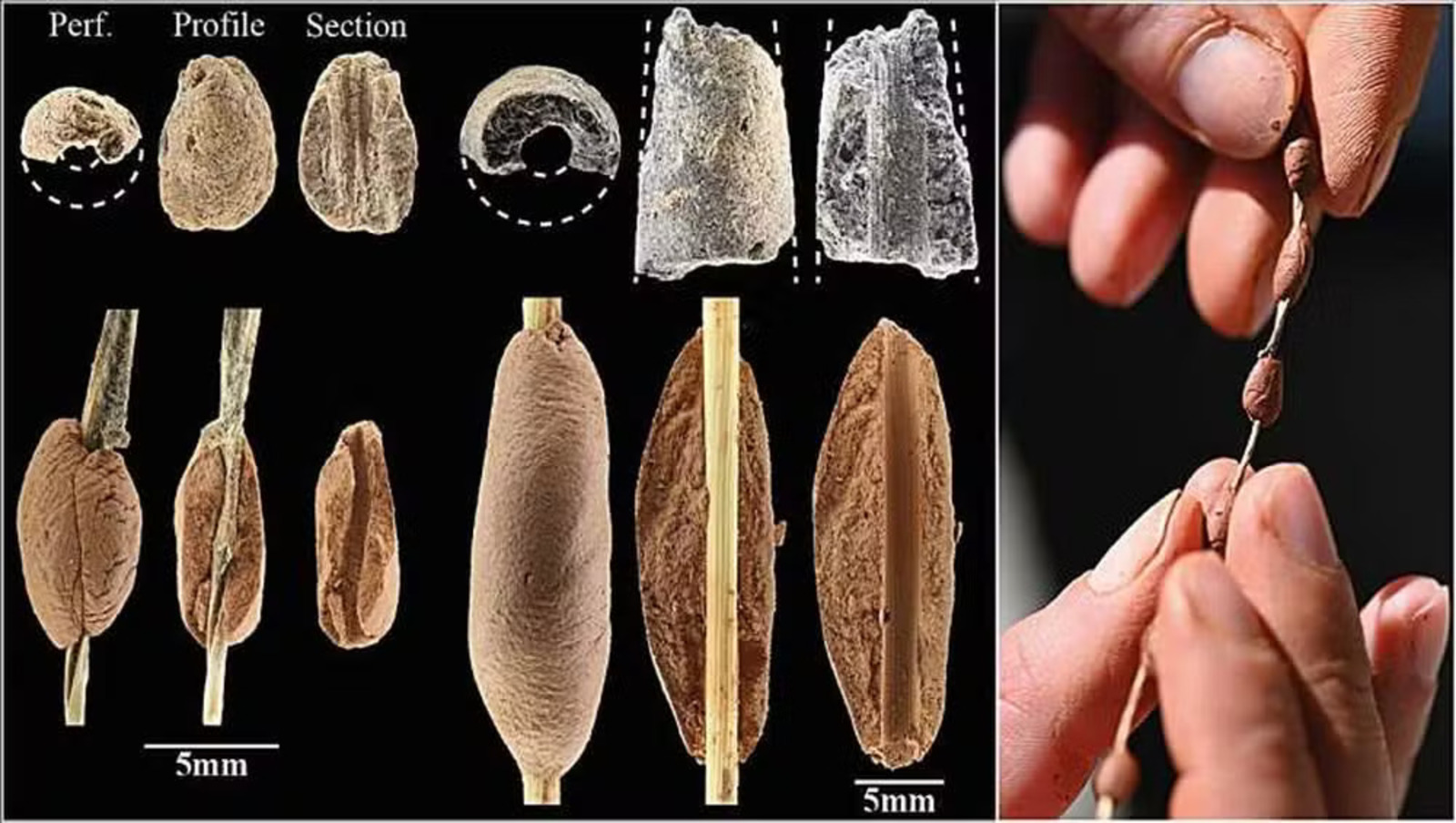
Research identifies 142 clay beads and pendants in four Natufian sites and reveals that children participated in the production of Paleolithic ornaments
A study published in the journal Science Advances on Wednesday (18) details the discovery of 142 clay beads and pendants in Southwest Asia, the oldest in the region, and shows that some of the Paleolithic ornaments were shaped by children, expanding the understanding of symbolism and sedentary life.
Discovery of the artifacts
The research was conducted by an international team of archaeologists. The objects were found in four Natufian sites: el-Wad, Nahal Oren, Hayonim, and Eynan-Mallaha, covering more than three millennia of occupation of some of the world’s earliest sedentary communities.
Among the findings were 142 Paleolithic ornaments, formed by beads and pendants small enough to fit in the palm of a hand.
-
New semi-autonomous legged robot technology challenges the limitations of space exploration by operating almost without human intervention on the Moon.

-
Super toxic red mineral found in the double burial of two women aged 1,900 years near the banks of the Dnieper River in Ukraine.
-
No one expected this under a common street: archaeologists find 3 intact oak barrels, buried about 400 years ago, with traces of lime and pieces related to 17th-century construction.
-
After decades of failed attempts, Brazil is once again looking to space with an orbital rocket measuring 12 meters, weighing 12 tons, costing R$ 189 million, and scheduled for launch in 2026, in a new race to finally achieve autonomous access to orbit.


The pieces were shaped into cylinders, discs, and ellipses from raw clay, with careful finishing and varied shapes.
Preserved marks on the pieces
The researchers identified 50 preserved fingerprints on the surfaces of the artifacts.
The analysis allowed for identifying who had produced some of the objects, something described as the first time archaeologists have been able to identify manufacturers of Paleolithic ornaments.
Some of the pieces appear to have been made specifically for children. One of the cited examples is a clay ring only 10 millimeters wide.
Additionally, some marks recorded on the surfaces indicate that small members of the community participated directly in the modeling.
Ancient technique and consolidated tradition
Many beads received a red ochre coating through slip, a technique that consists of applying a thin layer of liquid clay over the surface.
The study points out that this is the oldest known use of this coloring procedure in the world.
The quantity of pieces found indicates that the use of clay was not an isolated test.
For the archaeologists, the Paleolithic ornaments were part of a tradition already consolidated, linked to the expression of identity, belonging, and meaning through material culture.
Laurent Davin from the Hebrew University of Jerusalem stated in a statement that the discovery completely changes the way the relationship between clay, symbolism, and the emergence of sedentary life is understood.
Collective participation and learning
The results suggest that the making of these pieces was a shared everyday activity among community members.
This collective process would have played a role in learning, imitation, and the transmission of social values from one generation to the next.
Of the 19 distinct beads identified, many reproduced shapes of plants central to Natufian life, such as barley, wheat, and lentils.
Together, the artifacts indicate that nature was not only a source of food but also of social meaning.
Impact on historical view
The study contradicts the idea that the symbolic uses of clay in Southwest Asia only emerged with agriculture and the Neolithic way of life.
The research points to an earlier movement, initiated in the early stages of human sedentarization.
During this period, communities were still practicing hunting and gathering but were beginning to live in permanent settlements.
It was in this context that Paleolithic ornaments began to express identity, affiliation, and social relationships, revealing that social and cognitive changes were already underway.
With information from Revista Galileu.








Seja o primeiro a reagir!