





 Portuguese
  English
  Spanish
  9 min of reading
  4 comments


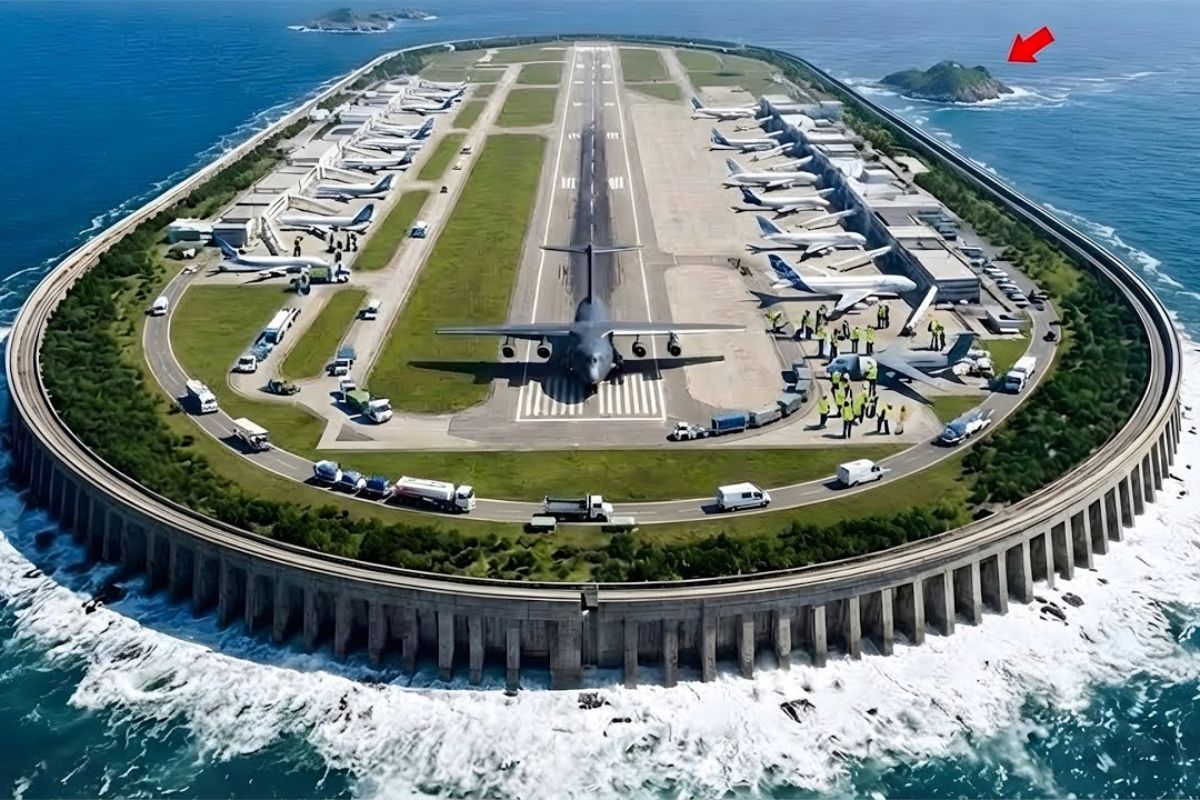


In Jinzhou Bay, In China, An Impossible Airport Was Built On An Artificial Island Created By Dredging And Compaction, At A Cost Of 14 Billion Euros. The Project Faces Typhoons, Waves, And Marine Corrosion, On Gelatin-like Soil, With 20,000 Surveys, Multifrequency Sonar, Vertical Drains, Sensors, And Retaining Walls.
In Jinzhou Bay, In China, the impossible airport was born from a straightforward decision: when the coast gets crowded and land becomes contested, new land is created in the sea. The Dalian Jinzhouwan International Airport has been described as a whole international airport over the ocean, at a cost of around 14 billion euros, in an environment subject to violent typhoons, giant waves, unpredictable currents, and ongoing marine corrosion.
The execution required an engineering package that starts before the concrete: mapping the seabed in high resolution, drilling thousands of points to read the subsoil, producing billions of cubic meters of fill through dredging, and then transforming saturated sand into a stable foundation capable of supporting aircraft weighing hundreds of tons, with no room for uneven deformation.
The Scenario In Jinzhou Bay And The Reason To Push The Sea Back

The Dalian Jinzhouwan International Airport was located in the middle of the ocean, in Jinzhou Bay, where the water hides the terrain and risks do not appear to the naked eye.
-
This star-shaped fortified construction, hidden near the border of Spain, may be the largest fortress on the planet.

-
Congonhas receives the monorail promised for the 2014 World Cup after more than a decade of delays and becomes the first airport in Brazil with integrated subway.
-
Goodbye, concrete: a new trend in civil construction reduces the weight of the structure by up to 30%, accelerates projects by up to 40%, cuts costs on steel and labor, and improves thermal insulation with EPS.
-
Russian engineers create an innovative propeller blade for aircraft that could completely change the way airplanes and helicopters operate.


The area is described as a maze of unstable mud, geological hazard pockets, and underwater currents capable of shifting tons of material without warning, a type of base that behaves more like jelly than solid ground.
In this context, the construction ceases to be merely civil engineering and becomes almost applied scientific research, because the first challenge is to see what is under meters of dark water and predict how the subsoil reacts when subjected to load, vibration, and repeated impact.
The decision to build there assumes that the sea will not be scenery; it will be an opposing force every day.
Mapping The Ocean Floor And The 20,000 Boreholes

Before any structural block, China mobilized prospecting fleets to map the ocean floor.
Ships equipped with multifrequency sonar emitted acoustic pulses, recorded the return, and fed computers that created a three-dimensional map, with precision described as millimeter-thin, to identify unevenness, consistency, and critical zones.
The mapping alone was not treated as a guarantee.
The next stage raised the level of control: more than 20,000 boreholes in the seabed, with each hole going hundreds of meters below the ocean floor.
The logic was straightforward: beneath an apparently stable layer of sand, there could exist pockets of sludge capable of allowing a landing strip to slide as if it were on soap when the first plane touches down.
Each sample taken was analyzed grain by grain, layer by layer, to reduce the chance of geotechnical surprises.
Dredging, Tianc, Sand Rainbow, And The Creation Of An Island From Nothing

With the diagnosis of the subsoil, the project hit the scale question: where to get billion cubic meters of earth and rock to create an island.
Bringing soil from the mainland by truck was described as financially unfeasible and logistically absurd, so the solution was to industrialize the fill with giant machines.
Enter the self-propelled dredger Tian Kun Hao, regarded as a floating factory.
At the bow, ultrahigh-strength steel cutters grind rocks on the seabed; the material turns into a mix of sand, stone, and water, sucked in and then launched by a colossal hydraulic cannon.
The technique comes with a visual name: sand rainbow, an arc of sediments that falls back into the sea already with planned distribution.
Height and angle of the launch are calculated to favor initial compaction during the fall and spread material evenly, without damaging the underlying protective layers. The daily capacity is described as sufficient to create an area equivalent to several football fields. The key point is simple and brutal: instead of looking for space, the project manufactured space.
The Danger Of Liquefaction And The Transformation Of Sand Into Foundation
Creating the island was just the first act. The great risk came later, when the newly deposited mass was still a loose mix of sand, water, and sediments.
In an airport, tolerance for differential settlements is minimal, because a runway receives repeated impacts and dynamic loads, and a few centimeters of uneven sinking can lead to cracks, deformations, and operational failures.
The technical enemy cited is liquefaction, when water-saturated soils, under intense vibration, lose strength and behave like a liquid.
For an impossible airport in a stormy and vibrating environment, this is treated as unacceptable, so the construction needed to “cure” the soil in stages.
The island was built in controlled-height layers.
After each layer, giant vibratory rollers traversed the surface repeatedly, expelling water between grains and forcing denser reorganization.
The process is described as slow, noisy, and methodical, because speeding up too much increases the risk of instability.
Vertical Drains, Real-Time Sensors, And A Monitored Construction Like Intensive Care
Compacting the surface does not resolve what is underneath, so the work progressed to a deeper technique: vertical drains, in thousands of units.
Long tubes were vertically driven through layers of sand to deeper levels, with a simple yet decisive function: to allow trapped water to escape over time, speeding up natural densification.
Without these drains, densification would take decades. With them, the timeline is described as reduced to a few years, which changes the feasibility calculation of a mega project.
At the same time, sensors were installed throughout the area, measuring pressure, displacement, water level, and compaction in real time.
If a zone behaved unexpectedly, the work stopped there. The logic adopted was decision-making based on measurement, not intuition.
Retaining Walls, Coastal Armoring, And The Daily Fight Against Tide And Storm
In Jinzhou Bay, the sea does not wait.
Tides rise and fall, currents try to pull sediments away, and storms seek to undo what has been built.
To hold the edge of the artificial island, giant retaining walls were built with concrete blocks the size of trucks, designed to break the energy of the waves before they hit the main structure.
In addition, layers of heavier rock were positioned to prevent the finer material from being washed away.
The set was described as dressing the island with armor, because without this protection, years of work could be swept away by a single strong storm.
Structural Base, Multilayer Runway, And Design To Survive Typhoons
With the soil stabilized, the work entered the structural base phase: layers of gravel, concrete, and special reinforcements to distribute load uniformly.
The runway did not sit directly on sand, but on an “engineering sandwich” designed to absorb impact, vibrate without breaking, and resist the elements.
The impossible airport was designed for a region subject to typhoons, which required structures capable of controlled flexion.
Excessive rigidity was treated as dangerous as fragility. The goal is balance: to withstand and, when necessary, deform without losing function.
The runway, in this pattern, was constructed as a multilayer system.
First, a highly graded gravel base; then, reinforced concrete layers; finally, a top coating for adequate friction, even under heavy rain.
Each section was monitored by sensors during and after construction, and adjustments were made when any point showed different behavior.
Terminal, Marine Corrosion, And Out-Of-The-Ordinary Material Choices
In the ocean, the salt in the air becomes a permanent enemy.
Therefore, the terminal of the impossible airport was described as a technological building focused on resistance to typhoons and marine corrosion.
Special steels with high corrosion resistance, concretes with specific additives, and reinforced sealing systems, with joints, connections, and screws designed to last decades in a hostile environment.
Another critical detail is weight.
The heavier the building, the greater the load on the artificial foundation, so engineers sought structures that were strong yet as light as possible within acceptable limits, with extensive use of prefabricated elements assembled like giant blocks.
Parts of the terminal arrived ready by barge and were hoisted with millimeter precision, reducing error and increasing repeatability.
Operation In The Middle Of The Sea, Redundancy, And Bridge Access To The Mainland
A modern airport is a city of invisible systems: electricity, water, sewage, climate control, telecommunications, air traffic control, security, and firefighting, operating 24 hours a day.
In the sea, the infrastructure needs to be almost self-sufficient.
Submarine cables bring power from the coast, but there are redundant systems within the complex itself, such as generators, batteries, and independent control centers, because redundancy is not a luxury in an isolated environment; it is a requirement.
The control tower was also treated as a sensitive point: it needs clear visibility, perfect communication, and protection against extreme winds.
The design allows for slight flexion without compromising equipment, again seeking a balance between rigidity and elasticity.
And there is the access issue, unavoidable in the middle of the ocean: a giant bridge connects the artificial island to the mainland, carrying cars, buses, emergency systems, and critical infrastructure.
If the bridge fails, the airport becomes isolated, so it was designed with the same level of structural concern applied to the island.
Extreme Tests, Inauguration, And What Changes When The Island Becomes A Hub
Before the first commercial flight, the impossible airport underwent a battery of tests described as extensive: emergency landing simulations, evacuation tests, simulated power failures, fire drills, and typhoon scenarios.
The idea was to enter operation as a machine, not as a symbol.
When the airport begins operations, the impact is presented as immediate: regional air capacity increases, international connections become faster, and the endeavor acts as a hub, alleviating pressure on congested terminals.
At the same time, it shifts the debate to the bigger question of cost, limits, and lessons learned.
The Real Price: Maintenance, Continuous Settlement, Climate Risk, And Environmental Impact
The cited number is central: 14 billion euros.
The work is treated as a response to the lack of space, in an urban and economic logic: contested coast, expensive land, growing industrial and population demand.
In this scenario, the choice is described as binary: stop growing or create new ground.
But the cost does not end at inauguration.
The first invisible cost is maintenance.
In the sea, salt accelerates corrosion, weakens structures, and invades microcracks, requiring constant inspection, scheduled component replacement, and continuous anti-corrosion systems, with 24-hour monitoring.
The second invisible cost is settlement. Even with heavy compaction, vertical drains, sensors, and structural layers, the artificial island continues to settle for years, requiring runway corrections, drainage adjustments, equipment recalibrations, and reinforcements over time.
Building is only half the work; operating and maintaining becomes a permanent routine.
The third cost is climate risk. Typhoons and strong storms require containment, wave-breaking, edge reinforcement, aggressive drainage, and rapid closure protocols.
The risk never zeros out; it is managed.
Finally, there is the environmental impact, described as inevitable: creating an artificial island alters currents, sediment transport, marine ecosystems, fishing, and water quality.
Mitigation relies on long-term monitoring, operational adjustments, and environmental compensation, because the trade-off is direct: you gain infrastructure and lose the naturalness of the environment.
The Strategic Message: When Space Runs Out, The Sea Becomes Territory
The impossible airport is presented as a sign of a larger change: with overcrowded coasts, growing cities, and scarce space, the trend is to move more infrastructure to the sea, including airports, neighborhoods, logistics centers, and energy.
At the same time, it creates exportable technical expertise: dredging, containment, prefabrication, maritime logistics, quality control, and structural monitoring, skills applicable to ports, bridges, tunnels, and new coastal expansions.
The limit, in this framing, stops being “it can’t be done” and turns into “how much does it cost, how long does it take, and how can it be maintained afterwards,” with an ongoing account as long as the ocean is there, charging interest in salt, wind, and waves.
Do you think projects like this impossible airport will become standard when land runs out, or will climate and environmental risks hold back this race to the sea?






Guaranteed, the human cost of slave labor in the Chinese “camps” was much more than the monetary cost.
Awesome
Eso solo lo pufden hacer los chinos. El costo es imposible.