Portuguese
 Spanish



Automaker accelerates expansion plans in Brazil, bets on electrified vehicles and prepares an industrial operation that could reshape its presence in the country’s auto sector.
Chinese automaker Jetour announced a new R$400 million investment in Brazil, bringing its total announced investment in the country to R$800 million. The decision was announced on November 18, 2026, during the Global Fan Festival in Rio de Janeiro, and is part of plans to begin domestic production of the T1 and T2 SUVs in 2027.
The announcement also included news for Brazilian consumers. The automaker confirmed the arrival of the Jetour T0, its first all-electric SUV in the country, as well as a plug-in hybrid version. The strategy includes developing flex-fuel engines that can run on gasoline or ethanol and expanding the dealership network to 150 locations by the end of 2027.
Jetour prepares to build T1 and T2 SUVs in Brazil, but factory location has yet to be announced
The T1 and T2 SUVs will be the first models produced at the future Brazilian manufacturing operation. The selection reflects production-capacity planning and opportunities to partner with local suppliers, based on information the automaker released during the event in Rio de Janeiro.
-
Mitsubishi unveils new Triton Estradeiro with a 205-hp twin-turbo diesel, 415;4 drive, seven driving modes and Starlink Mini satellite internet prep in a special edition for Brazil;s agribusiness sector

-
Chery launches 2027 Tiggo 5X Fastback in China with 154-hp turbo, automatic transmission, 540-degree camera and comfort features including heated, ventilated seats
-
Volkswagen ID. Polo tops 30,000 orders, sells out 2027 production, with new deliveries expected in 2028, European media report
-
Owners of 2026 and 2027 Ford Ranger Black, XL, XLS and XLT models face dealership return due to 10.1-inch screen defect affecting backup camera and air conditioning, repairs start in 2027



Jetour International President Ke Chuandeng said the factory location will be revealed in the first quarter of 2027. The company has not yet given a firm date for the start of vehicle production, however. For now, domestic manufacturing remains a planned stage in the brand’s expansion.
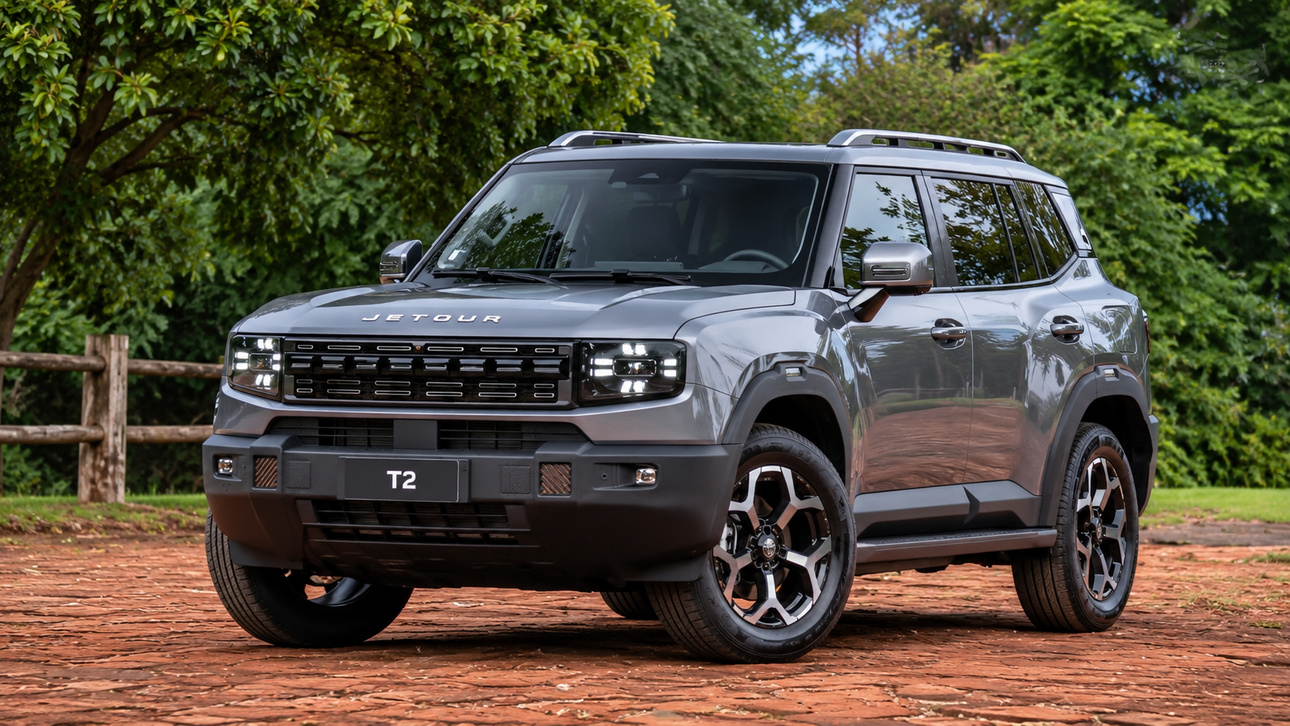
R$800 million investment supports Chinese automaker’s strategy to expand its operations in Brazil
The new R$400 million investment adds to another R$400 million Jetour announced earlier. As a result, the automaker’s total announced investment in Brazil reaches R$800 million, an amount tied to the company’s plans to grow in the domestic market.
The decision comes as the company prepares a production structure initially focused on the T1 and T2 SUVs. The automaker is considering opportunities to work with Brazilian suppliers, but has not yet detailed how resources will be allocated across the project’s various stages.
New Jetour T0 will offer two powertrains and mark the brand’s debut of an all-electric SUV in Brazil
The Jetour T0 will arrive in the Brazilian market in 2027 as the entry-level model in the T family. The automaker confirmed the SUV will have two powertrain options, expanding its lineup of electrified vehicles in the country.
One version will be a plug-in hybrid, a technology that combines an internal combustion engine with electric propulsion and allows the battery to be recharged from an external power source. The other configuration will be all-electric, with no internal combustion engine, making the T0 the first fully electric vehicle from Jetour to be sold in Brazil.
The new model’s arrival is part of the company’s strategy to expand its Brazilian lineup. Although its 2027 launch has been confirmed, the automaker did not provide information in its announcement about the SUV’s prices, range or detailed technical specifications.
Expansion to 150 dealerships includes technical support, professional training and parts availability
Expanding its sales network is another priority announced by Jetour. The company has set a target of reaching 150 dealerships in Brazil by the end of 2027, in line with its growth plans in the domestic automotive market.
The plan also includes investments in technical support, professional training and parts availability. These are part of the customer service infrastructure the automaker intends to build as it expands its operations in Brazil.
Flex-fuel technology using gasoline and ethanol is part of Jetour’s upcoming projects for the Brazilian market
The automaker also confirmed plans to develop a flex-fuel powertrain compatible with gasoline and ethanol, taking the characteristics of the domestic market into account. The technology is expected in 2027 and represents another area of technological development announced by the company.
Jetour says the project takes Brazil’s potential for biofuel use into account. The automaker also plans to make progress on autonomous driving systems and driver-assistance technologies, features designed to help drivers in a range of traffic situations.
Jetour records more than 8,000 vehicle sales in Brazil and unveils six new models in its first year
In its first year operating in the Brazilian market, Jetour says it sold more than 8,000 vehicles. During that period, the automaker introduced six models: S06, T1, T2 4×2, T2 XWD 4×4, S08 and G700.
Founded in 2018, the automaker says it has sold more than 2.4 million vehicles worldwide. The company also says it operates in more than 100 countries and regions, following its international expansion since the brand was established.
Jetour’s global plan calls for 19 factories outside China and annual capacity of more than 600,000 vehicles by 2030
The expansion in Brazil is part of a broader international plan. Jetour currently has 14 factories outside China, including facilities in Indonesia, Malaysia, Pakistan, Egypt and Nigeria.
The goal for 2030 is to expand that network to 19 international production facilities, with combined capacity of more than 600,000 vehicles a year. The plan reflects the automaker’s aim to increase its industrial presence in different markets.
In Brazil, the next steps will depend mainly on selecting a factory location and setting a production schedule for the T1 and T2 SUVs. The location of the facility is expected to be announced in the first quarter of 2027, while new model launches and commercial expansion remain part of the automaker’s announced plans.