





 Portuguese
  English
  Spanish
  2 min of reading
  0 comments


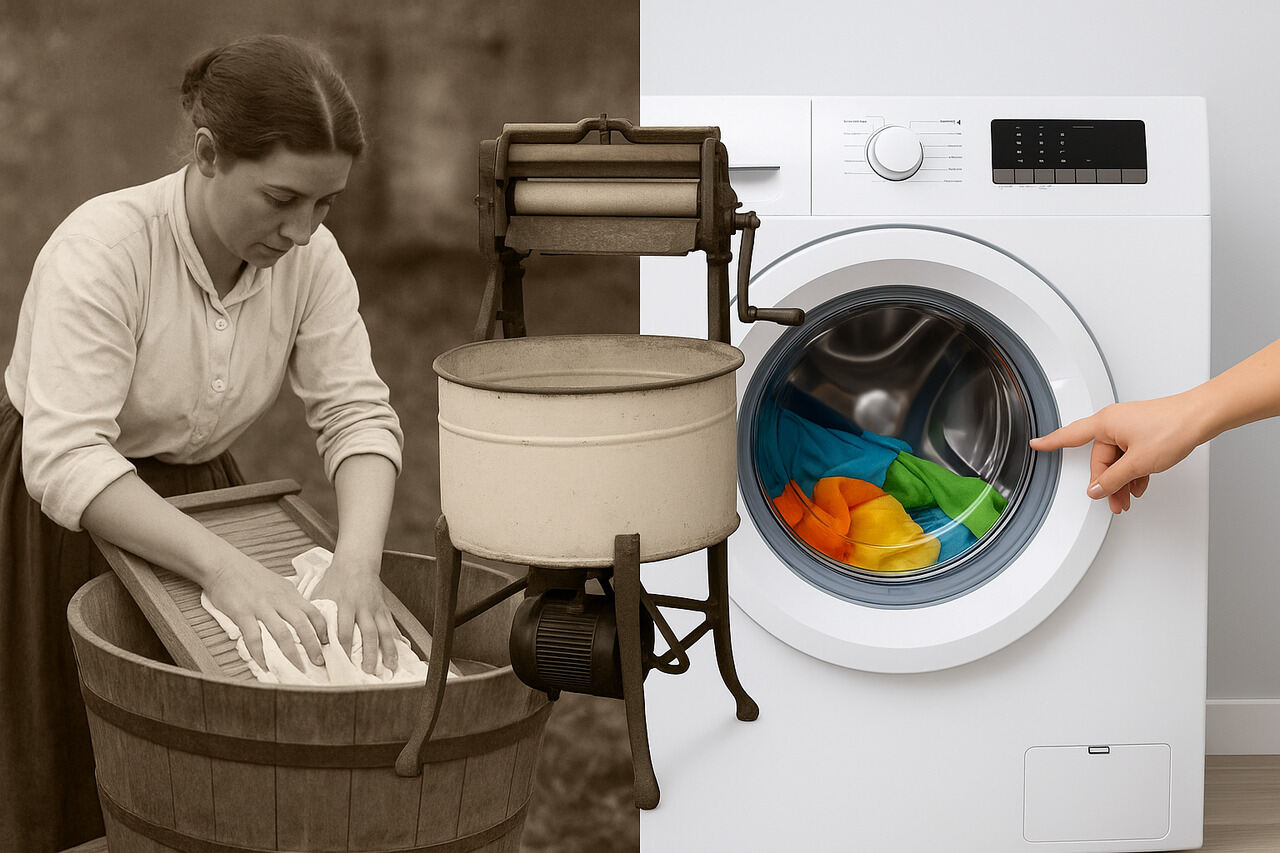
From Rudimentary Inventions in the 19th Century to Modern Washers with Sensors and Energy Efficiency, the Washing Machine Has Undergone Radical Transformations
By the end of the 19th century, doing laundry was a tiring and time-consuming task. Everything changed with the emergence of the first washing machine models. Since then, the appliance has undergone remarkable transformations that changed household routines in various parts of the world.
The First Attempts
The first registered patent for a washing machine appeared in 1851. The inventor was James King, in the United States.
However, the model did not achieve practical success or large-scale production. The turning point came in 1908, with the invention of the “Thor” by Alva J. Fisher.
-
(Video): Italian pilot lands plane on moving train at 120 km/h and achieves unprecedented feat in aviation, even with a narrow runway and without direct visual contact.
-
It seems to have come out of a science fiction movie: A Brazilian city where it rains almost every day, recording over 4,000 mm per year, driven by climatic factors — a direct result of its strategic location in the Amazon.

-
The water crisis that could change everything this year has already begun; it’s not just about the climate, it affects technology, raises product prices, and can halt entire companies without warning.

-
A Japanese mason transforms raw granite into small cups and handcrafted utensils, collects giant stones, cuts with precision, and impresses with detailed manufacturing and finishing.
This was the first machine to operate with an electric motor, with a capacity of 8 kg. Despite the progress, it still required clothes to be manually transferred to the centrifuge after washing.

The Arrival of Automatic Machines
The 1930s marked a new phase: automatic machines. In 1937, Jacob Schäffer, a German engineer, created the first model that washed and spun without manual intervention.
This innovation used a rotating drum and a pump to remove water. By the 1950s, access to this type of machine increased.
Most models featured agitators, but some used a rotating drum. The average capacity rose from 8 kg to about 13 kg.
Change in Format: Front-Loading
In the 1960s, a new standard emerged: the front-loading washing machine. This model was more economical in water and energy consumption.
Instead of agitators, it used a horizontal drum that turned slowly. This provided a more efficient and less aggressive wash for fabrics.
Another innovation was the introduction of personalized programs for different types of clothing, such as cotton, wool, or silk.
Although initially expensive, front-loading machines became more common starting in the 1970s and 1980s, when prices dropped and production expanded.
Technology Serving Clean Clothes
Today, the washing machine has evolved significantly since its first manual models. What once required physical strength and time can now be resolved with the touch of a button.
The trend is that new technologies will continue to emerge to make this household task even simpler and more efficient.
With information from SOS das Máquinas de Lavar.





-

3 pessoas reagiram a isso.