





 Portuguese
 Spanish


European Parliament and European Union governments reached an agreement Thursday, November 19, 2026, delaying methane controls for oil, gas and coal importers from 2027 to January 1, 2029. Europe bought 38% of Brazil’s oil exports in September
The European Union has delayed methane controls on imported oil, gas and coal until January 1, 2029. The provisional agreement was reached early Thursday, November 19, 2026.
The agreement was reported that day by Offshore Technology, in a report by Shree Mishra, and by Euronews, in an article by Marta Pacheco. The original deadline for importers was January 2027.
The change affects Brazilian oil. In September 2026, Europe was the leading destination for the country’s crude oil exports, taking 38% of the total, ahead of China at 34%.
-
Russia’s refinery throughput drops 45% after Ukrainian drone strikes, impacting Brazil’s diesel imports

-
U.S. diesel inventories remain 7% below the five-year average at 104.9 million barrels as U.S. suppliers provided 74% of Brazil’s diesel imports in September
-
Sulgás cuts natural gas rates by up to 35% for free-market industrial customers in Rio Grande do Sul, up to 15% for residential customers and 4.8% for CNG
-
Edge and SCGÁS finalize agreement for up to 94,500 cubic meters of natural gas to Três Barras and Canoinhas via cryogenic trucks from Santos, bypassing pipelines


The figures come from Comex Stat, a trade data system run by Brazil’s Ministry of Development, Industry, Trade and Services (MDIC), and were published by eixos on October 16.
With the delay, buyers of Brazilian oil in Europe have two more years before they must prove that the oil meets methane-control standards equivalent to the EU’s.
How the methane compliance deadline changes for importers
The bloc’s methane rules have been in force since August 4, 2024. They set standards for measuring and verifying emissions, controlling leaks, and reducing gas venting and flaring.
It is the world’s first law to apply these controls to imported fossil fuels. Importers must show that contracts signed or renewed after August 4, 2024, meet standards equivalent to the EU’s.
Under the agreement, the requirement for monitoring, reporting and verification by oil, gas and coal importers moves from January 2027 to January 1, 2029.
The Council of the European Union announced the agreement on X:
The requirement to report the methane intensity of fuels sold in the bloc is pushed back to August 5, 2030. It applies to European producers and importers.
Offshore Technology details other deadlines. Importers have until May 2030 to prove that their contracts cover only fuels subject to the measures. The date also applies to existing contracts.
Oil companies operating within the bloc also get more time. Verified reports for operated assets are due February 5, 2029. Reports for non-operated assets are due August 5, 2030.
Why Europe matters for Brazilian oil
Brazil exported 13.75 million cubic meters of crude oil in September 2026. Europe took 38% of that volume, while China took 34%.
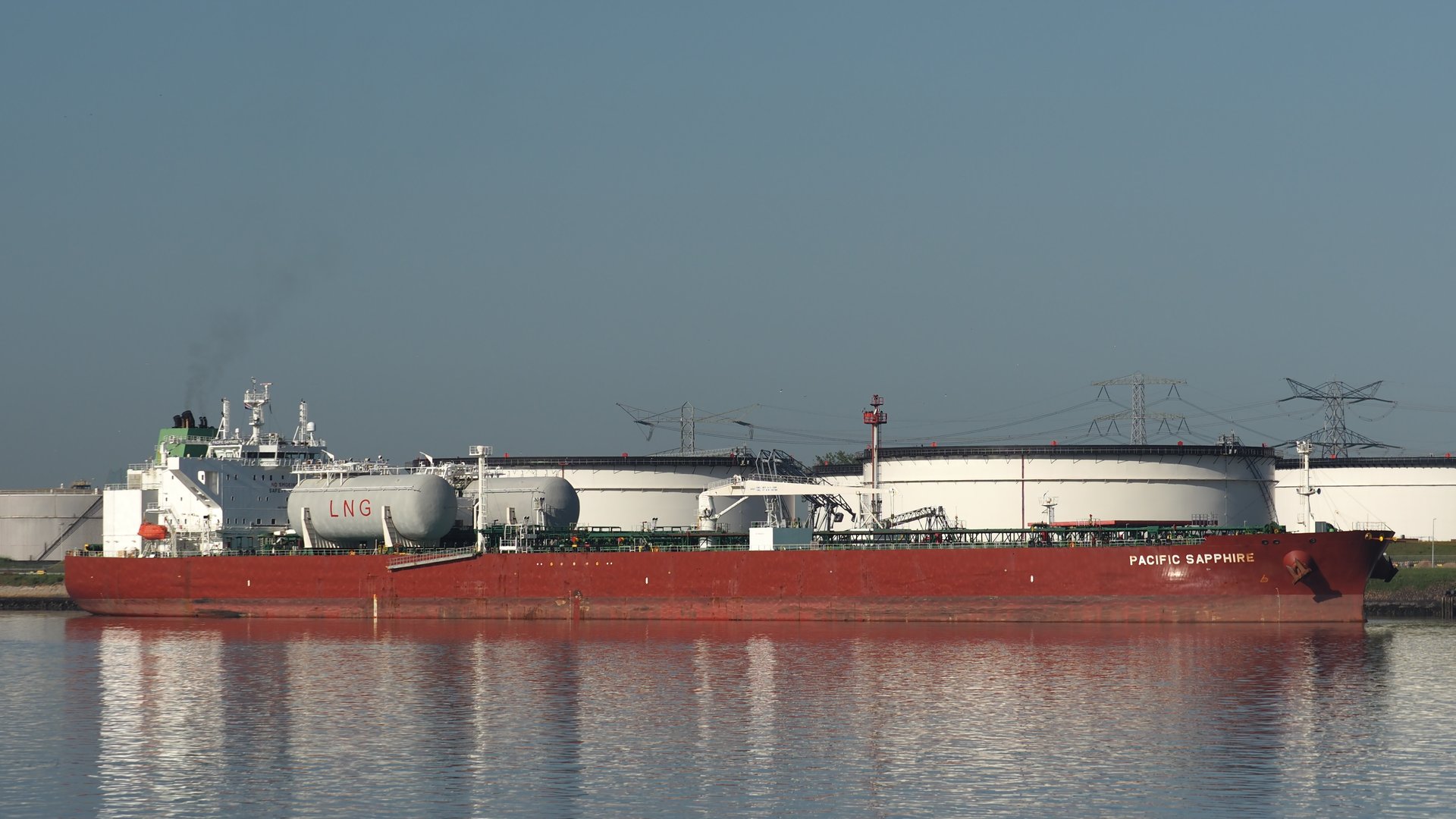
In August, the shares were different: China accounted for 39% and Europe for 29%. Eixos reported that Brazil increased oil sales to Europe in September.
China has historically been the main destination for Brazilian oil. In Europe, the largest buyer in September was the Netherlands, which purchased nearly 1.5 million cubic meters that month.
Eixos also cited Icomex, an indicator published by the Getulio Vargas Foundation (FGV) on October 15. The European Union’s share of Brazilian exports rose from 14.2% to 20.2% in one year.
Oil accounted for 34.1% of Brazil’s exports to the bloc, with their value increasing by 139.0%.
From January through September, Brazil’s trade balance with the European Union swung from a US$1.0 billion deficit in 2025 to a US$6.1 billion surplus in 2026.
The crisis in the Middle East has removed major suppliers from the market. European embargoes on Russia remain in place.
What the rules require of companies selling Brazilian oil to Europe
An analysis by law firm Mayer Brown, published on August 17, 2026, examines the impact on Brazilian exporters. The analysis was written by Luiz Gustavo Escorcio Bezerra, Gedham Gomes and Victor Rodrigues.
The law firm recommended that exporters assess how mature their leak detection and repair programs and emissions reporting systems are. It also advised them to identify gaps relative to European standards.
A video from IOGP Europe, an oil and gas industry association, explains how the methane rule affects imports:

Starting in 2030, fossil fuels will have to meet maximum methane-intensity thresholds to be set by the European Commission.
Each country in the bloc will be responsible for penalties, ranging from public warnings to fines of up to 20% of annual revenue from the previous fiscal year.
On July 20, 2026, the Commission had already recommended that countries suspend fines for importers for three years. The recommendation was not legally binding and did not change the text of the regulation.
How Brazil is preparing to regulate methane in oil production
Brazil has its own agenda. CNPE Resolution No. 8, dated September 3, 2024, set guidelines for decarbonizing oil exploration and production.
The same resolution directed Brazil’s oil regulator, the ANP, to take measures to reduce emissions, including fugitive methane emissions.
The ANP included methane regulation in its 2025-2026 Regulatory Agenda. On September 22, 2025, it opened Preliminary Consultation No. 4/2025 on an initial study of the subject.
On July 24, 2026, the agency’s board approved public consultations and hearings to revise ANP Resolution No. 806/2020, which covers natural gas flaring and losses.
The proposal would address fugitive methane emissions in a separate regulation. It would also tighten controls on extraordinary flaring, such as during emergencies and well tests.
The schedule cited by Mayer Brown calls for a public consultation in November 2026, a public hearing in February 2027 and final texts in May 2027.
Why the European Union decided to delay the rules
Governments cited supply risks and high prices. The United States and Israel’s war against Iran affected oil and gas supplies from the Gulf and traffic through the Strait of Hormuz.
The agreement fell between the positions of the two sides. Governments wanted a one-year delay. The European Parliament had voted in October for a three-year delay, with 341 votes in favor and 225 against.
The European Commission had proposed a one-year delay. The final two-year deadline is twice as long as that proposal, according to EUobserver, in an article by Wester van Gaal.
Bloomberg recorded the agreement on X:
The European Parliament’s negotiator, Greek lawmaker Dimitris Tsiodras of the European People’s Party, said the rule had not been suspended. “We are not suspending the Methane Regulation,” he said.
Polish lawmaker Borys Budka, rapporteur for the industry committee, summed up his position: “Security of supply comes first.”
Who pushed for the methane delay
French President Emmanuel Macron wrote to European Commission President Ursula von der Leyen in September, calling for a delay. France had previously advocated tougher methane rules.
Czech Industry and Trade Minister Karel Havlíček said the agreement would prevent further increases in oil and gas prices. He said he had brought 19 other countries over to his side.
The United States, Europe’s largest supplier of liquefied natural gas (LNG), has criticized the rules several times. It argued that they would increase costs and make exports more difficult.
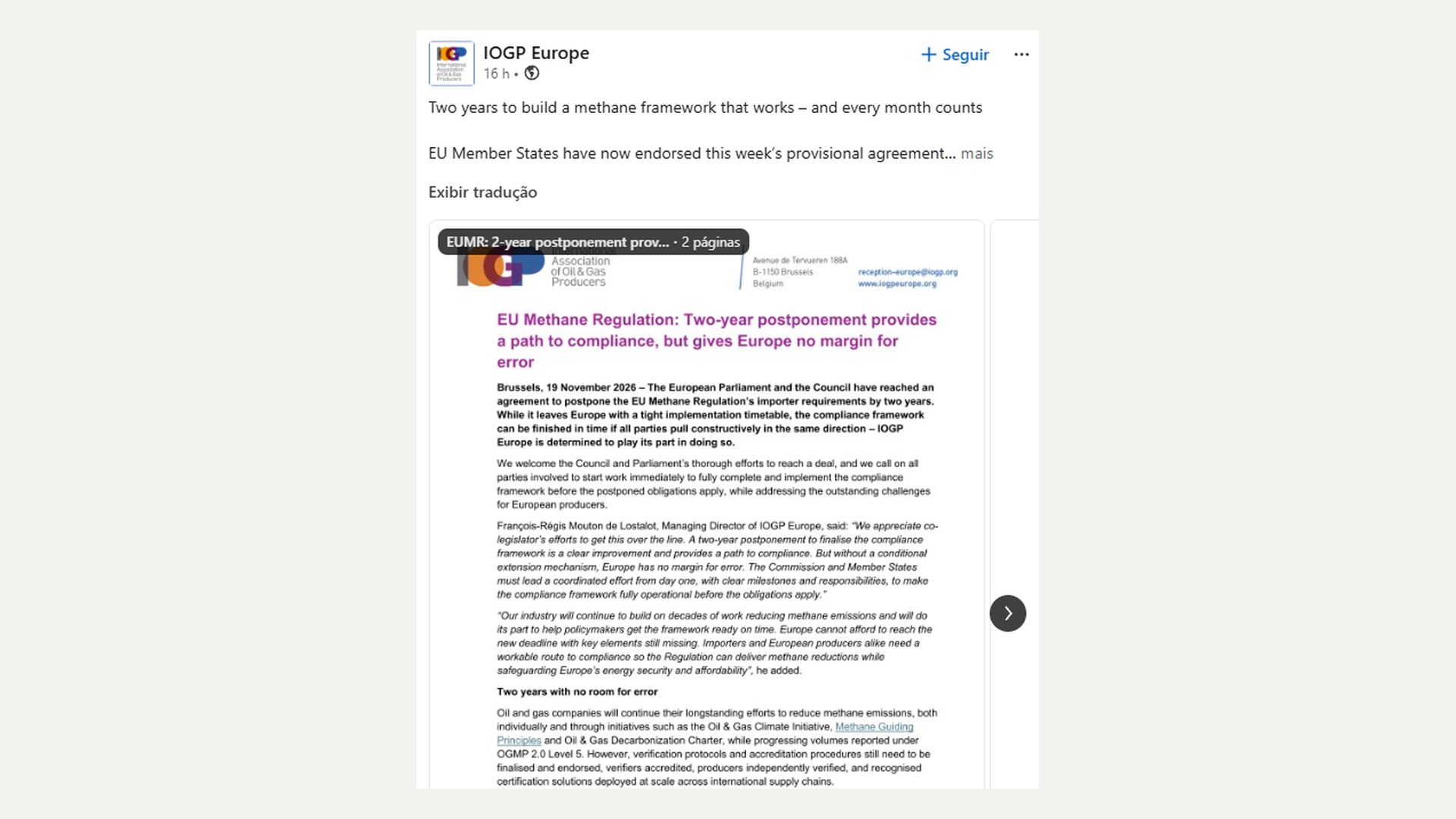
IOGP Europe, an industry association, called the delay “some improvement.” Director François-Régis Mouton de Lostalot said that without a review clause, Europe would have no room for error.
A video from FuelsEurope, the European fuel industry association, explains what the methane rule means for gas, oil and prices:
Criticism and the cost of methane rules
Methane traps about 80 times more heat than carbon dioxide over 20 years. Much of it leaks from wells, pipelines and coal mines.
Léa Pilsner of Environmental Defense Fund Europe said governments had “bought two years the regulation never needed.”
She estimates that about 24 billion cubic meters of methane will leak during that additional period. That volume is equivalent to about two-thirds of France’s annual gas consumption.
EUobserver cited an estimate from consulting firm Rystad Energy. The rules would cost just a few euro cents per million British thermal units, about 0.3% of current gas prices.
The Greens accused conservatives of joining forces with the far right to weaken climate rules. The European People’s Party responded that the original timetable was unrealistic and would hurt European producers and importers.
Next steps in the European Parliament
The text is being fast-tracked. The Environment (ENVI) and Industry (ITRE) committees will vote on the provisional agreement on November 23 in Strasbourg.
The European Parliament’s Industry Committee (ITRE) posted the agreement on X:
The plenary vote comes in the same week.
EU governments must give formal approval before the end of 2026, when the original rules were set to take effect.
The option of extending the deadline again, which governments had advocated, was dropped during negotiations. Further delay would require a new methane law.
The European Commission is expected to review the law’s implementation and submit a report to the Parliament and Council by January 1, 2028, and every five years thereafter.
The law does not override European Union sanctions against sanctioned countries.
For Brazilian crude oil sold to Europe, the date that now applies is January 1, 2029, if the agreement passes the votes. Brazil’s oil and gas regulator, the ANP, is still developing Brazil’s own methane regulations.


