





 Portuguese
 Spanish


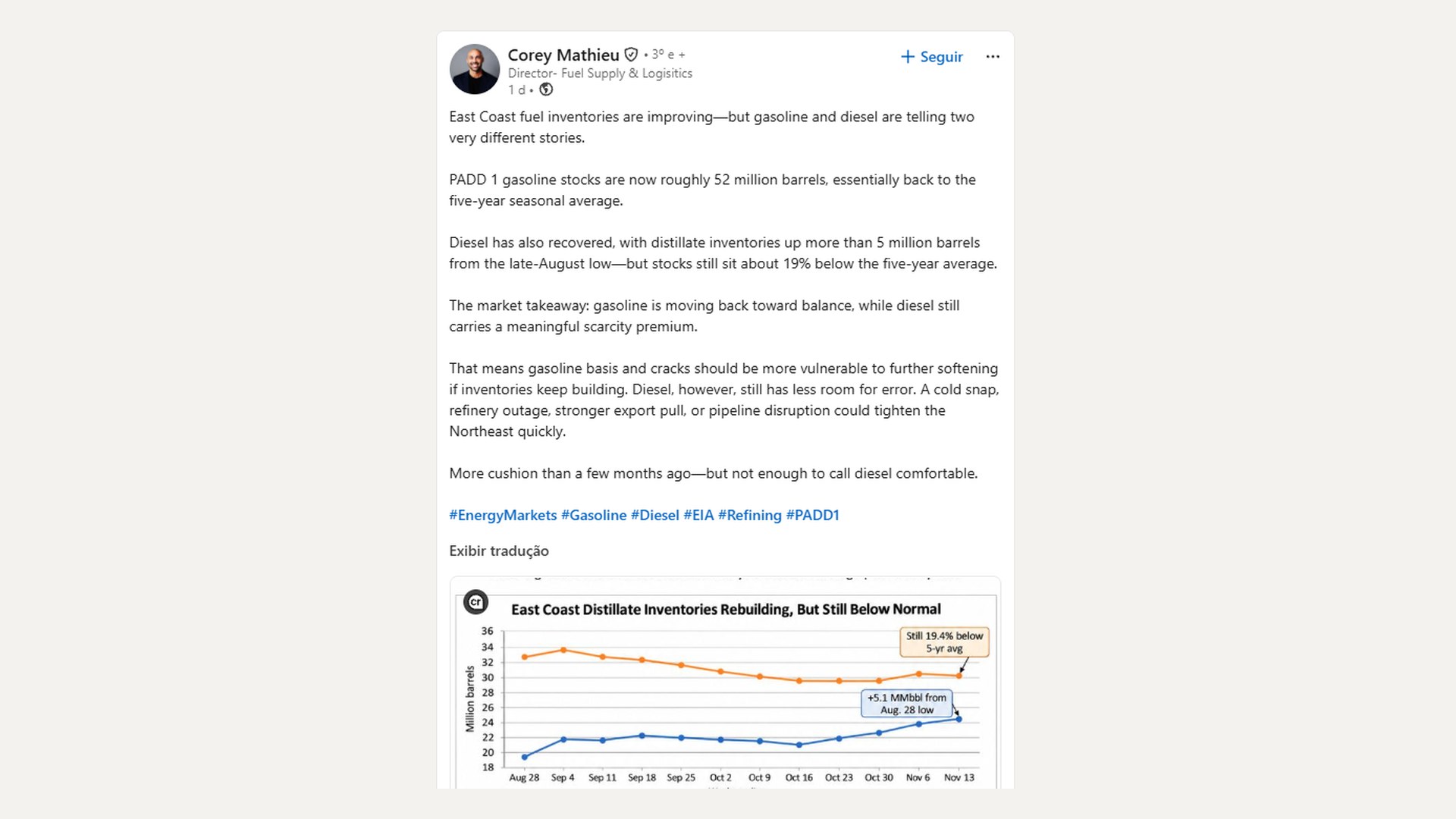
U.S. inventories of diesel and heating oil rose by 1.6 million barrels in the week through November 13, 2026, to 104.9 million barrels, remaining 7% below the five-year average. In September, U.S. suppliers accounted for 74% of Brazil’s diesel imports
U.S. inventories of diesel and other distillates rose by 1.6 million barrels in the week ended November 13, 2026, reaching 104.9 million barrels.
The volume remains 7% below the five-year average.
The U.S. Energy Information Administration (EIA) released the data Wednesday, November 18, in its weekly petroleum report.
-
Sulgás cuts natural gas rates by up to 35% for free-market industrial customers in Rio Grande do Sul, up to 15% for residential customers and 4.8% for CNG

-
Edge and SCGÁS finalize agreement for up to 94,500 cubic meters of natural gas to Três Barras and Canoinhas via cryogenic trucks from Santos, bypassing pipelines
-
EnQuest sells entire UK North Sea production, including Magnus and Kraken fields, to NEO NEXT+ for up to $960 million, transferring $2.12 billion in liabilities
-
Brent drops from $136 to around $93 since October as IEA reports oil supply has surpassed demand



The Reuters news agency also reported the figures in a story republished by Canadian website BOE Report.
The data matter to Brazil because the United States has become the country’s leading supplier of imported diesel. In September, U.S. suppliers accounted for 74% of the diesel Brazil bought from abroad.
The figures come from Comex Stat, Brazil’s Ministry of Development, Industry, Trade and Services foreign trade database, and were cited by eixos on October 30. From July through September, the U.S. share was 70%.
Distillate inventories rise by 1.6 million barrels in a week
The distillate category includes diesel and heating oil. Inventories of these products rose by 1.6 million barrels in the week through November 13.
Analysts surveyed by Reuters had expected a smaller increase of 1.3 million barrels.
Despite the increase, U.S. distillate inventories remain 7% below the five-year average for this time of year, according to the EIA.
OPIS, a Dow Jones fuel-pricing information company, discusses the tight diesel market in the video:


U.S. refinery production of distillates rose to 5.2 million barrels per day in the same week. Distillate imports averaged 133,000 barrels per day.
U.S. diesel consumption rises 4.3%
Consumption also affects inventories. Over the past four weeks, the average volume of distillates supplied to the U.S. market rose 4.3% year over year to 4 million barrels per day.

Gasoline moved in the opposite direction. The four-week average volume of gasoline supplied to the market fell 1.8% year over year to 8.7 million barrels per day.
Total petroleum products supplied in the United States averaged 20.6 million barrels per day over four weeks, down 0.3% from the same period a year earlier.
Jet fuel supplied to the market rose 0.3% over the same period.
U.S. refineries operate at 95.7% of capacity
U.S. refineries processed 16.9 million barrels of oil per day in the week through Nov. 13. The volume was 129,000 barrels per day below the previous week.
The refinery utilization rate rose 0.5 percentage point to 95.7% of capacity. Gasoline production averaged 9.4 million barrels per day.
A chart on refining margins was posted on X on the day the report was released:
Oil and gasoline inventories also rise
U.S. commercial crude oil inventories, excluding the Strategic Petroleum Reserve, rose by 3.4 million barrels to 417.8 million. The total is 3% below the five-year average.
Analysts polled by Reuters had expected an increase of just 58,000 barrels. At the Cushing storage hub in Oklahoma, crude oil inventories fell by 1.2 million barrels.
Gasoline inventories rose by 5.2 million barrels to 215.9 million. Analysts had forecast an increase of 1.6 million. Gasoline inventories are now 3% above the five-year average.
Commercial inventories of crude oil and petroleum products in the United States rose by 9.2 million barrels for the week.
U.S. crude oil imports and exports
U.S. crude oil imports fell by 1.1 million barrels per day to 5.6 million.
The four-week average of 6.3 million barrels per day is 13% above the level a year earlier.
Crude oil exports rose by 1.03 million barrels per day to 4.49 million, Reuters reported. Net imports fell by 2.15 million barrels per day.
The country also imported an average of 533,000 barrels per day of gasoline for the week.
Oil prices fall after report
Oil futures extended their losses after the inventory data was released. At 10:38 a.m. in New York, Brent was trading at $91.85 per barrel, down $1.29.
At the same time, U.S. crude, or WTI, was down $1.81 at $84.20 per barrel. The figures were reported by Reuters in a story by Liz Hampton in Denver and Arathy Somasekhar in Houston.
GasBuddy analyst Patrick De Haan commented on X on falling gasoline and diesel prices at U.S. gas stations:
United States becomes Brazil’s leading diesel supplier
Brazil imports some of the diesel it consumes, and the United States became its leading supplier in 2026. Russia had been the top supplier through April.
Russia supplied 47% of Brazil’s diesel imports in 2025, a share that reached 91% in April 2026.
In July, Moscow banned exports after Ukrainian attacks on refineries. Russia’s share fell to 6% in September.
The United States filled that gap. It accounted for 70% of diesel imports from July through September and 74% in September, according to Comex Stat data cited by eixos.
Brokerage StoneX analyzes the outflow of diesel from the United States and its effect on inventories in this video:

In September, U.S. President Donald Trump called for suspending the country’s diesel exports. The statement was also reported by eixos.
On the Russian side, the U.S. Treasury, through OFAC, authorized transactions involving Russian diesel through April 2027 on October 9. The following day, Moscow authorized the export of 500,000 metric tons.
The European Union and the United Kingdom’s bans on Russian diesel remain in effect.
12 U.S. diesel tankers are bound for Brazil in November
Diesel imports scheduled for November total 1 million cubic meters, or 1 billion liters, aboard 17 ships. The volume was 59% above the estimate made on October 27.
The United States accounts for 12 of these vessels, carrying 632,700 cubic meters, or 63% of the total. India has one vessel, carrying 150,000 cubic meters, or 15%.
Russia accounts for two vessels and 93,000 cubic meters, or 9%. Two other vessels, carrying 128,000 cubic meters, had no origin specified in the schedule.
Brazil’s National Agency of Petroleum, Natural Gas and Biofuels (ANP) tracks shipments, offloads and the distribution of this diesel in the country.
Brazil’s diesel balance in November
Demand for S10 diesel in Brazil in November is estimated at 3.6 million cubic meters, excluding the biodiesel blend.
With the scheduled imports, the balance now shows a surplus of 167,700 cubic meters.
In the previous estimate, dated October 27, there was a deficit of 205,000 cubic meters, equivalent to 5.7% of demand. Inventories totaled 2 million cubic meters on October 22.
Petrobras approved lower diesel volumes for November than for November 2025, according to eixos. The ANP received complaints from distributors and scheduled a meeting with the state-controlled company.
A source interviewed by eixos said November demand is covered by scheduled imports.
Imported diesel became more expensive for Brazil
From January through September 2026, Brazil imported 9.1 million metric tons of diesel, 13.5% less than in the same period of 2025. Spending rose 33% to US$9.2 billion.
The average price of imported diesel was US$1,010 per metric ton, 53% higher than a year earlier, according to eixos.
At Brazilian gas stations, S10 diesel averaged R$7.40 per liter in October, according to the Ticket Log index. The 12-month increase was 19.4%, according to the Veloe/Fipe Monitor.
S500 diesel, used mainly in agriculture and older vehicles, averaged R$7.20 per liter nationwide in October. It rose 4.8% for the month.
At refineries, Petrobras’ price gap relative to import parity was R$3.90 per liter on October 28. The calculation is from Abicom, cited by eixos.
Domestic diesel production rose in the first half
Brazil also began refining more diesel in 2026. The data are in the SEI Information Note No. 2350/2026, from the Ministry of Finance, signed on August 25 and published by Camex.
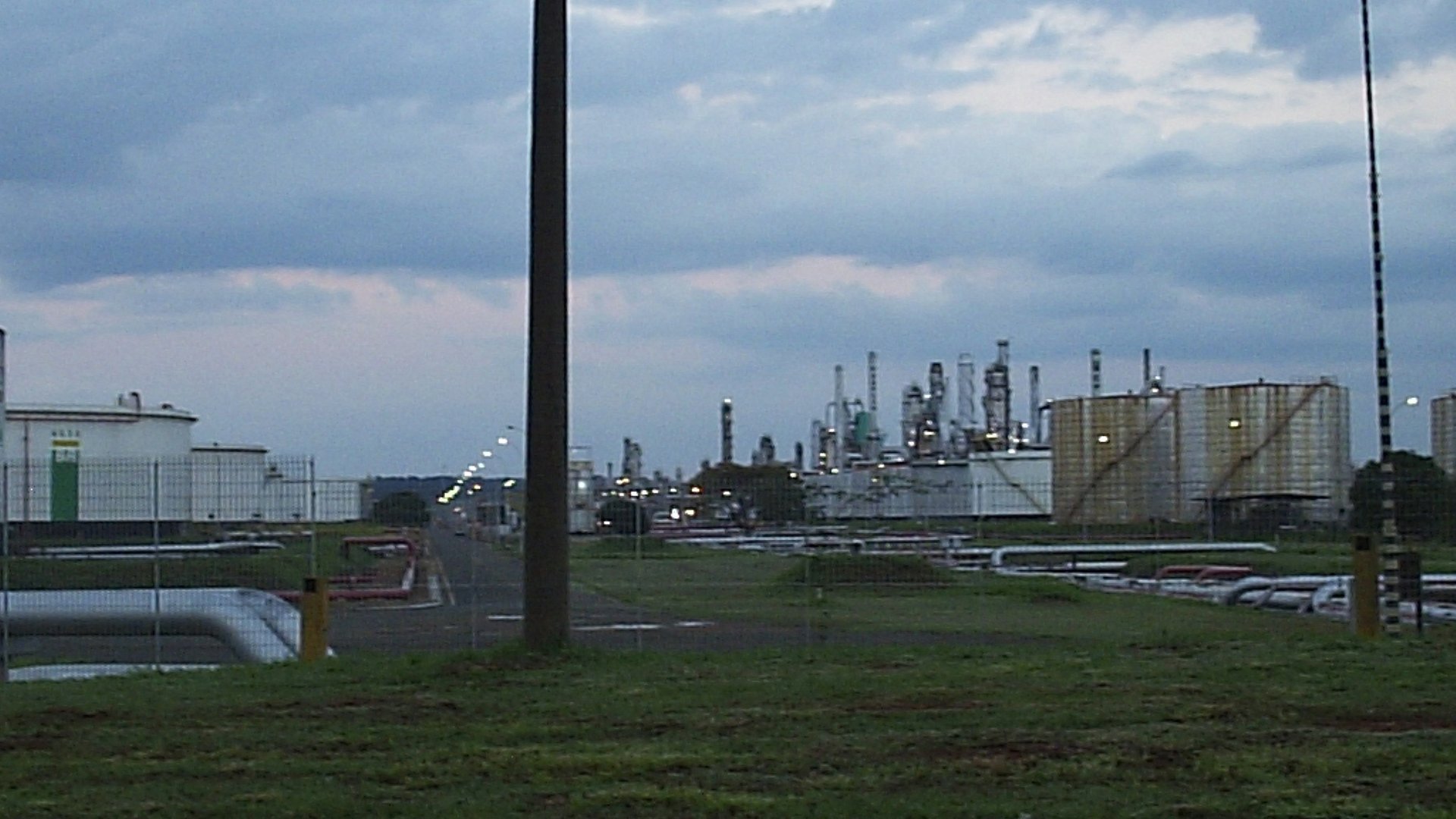
Between January and June 2026, domestic diesel production reached 24.6 million cubic meters, up 7.1% from the same period in 2025. Sales of diesel B rose 1.7%.
Imports of diesel A fell 11.7% in the same six-month period. In June, imported diesel’s share of domestic sales fell to 11.86% from 26.65% in June 2025.
Petrobras reported a refining utilization rate of about 101% in the second quarter of 2026, according to the note.
U.S. distillate inventories are still 7% below the five-year average, while the United States remains the leading source of diesel imported by Brazil.


