Portuguese
 Spanish


Ukrainian drone strikes lead to significant drop in Russian refinery throughput, affecting Brazil’s diesel supply
Ukrainian drone strikes have cut the volume of oil processed at Russian refineries by 45% since late October.
The estimate was published by Reuters on Wednesday, November 18, 2026.
The Reuters exclusive, republished by the Italian website Internazionale, is based on estimates from two industry sources. The website Meduza and the Ukrainian news agency UNN also reported the figures.
-
U.S. diesel inventories remain 7% below the five-year average at 104.9 million barrels as U.S. suppliers provided 74% of Brazil’s diesel imports in September

-
Sulgás cuts natural gas rates by up to 35% for free-market industrial customers in Rio Grande do Sul, up to 15% for residential customers and 4.8% for CNG
-
Edge and SCGÁS finalize agreement for up to 94,500 cubic meters of natural gas to Três Barras and Canoinhas via cryogenic trucks from Santos, bypassing pipelines
-
EnQuest sells entire UK North Sea production, including Magnus and Kraken fields, to NEO NEXT+ for up to $960 million, transferring $2.12 billion in liabilities


The decline affects a major supplier to Brazil.
Russia supplied 47% of Brazil’s diesel imports in 2025, a share that reached 91% in April 2026, according to data published by Eixos on October 30.
Russia’s share had already been shrinking before the latest wave of attacks. In July, Moscow banned exports after Ukrainian strikes on its refineries.
In September, Russia accounted for 6% of Brazil’s diesel purchases.
Refinery throughput falls from 700,000 to 400,000 metric tons a day
In late October, Russian refineries were processing more than 700,000 metric tons of oil a day.
That figure is now about 400,000 metric tons a day, equivalent to roughly 3 million barrels a day.
Russia’s primary refining capacity in peacetime is estimated at 930,000 metric tons a day.
The facilities hit have a combined nameplate capacity of about 500,000 metric tons a day, close to 54% of the total.
The November average still exceeds 500,000 metric tons a day.
That is 5% to 10% below September and October levels. The smaller decline reflects the gradual reduction in operating capacity over the course of the month.
Indian TV channel Mirror Now aired a report on the 45% drop in Russian refinery processing:


Strikes hit 15 of Russia’s 35 largest refineries
The sources told the agency that operations at 15 of the country’s 35 largest refineries had been halted or disrupted. By the middle of the previous week, the number had been nine.

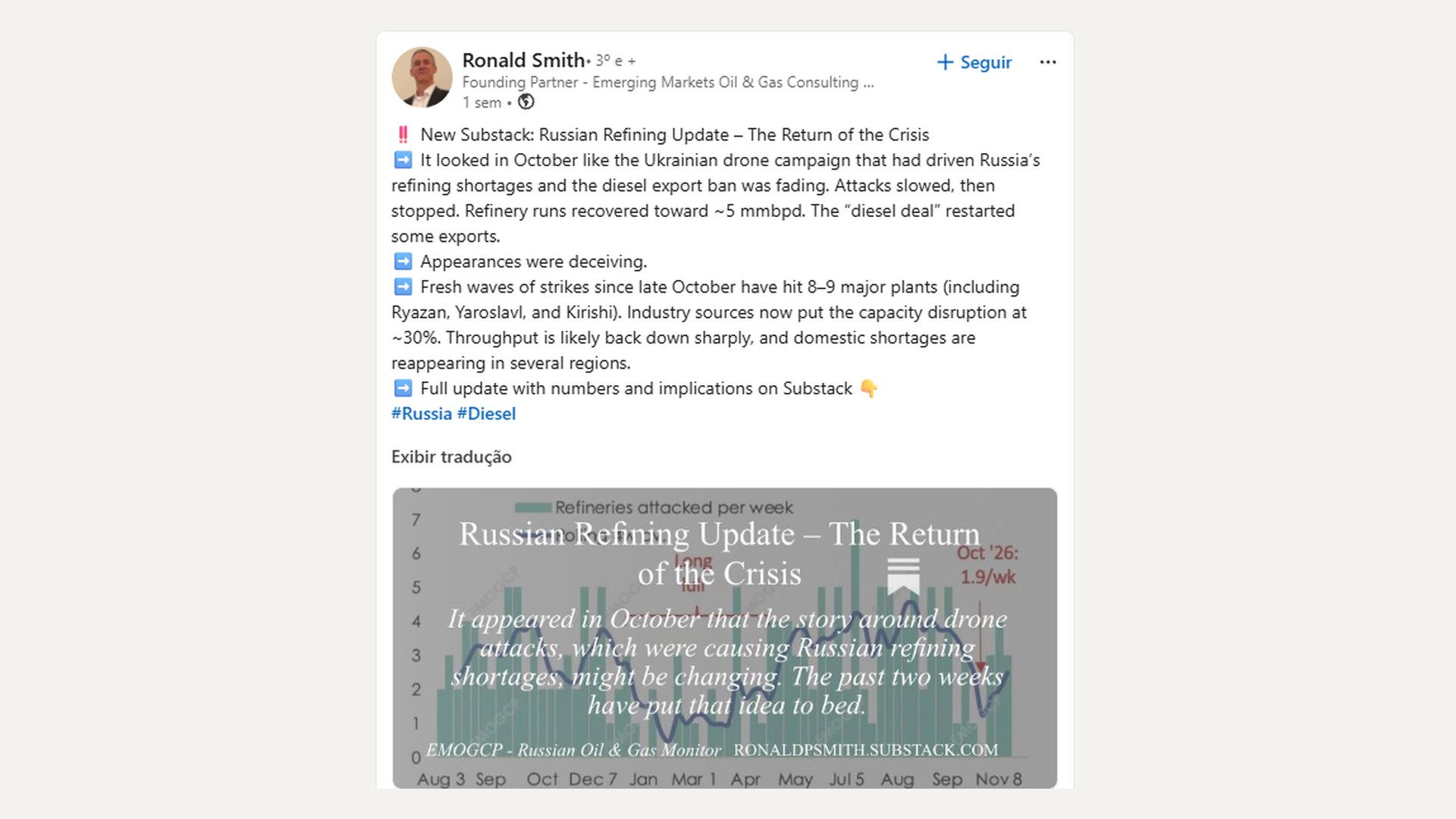
Reuters lists the Ryazan, Yaroslavl and Kirishi refineries among the facilities hit, along with plants in the Volga region. Russia’s Energy Ministry did not respond to the agency’s request for comment.
UNN adds that Ukraine’s General Staff confirmed attacks on the Ilsky and Afipsky refineries in the Kuban region on November 18.
Ukraine’s Defense Ministry posted an announcement of the attacks on the two refineries on X:
On Friday, November 13, the military had already confirmed an attack on a major refinery in Volgograd.
Attacks have become almost daily in recent weeks
Ukraine has begun attacking Russian refineries almost every day, using a growing number of drones. Meduza reports that the frequency has increased in recent weeks.
Reuters’ video shows smoke rising over a Russian oil refinery:
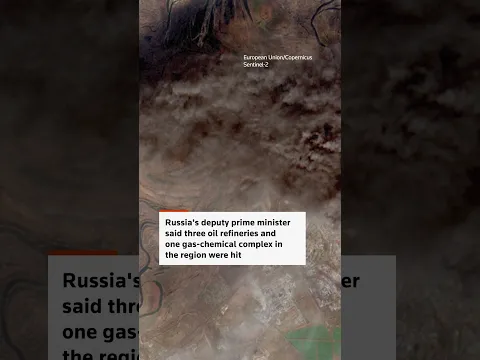
The war has intensified on both sides. Ukrainian attacks have grown in scale, while Russia has expanded its use of drones and missiles.
Data from Russia’s Defense Ministry cited on Monday, the 16th, described the largest overnight drone attack against the country since 2022.
Kyiv also struck a bridge considered strategically important, Reuters reported. The offensive against energy infrastructure is part of the same escalation.
Energy truce announced in October did not hold
On October 11, U.S. President Donald Trump announced a ceasefire in attacks on energy infrastructure. Neither Moscow nor Kyiv confirmed it had agreed to the deal.
The attacks continued after the announcement. Ukrainian strikes on refineries declined for about two weeks. They then grew in scale and frequency again.
Fuel shortages are already emerging inside Russia
The drop in refining first weighs on Russia’s domestic market. Some regions of the country are already facing fuel shortages, Reuters reported.
Meduza reports that, in early November, Russian regions again began restricting gasoline sales at gas stations. The measure followed an intensification of the attacks.
The Kyiv Post summarized Kyiv’s figures on the attacks’ impact on Russian gasoline on X:
The attacks also hit ports and limited Russia’s export capacity.
The agency said lower refining could tighten the global fuel market and complicate a Russian deal to export diesel to the United States.
The role of Russian diesel in Brazil’s imports
Brazil buys some of the diesel it consumes from abroad. In 2025, Russia supplied 47% of that imported diesel, according to data compiled by eixos.
Dependence peaked in April 2026, when Russia accounted for 91% of Brazil’s diesel imports.
An export ban imposed by Moscow in July brought that share down to 6% in September.
The United States filled the gap. From July through September, U.S. sellers supplied 70% of the diesel imported by Brazil.
The U.S. share reached 74% in September, according to Comex Stat, a database maintained by Brazil’s Ministry of Development, Industry, Trade and Services.
On October 9, the U.S. Treasury Department, through the OFAC, authorized transactions involving Russian diesel through April 2027.
The following day, Russia authorized the export of 500,000 metric tons. The European Union and United Kingdom bans remain in force.
Two Russian ships scheduled to arrive in Brazil in November
Diesel imports scheduled for November total 1 million cubic meters, or 1 billion liters, aboard 17 ships. The volume was 59% above the estimate as of October 27.
The United States leads the list, with 12 ships carrying 632,700 cubic meters, or 63% of the total. India ranks next, with one ship carrying 150,000 cubic meters, or 15%.
Russia has two vessels on the schedule, carrying 93,000 cubic meters, or 9% of the diesel imports expected for the month.
Two other vessels, carrying 128,000 cubic meters, still had no origin identified.
Brazil’s demand for S10 diesel in November is estimated at 3.6 million cubic meters.
With the scheduled imports, the balance showed a surplus of 167,700 cubic meters. Inventories totaled 2 million cubic meters on October 22.
Price and cost of imported diesel rose in Brazil
From January to September 2026, Brazil imported 9.1 million metric tons of diesel, 13.5% less than in the same period of 2025. Spending, however, rose 33% to US$9.2 billion.
The average price of imported diesel was US$1,010 per metric ton, 53% higher than a year earlier. The figures are from a survey by eixos.
At the pump, S10 diesel averaged R$7.40 per liter in October, up 2.5% from September, according to the Ticket Log index. Over 12 months, the increase was 19.4%, according to the Veloe/Fipe Monitor.
S500 diesel, used mainly in agriculture and older vehicles, averaged R$7.20 per liter nationwide in October, up 4.8% for the month.
At refineries, Petrobras’ price was R$3.90 per liter below import parity on October 28. The calculation is by Abicom, the importers’ association, as cited by eixos.
Brazilian government had already cited Russian refineries in its discussion of diesel
Attacks on Russian refineries are mentioned in a Brazilian government document. The Informational Note SEI No. 2350/2026, from Brazil’s Ministry of Finance, was signed on August 25, 2026, and published by Camex, Brazil’s Foreign Trade Chamber.
The note cites the International Energy Agency (IEA). In July, global refining was about 5 million barrels per day below the level a year earlier.
Brazil’s Finance Ministry said restrictions on exports from the Middle East and attacks on Russian refineries reduced fuel supply.
The same developments tightened the middle-distillate market, particularly for diesel, gasoil and jet fuel, the note said.
The document also records an increase in domestic production. From January to June 2026, Brazilian refineries produced 24.6 million cubic meters of diesel, 7.1% more than in the same period of 2025.
In the same half-year, imports of diesel A fell 11.7%. In June, imported diesel’s share of domestic sales dropped to 11.86% from 26.65% compared with the same month in 2025.
Petrobras reported a refining utilization rate of about 101% in the second quarter of 2026, according to the note. Production of refined products was close to 1.9 million barrels per day.
In the same quarter, the state-owned company cut imports of refined products by 40% compared with the previous three months.
What remains unresolved
Reuters measures the 45% cut from the end of October. Russia’s average refining rate in November remains above 500,000 metric tons per day.
Russia’s Energy Ministry did not comment on the figures. The 15 refineries with disrupted operations are included in the counts reported by both industry sources interviewed by the news agency.
The U.S. license for Russian diesel is valid through April 2027. The November schedule still includes two Russian vessels, while the United States remains Brazil’s leading diesel supplier.