






 Portuguese
  Spanish
  3 min of reading


In 2020, it was expected that Guyana, Brazil, and Norway would deliver most of the growth in non-OPEC and non-shale production, but as Covid-19 hit Brazil hard and some technical issues disrupted oil production in Guyana and Norway, these countries delivered much less than anticipated.
This supply growth gap is expected to be partially filled in 2021, as highlighted in the first two months of the year. However, February was a bit lower than expected, again due to some gas compression issues in Guyana.
Guyana Once Again Suffering from Gas Compression Seal
Guyana’s exports reached 102 kbd in February , less than expected and 10% below the previous month, due to a natural gas compression seal that already affected production last year . According to ExxonMobil, the problem reoccurred in early February and repairs could take almost two months. The target for the entire year is to reach 109 kbd according to the Ministry of Finance, slightly less than initial expectations (Liza Phase 1 can produce 120 kbd).
-
Petrobras is expected to complete the drilling of the Morpho well in the Foz do Amazonas in August 2026, the first well in the Equatorial Margin, an oil frontier that the ANP estimates at more than 30 billion barrels and could redraw the map of Brazil.

-
Oil returns to the center of concerns with tension between the US and Iran

-
IEA reduces forecast for global oil demand in 2026 after impacts of the Middle East crisis

-
Bank of Japan raises interest rates to 1%, reaching the highest level in over three decades



As a reminder, ExxonMobil began producing 32.1 ° API Liza crude at the end of 2019 and forecasts production of 750 kbd by 2026 with two projects, Liza Phase 2 and Payara, which are expected to start up around early 2022 and 2024, respectively, with 22 kbd each. In February, more than half of Guyana’s exports went to Panama (75 kbd), while Malaysia, for the first time, imported 37 kbd.
Brazil: Increased Oil Exports Despite Lower Production from Tupi and Búzios Fields
In Brazil, maritime oil exports in February reached 1.38 mbd, up by 4 months after a record low in December of 1 mbd. Compared to January 2021, exports increased by 17 kbd, but are still far from the record of 1.87 mbd in April 2020. By grade, Tupi (formerly Lula) is the leader with 438 kbd, followed by Búzios (255 kbd) and Sapinhoá (206 kbd) which almost doubled compared to January. China remained the top buyer with 593 kbd, though much less than in January when it imported 950 kbd. On the other hand, to a lesser extent, the United States and India imported more Brazilian oil: 126 kbd and 90 kbd.
With the increase in exports, former Brazilian President Lula da Silva was released by judicial decision and emphasized his opposition to any privatization , stating “We did not discover the pre-salt to export oil.” The preliminary decision accelerated his chances of winning the elections in late 2022.
Additionally, in February, Petrobras signed a letter of intent with Dutch FPSO supplier SBM Offshore for the delivery of an FPSO to be deployed in the Búzios field, which will be the largest oil production unit operating offshore in Brazil, with a capacity of 225 kbd. Delivery is scheduled for the second half of 2024.
Norway: Less Oil Shipped to China
In Norway, higher exports are driven by the Johan Sverdrup field, which produced over 462 kbd, as total exports reached 1.57 mbd, slightly below the 1.72 mbd recorded in January . Norwegian oil was shipped mainly to China (286 kbd) , Sweden (259 kbd), and the Netherlands (238 kbd). In recent months, China has purchased significantly more oil from Norway, averaging nearly 400 kbd.
Norway may continue to increase its production capacity in the coming years, as Equinor recently made an oil discovery estimated at 31-50 million barrels near its Johan Castberg complex in the Barents Sea.
Daily Maritime Oil Exports from Brazil, Guyana, and Norway
Volumes Smoothed by the 14-Day Moving Average
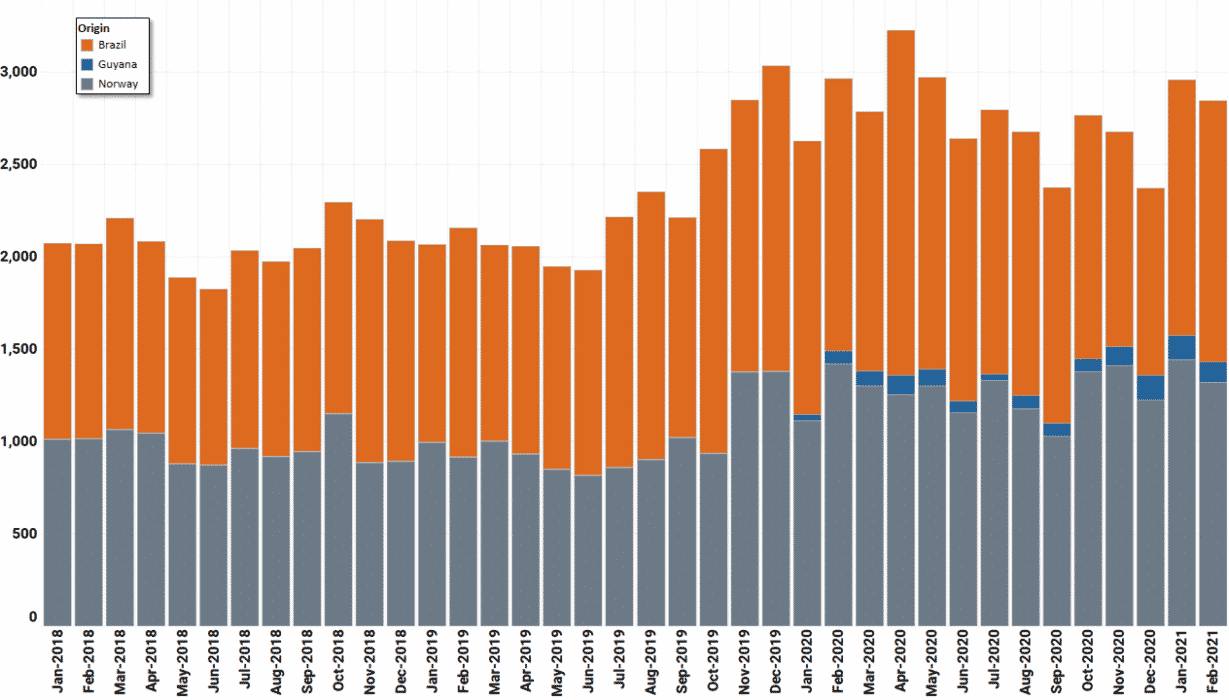
Source: Kpler








Be the first to react!