





 Portuguese
  English
  Spanish
  5 min of reading
  0 comments


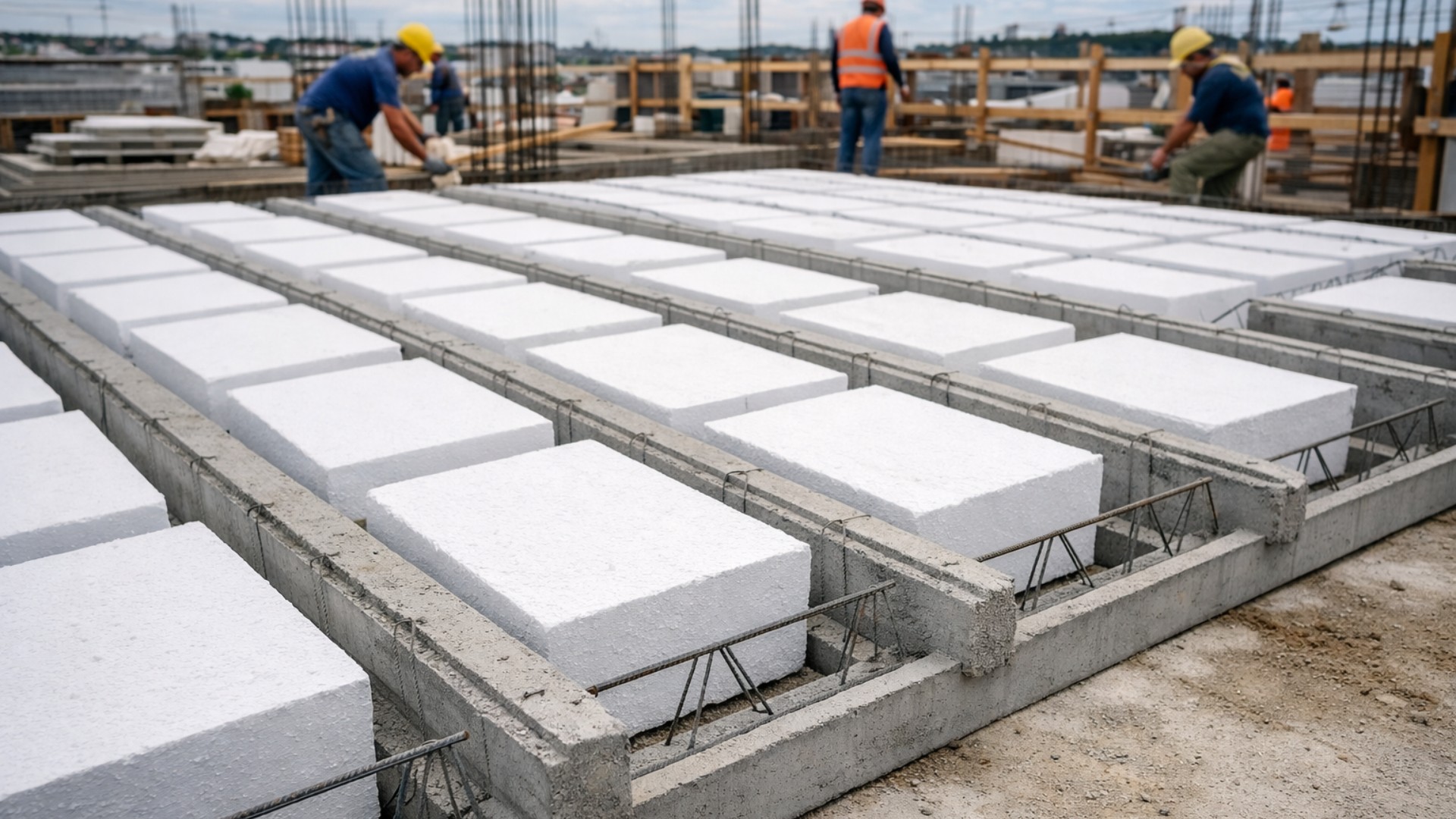
Increasing use of EPS in slabs changes the logic of construction by reducing structural weight, improving thermal performance, and optimizing stages on site, with direct impact on productivity and construction planning, although results vary according to project, execution, and specific characteristics of each enterprise.
The adoption of EPS in slabs has gained ground in Brazilian civil construction by combining lower self-weight, cleaner execution, and increased thermal comfort, without dispensing with reinforced concrete that ensures the structure’s strength.
In practice, the material acts as a filling element between beams or ribs, which helps to reduce loads, simplifies transportation on site, and can shorten construction stages, although the percentages of savings and speed vary according to the project, the system adopted, and the structural sizing.
The advancement of this type of solution accompanies a broader change in the sector.
-
Russian engineers create an innovative propeller blade for aircraft that could completely change the way airplanes and helicopters operate.

-
Couple finishes building PVC chalet on the beach on the last day, with air conditioning and curtains, but discovers the bathroom drain is inverted: water escapes from the drain, risking breaking the floor, and the rush continues before the trip.

-
Niterói surprises with a mega project of R$ 34 million and advances in the new Caramujo Bus Terminal, promising to revolutionize urban mobility by 2027.
-
A slatted wall that looks like it cost thousands of reais was made for just R$ 90, and the secret lies not in expensive materials but in careful planning, correct spacing, and uniform layers of finishing.


Instead of concentrating the discussion solely on the volume of concrete used, construction companies and designers have begun to pay more attention to productivity, logistics, waste, and the performance of the building after completion.
In this scenario, lightweight and industrialized materials have gained relevance because they reduce assembly effort, favor standardization, and make execution less prone to losses common in conventional systems.
How the slab with EPS works in practice
Despite the immediate association with the idea of “replacing concrete,” the functioning of the slab with EPS is different.
The technical standard and engineering literature describe the ribbed slab as a system where the resistant zone is concentrated in the ribs, between which inert material can be placed.
It is in this space that EPS appears, relieving the weight of the slab without taking on the structural role of concrete and steel reinforcement.
This arrangement has a direct effect on the self-weight of the structure.
Since slabs account for a significant portion of concrete consumption in a construction project, reducing mass at this stage affects not only the flooring itself but also the forces transmitted to beams, columns, and foundations.
Academic studies and technical materials on ribbed slabs point to lower self-weight and lower concrete consumption as the main advantages of the system when compared to solid solutions.
The lightness of EPS also alters the routine on site.
As the pieces are lightweight and easy to cut, internal transportation tends to require less effort, and assembly can gain momentum when there is a coordinated project and a trained team.
This operational gain helps explain why manufacturers, sector entities, and technical publications associate the material with faster construction, although the published numbers vary according to the construction method analyzed and should not be treated as a universal rule for any enterprise.
Savings in construction with EPS depends on the project
In commercial discourse, the slab with EPS often appears linked to significant cuts in costs for steel, concrete, and labor.
There is technical basis for part of this argument, but the calculation is not automatic.
The reduction of load can allow for structural rationalization, and the simpler assembly tends to decrease execution time, waste, and rework.
Still, the financial result depends on the size of the project, the spans, the chosen structural solution, the local prices of materials, and the quality of the executive planning.
In comparative studies, the ribbed slab shows advantages in concrete and formwork consumption, while the behavior regarding steel can vary according to the structural configuration analyzed.
This means that savings exist, but they need to be confirmed in calculation memorials and budgets, and not just in promotional material.
The same applies to percentages of weight and time reduction, which can be achieved in certain contexts but change from one project to another.
There is another decisive point in this calculation: execution.
A lightweight and industrialized system tends to perform better when it arrives on site with defined modulation, coordination between projects, and a team that knows the correct sequence of assembly, shoring, and concreting.
Without this care, part of the operational advantage is lost, and any installation failures can nullify the expected productivity benefit.
Thermal insulation and comfort with EPS
If the reduction of weight catches the attention of engineers, the thermal insulation of EPS often weighs in the decision of those who will use the property.
The material has low thermal conductivity and, therefore, hinders the passage of heat.
In slabs, this characteristic helps to reduce thermal exchange between environments and the roof, which can improve the feeling of internal comfort and, in some cases, contribute to less use of artificial cooling.
This performance does not turn the slab into a standalone solution for environmental comfort.
Solar orientation, ventilation, roofing, frames, and sealing remain determinants in the final result.
Even so, the presence of EPS reinforces an increasingly valued logic in civil construction: seeking systems that deliver dual benefits, combining construction rationalization and better performance in the building’s usage phase.
Technical care and safety in application
The expansion of EPS usage does not eliminate basic technical requirements.
As the material acts as a filler, the safety of the slab depends on correct structural sizing, specification compatible with the standard, adequate shoring, and well-executed concreting.
When these steps fail, there are risks of excessive deformations, cracks, and inadequate load distribution, problems that do not arise solely from the material but from the overall execution.
The doubt about fire also appears frequently.
In constructive use, the EPS used must meet normative specifications, and technical studies highlight the use of flame-retardant type material in appropriate applications.
Furthermore, in the finished slab, the filling does not remain exposed, as it is surrounded by the construction system and protected by the concrete layer, an essential condition for the expected performance.
From a finishing perspective, the system does not impose unusual restrictions.
Ceilings, plaster, and painting can be adopted according to the architectural project, as long as the chosen solution respects the structural detailing and the expected loads.
This helps explain why the slab with EPS is already present in residences, commercial buildings, and enterprises of different scales, especially where the combination of lightness, speed, and performance is more important than maintaining traditional methods due to market inertia.
More than a simple exchange of materials, the diffusion of EPS in slabs highlights a change in criteria in civil construction.
The focus shifts from being solely on apparent robustness to including structural efficiency, rationalization of inputs, and thermal behavior of the building.
When the project is correctly calculated and the execution follows standards and specifications, the system consolidates as a viable alternative for projects seeking productivity without compromising safety and performance.









Seja o primeiro a reagir!