





 Portuguese
  English
  Spanish
  4 min of reading
  0 comments


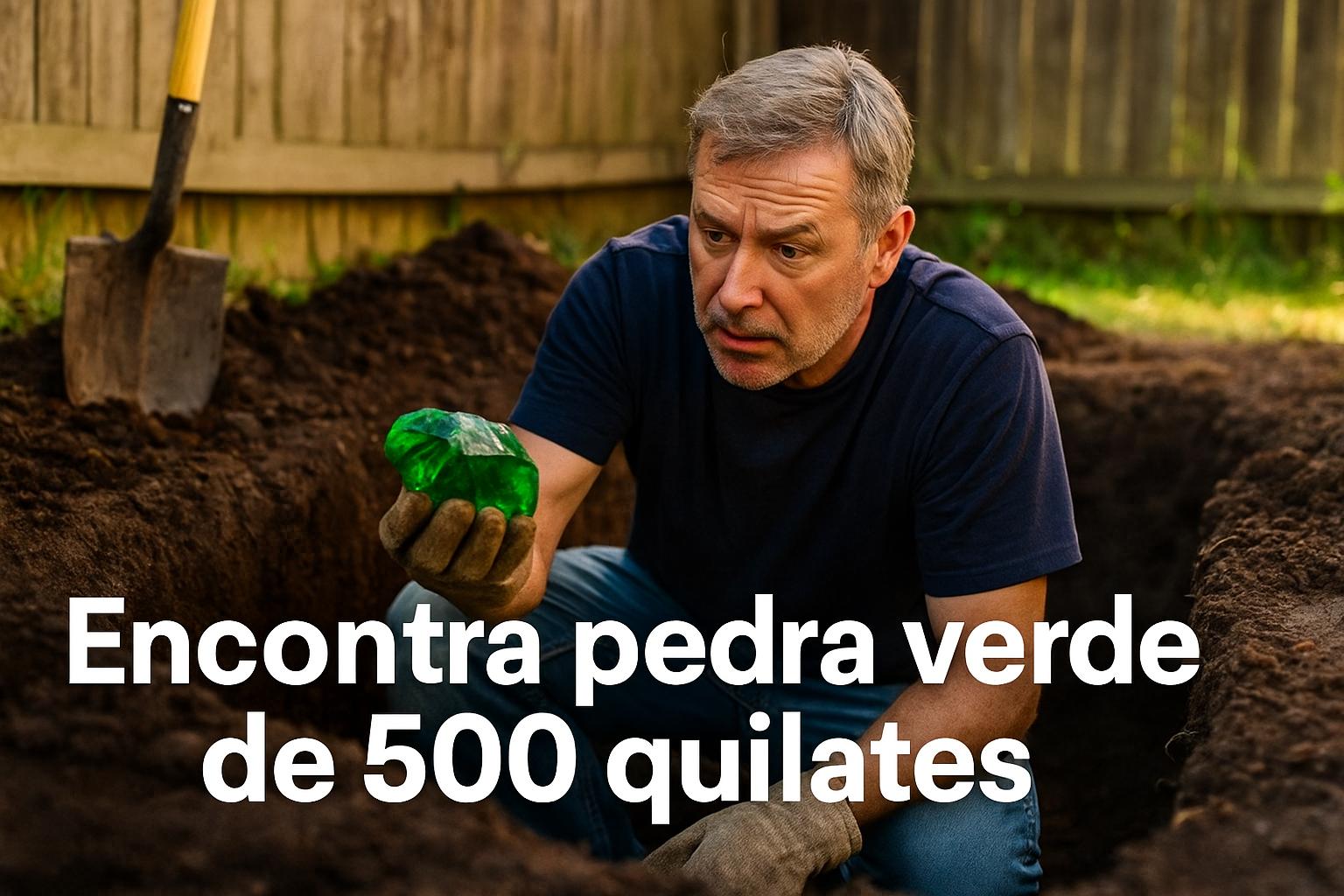
Man Finds 500-Carat Green Stone While Digging in Backyard in the U.S.; Discovery Confirmed by CBS19 Is Under Analysis and Could Be Worth Millions.
In November 2024, an unlikely scene in the interior of the United States made international headlines and sparked the interest of the scientific community. A man identified only as Arturo, a resident of Texas, was excavating his backyard when he found a translucent green stone weighing 500 carats, equivalent to about 100 grams, and, according to preliminary estimates, it could be worth over US$ 2 million if confirmed as a rare natural gem. The story was revealed by the network CBS19, which is following the analyses conducted by experts at local universities.
Since then, the discovery has intrigued geologists, gemologists, and collectors. The stone, with its intense green color and vitreous luster, is undergoing laboratory tests to determine its origin — whether it is a natural crystal, volcanic glass, or industrial slag formed over a century ago. Still, the episode has made global news, rekindling popular fascination with accidental discoveries of buried treasures.
The Coincidence That Made News
According to the report by CBS19, Arturo was digging to install a new drainage system when he noticed an unusual shine in the soil.
-
(Video): Italian pilot lands plane on moving train at 120 km/h and achieves unprecedented feat in aviation, even with a narrow runway and without direct visual contact.

-
It seems to have come out of a science fiction movie: A Brazilian city where it rains almost every day, recording over 4,000 mm per year, driven by climatic factors — a direct result of its strategic location in the Amazon.

-
The water crisis that could change everything this year has already begun; it’s not just about the climate, it affects technology, raises product prices, and can halt entire companies without warning.

-
A Japanese mason transforms raw granite into small cups and handcrafted utensils, collects giant stones, cuts with precision, and impresses with detailed manufacturing and finishing.


“I thought it was an old bottle, but when I cleaned it, I saw it reflected light in a different way,” said the resident.
The artifact was retrieved intact and measured about 10 centimeters in diameter, with a crystalline internal structure and uniform green color, characteristics that led a local jeweler to suggest that it might be a high-value gem.
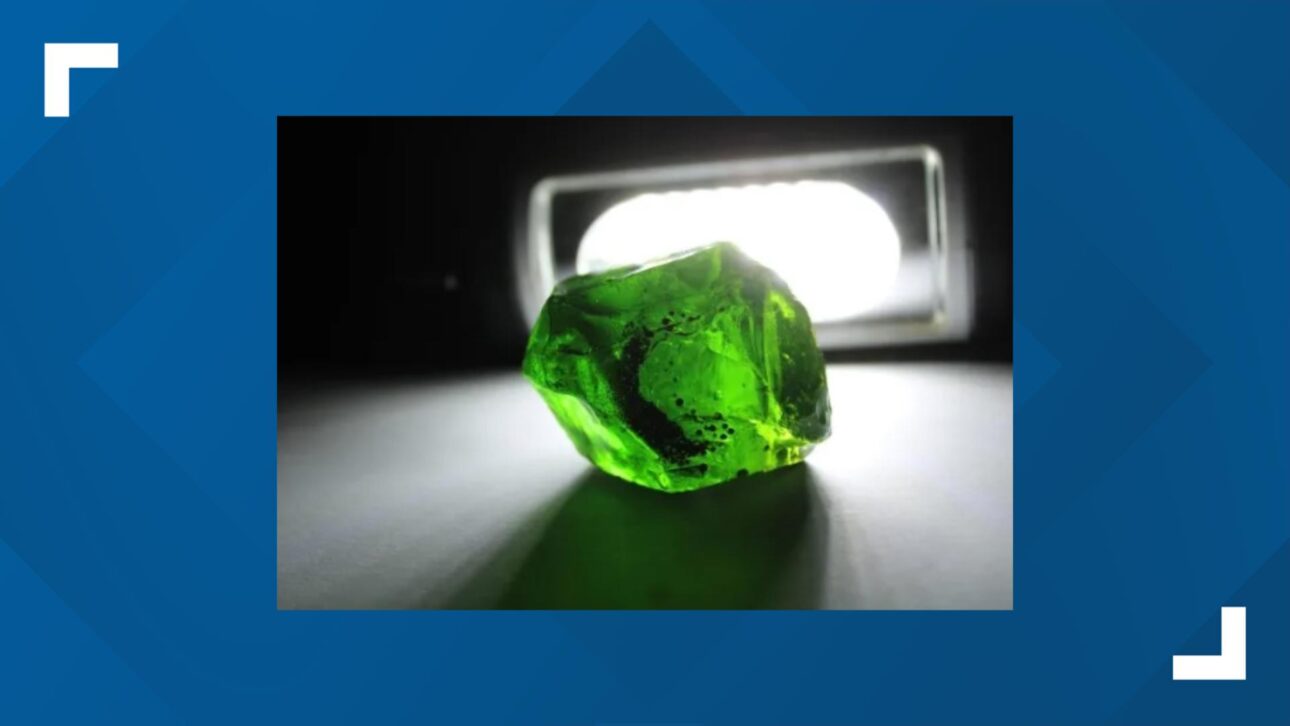
Images of the stone quickly went viral, and the story was confirmed by local authorities and scientists in the region. The find was sent to a team of mineralogists and gemologists for detailed analysis, as Texas is not known for housing deposits of precious stones with this profile.
Geological Mystery: What Could the 500-Carat Stone Be?
Initial tests indicate that the stone’s composition includes silicate, iron, and manganese, which could correspond to the structure of a demandite garnet or even olivine (also called peridot), although the hypothesis that it is volcanic glass or industrial slag remains the most likely.
Geologist Jim Smallwood, consulted by local media, explained that the eastern Texas region contains ancient deposits formed by volcanic activity.
“We cannot rule out that it is a natural glass formed by extreme heat thousands of years ago,” he stated. According to him, the translucent appearance and the hardness of the piece justify the astonishment of the initial evaluators.
“Even if it’s not a precious gem, it’s a fascinating geological find because the size is absolutely out of the ordinary. It’s 500 carats in a single piece, something that hardly forms by chance,” Smallwood added.
The Million-Dollar Value Is a Hypothesis, but It’s Not Ruled Out
While the final report has not been released, collectors and enthusiasts are already speculating about the stone’s potential value. If confirmed as a natural gem, which would be unprecedented for that region, the market price could exceed US$ 2 million.
The estimate is based on the pricing of high-purity gems, such as emeralds, tourmalines, or rare garnets, which can cost between US$ 10,000 and US$ 15,000 per carat. In this scenario, a 500-carat stone would become one of the largest and most valuable ever accidentally discovered in the United States.
“For every 100,000 gems evaluated, perhaps one has size and color like this,” commented gemology expert David Federman from Gemworld International. “Even if it’s a glass formation, the specimen has scientific and aesthetic value. It’s a piece that any museum would love to have.”
Between Dream and Science
While waiting for the results of the analyses, Arturo keeps the stone safely stored. In an interview with CBS19, he stated that he does not intend to sell it until he understands what he really has in hand. “It could be a precious stone or just a piece of glass, but it’s my luck that it was buried in the backyard,” he joked.
Cases like this are not rare: in several countries, fragments of old industrial minerals are confused with gems because of their color and shine. However, the size of the piece found by Arturo — equivalent to a tennis ball — is considered exceptional.
Even if it is not a natural gem, the discovery has scientific value as it raises new hypotheses about the region’s subsoil. “These casual finds help to understand local geological processes and reignite public interest in mineralogy,” observed Anna Blomquist, a gem specialist and professor at University of Texas at Austin.
A Reminder That the Extraordinary May Still Be Beneath Our Feet
Regardless of the final result, the episode has become a symbol of how chance can reveal fragments of the planet’s geological history.
“There is something poetic about finding a stone like this in the backyard,” Blomquist said. “It’s as if the Earth is reminding us that it still holds mysteries beneath the surface.”
While the official report has not been released, the 500-carat green stone remains under analysis and strict control. If confirmed as a natural gem, it will enter the list of the largest accidental discoveries of the century. But even if it isn’t, it will continue to be a mark of curiosity and fascination — proof that the extraordinary can emerge where least expected.








-

-

-

-

-

8 pessoas reagiram a isso.