Portuguese
 Spanish


Inside Elidir Fawr, in North Wales, Dinorwig pumped-storage hydropower plant has operated since 1984 in an old slate quarry, pumping water from one lake to another when electricity is plentiful and returning that power to the British grid in seconds, storing about 9.1 GWh
Take a look: a mountain in North Wales works as a giant energy-storage facility. Inside Elidir Fawr, above Llanberis, the Dinorwig plant stores energy in the form of water.
The story was told by British channel Terra in a YouTube video, and details about the operation appear in Turbomachinery magazine. The video was posted on Saturday, October 24, 2026. The plant itself is not new: it has been operating since 1984.
-
China activates 100-MW, 1-GWh CO2 battery in Xinjiang desert, surpassing Italy’s pioneering plant

-
Amazon pledges another $7 billion for renewable energy in India by 2030, on top of $4 billion already contracted, and secures 934 MW of solar and wind projects to power its own operations
-
Iberdrola replaces 74 old wind turbines with just 11 giant machines at its Muras wind farm in Galicia, each generating more than six times as much energy as its predecessor while continuing to supply the same 40,000 homes
-
Panasonic transforms glass windows into solar power plants, accelerates mass production of perovskite technology and begins selling first units for buildings


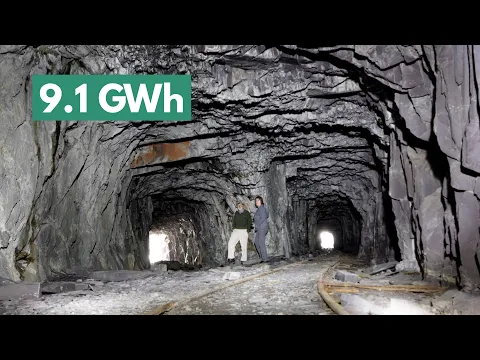

The video footage is from Engie UK, the company that also operates the plant.
Why Britain needs a mountain that doubles as an energy-storage facility
Here is how it works: when a popular British TV show ends, many people get up and switch on their electric kettles at almost the same time. The grid even has a name for this phenomenon: the “TV pickup.”
The record came at the end of the 1990 semifinal between England and West Germany. Demand surged by 2,800 MW in a matter of minutes, then fell back 20 minutes later.
Coal- and gas-fired power plants can respond in minutes, not seconds. Nuclear plants were not designed to change output quickly, either.
To cover a shortfall like that, power has to be ready, stored and waiting.
In many such moments, Dinorwig is the facility that responds, hidden inside a mountain on the edge of Snowdonia National Park.
What lies hidden inside Elidir Fawr
From the outside, all that can be seen is a mountain.
Inside, Terra’s video shows nine man-made caverns and 16 km of tunnels. Six machines there can deliver 1,728 MW to the national grid.
The main cavern is 51 meters high and 23 meters wide. Those dimensions match the Geological Society of London’s description of the space as a “concert hall.”
The cavern sits 71 meters below the surface of the lake outside. Almost no one driving along the road would know it is there.
How water moves up and down inside the mountain
High up, near the summit, lies the Marchlyn Mawr reservoir. A 36-meter-high rockfill dam holds it in place, 636 meters above sea level.
At the foot of the mountain is the natural lake Llyn Peris, at an elevation of about 100 meters. The difference in height between the two is around 500 meters.
When the grid needs power, valves open and water plunges down a shaft 10 meters in diameter. At full capacity, 390 cubic meters of water flow through it every second.
The water drives six reversible Francis turbines installed in the cavern, turning the machines before flowing through a tunnel to the lower lake.

When surplus electricity is available, usually overnight or on a very windy afternoon, the process runs in reverse.
The same machines act as pumps, pushing water from Llyn Peris back up the mountain.
How much energy Dinorwig stores and how much it returns
With its upper reservoir full, the plant stores about 9.1 GWh, a figure also listed on the U.K.’s Energy Dashboard.
It can run at full power for about 5 hours before the mountain “runs out”.
There are losses along the way, of course. The plant returns 74% to 76% of the electricity it uses to pump the water. In return, it delivers something almost nothing else in the system can: speed.
How many seconds does the plant take to reach full output
The figure varies depending on the source. The Terra channel puts the time at about 16 seconds to reach 1,728 MW from zero, during a peak that no one can predict precisely.
The plant’s owner uses a different measure. The announcement was made on June 30, 2026, and was republished by Turbomachinery magazine on July 28.
In it, First Hydro says Dinorwig can deliver up to 1,320 MW in 12 seconds from standby mode.
The same article says the plant can deliver up to 1,800 MW in less than a minute. The Geological Society of London and the video use 1,728 MW as the plant’s maximum output.
From slate quarry to hidden power plant
Before the plant was built, Elidir Fawr was the site of the Dinorwig slate quarry, one of the world’s largest for nearly two centuries.
The quarry opened in 1787 and, at its peak in the late 19th century, employed more than 3,000 men.
They cut slate from the mountain and sent it to the coast. From there, the slabs went on to cover the roofs of industrial Britain. The quarry closed on July 4, 1969, after 182 years.
Five years later, engineers began digging into the same mountain again. About 2,000 people worked to excavate the caverns, bore the 16 km of tunnels and expand the upper reservoir.
What the project cost and how much material it used
Construction began in 1974, took ten years and cost £425 million, according to the Geological Society. Twelve million tonnes of rock were removed from inside the mountain.
The project used 1 million tonnes of concrete, 200,000 tonnes of cement and 4,500 tonnes of steel. Each of the six machines weighs 450 tonnes, and the plant opened in 1984.

Why everything was built underground
The decision to put the plant inside the mountain was shaped by the location. Snowdonia is a national park, and nearly the entire project was designed to stay out of sight.
Even the grid connection runs underground: 10 km of 400 kV cables lead to the Pentir substation.
Outside, all that remains visible is a lake, a dam and a small building down below, next to the old quarry.
Why the mountain matters more to today’s grid
When the plant was built, electricity demand was the unpredictable part of the grid. Generation was controllable: operators could schedule power plants, and they would run. Today, the equation has flipped.
In 2025, renewables generated 44% of Britain’s electricity, up from 3% in 2000.
Wind and solar generate power when the weather allows, not when the grid needs it. The problem now also includes the wind dying down at six in the evening.
And nothing in Great Britain comes close in scale. Black Hillock, Scotland’s largest battery storage site, will store 600 MWh when completed. Dinorwig stores 9,100 MWh.
Who operates the plant and what comes next
The plant is owned by First Hydro, a partnership between French company Engie, the majority shareholder and operator, and Canadian pension fund La Caisse.
Together with the Ffestiniog plant, the company has 2.1 GW of capacity, about 74% of the UK’s pumped-storage hydropower capacity.
GE Vernova was selected to modernize the first two units, each rated at 315 MW.
This is the first phase of a program that will cover all six units and extend the plant’s operating life by more than 25 years.
The project includes upgraded motor-generators and pump-turbines. The spiral casing, stay ring and draft tube will be refurbished. A new control system and low- and medium-voltage equipment will also be installed.
In other words, opened in 1984, Dinorwig remains Britain’s largest electricity reserve. It will get new equipment to keep meeting peak grid demand.
Do mountain-scale energy-storage facilities like Dinorwig still make sense in the age of lithium energy-storage systems? Share your opinion.