






 Portuguese


Jeep Cherokee Returns as a 4×4 Hybrid SUV, Exceeding 800 km of Range, Delivering 212 hp, and Recapturing the Boxy Look That Defined Its Legacy.
After disappearing from the North American lineup, one of Jeep’s most recognized names is back in dealerships across the United States. The 2026 Jeep Cherokee revives a legacy that began in 1974, completely discards the mechanical setup of the previous generation, and reemerges with a 1.6-liter turbo engine paired with two electric motors, standard 4×4 all-wheel drive, and a range exceeding 800 kilometers on a single tank. The transformation is profound, but Jeep chose to do the opposite with the design: looking back to reclaim the straight and robust shapes that made the Cherokee recognizable.
The comeback also marks the debut of a new hybrid powertrain from Stellantis. In the United States, the manufacturer reports a combined output of 210 hp and 230 lb-ft of torque. There is an important unit difference for the Brazilian audience: in the official materials released by Stellantis in Brazil, the same powertrain appears as 212 hp and 31.8 kgfm.
The brand also confirms an estimated fuel economy of 15.7 km/l and more than 800 km of range. The Cherokee is already available in the North American market and was showcased to the Brazilian public at the São Paulo Auto Show in 2025, although that presentation did not confirm a commercial launch in the country.
-
Renault Revives the Iconic 1990s ‘Little Frog’ Twingo: Returns in 2026 as Electric with Round Headlights and 263 km Range

-
Demand for Electric Car Chargers in São Paulo Condominiums Surges 80%, Costs Reach R$60,000, and New Rules Allow Installation in Private Spaces
-
Fiat Strada Surpasses Polo, Tera, Argo, and Dolphin Mini to Remain Brazil’s Best-Selling Car: Pickup Offers Turbo Flex and Firefly 1.3 Flex Engines, CVT or Manual Transmissions, Air Conditioning, Electric Steering, Adjustable Steering Wheel, and Bed Liner

-
University Student Lost Ring at Sea, Believed It Gone Forever, but Diver Returned It 56 Years Later


Cherokee Returns After Leaving a Significant Gap in Jeep’s Lineup
The name Cherokee has traversed different generations, sizes, and proposals since its debut in the 1970s. In its most recent generation before the hiatus, the SUV reached the 2023 model year and then exited from the regular North American lineup.
Now it returns as a 2026 model.
This is not a profound update of the previous car. The new Cherokee was practically redesigned from a blank slate, featuring new visual architecture, a new hybrid powertrain, larger dimensions, and a clearly defined position in the highly competitive medium SUV market in the United States.

Jeep made it clear when presenting the model in August 2025: the intention was to reclaim space in the largest segment of the North American market.
This explains why the comeback received significant importance within the manufacturer’s strategy.
The Name Cherokee Was Born More Than 50 Years Ago and Helped Shape the History of SUVs
The first Cherokee appeared in 1974, initially as a two-door version derived from the Wagoneer.
It was a very different vehicle from today’s urban SUVs. The proposal combined family space, off-road capability, and a more practical enclosed body than the smaller Jeep models of that era.
Over the following decades, the name went through different generations, but one of them became particularly noteworthy: the Cherokee XJ, known for its straight lines, compact body, and significant presence in the United States and several other markets.
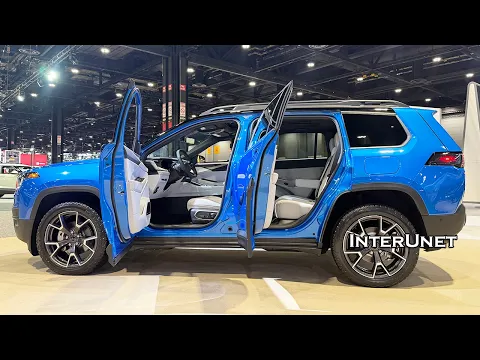

The new model doesn’t literally copy that car. The strategy was to recover elements that would make consumers immediately think of a Cherokee.
This is why there are more vertical sides, straight lines, a tall front, nearly square headlights, and the classic Jeep seven-slot grille.
Rounded design gives way again to the square Cherokee
The previous generation featured narrow headlights and a very rounded body, a solution that divided opinions among the brand’s more traditional fans.
In the 2026 Cherokee, this design language has been abandoned. The manufacturer claims the design was created by looking at 50 years of the model’s history.
At the front, the light assemblies take on a rectangular shape, framed by LED daytime running lights. The grille continues to use Jeep’s traditional seven slots.
The sides are also much more vertical. At the rear, the taillights were inspired by the classic military fuel cans, another historical element frequently used by the brand.
The result is an SUV that is visually much closer to the classic idea of a Jeep than the Cherokee that previously left the market.
New Cherokee became larger externally and gained 30% more cargo space
The growth didn’t just happen visually. According to Jeep, the 2026 Cherokee is longer, wider, and taller than its predecessor.
The total length reaches 4,778 mm, while the wheelbase is 2,869 mm. The body width is approximately 1,898 mm, and the height reaches 1,715 mm.
These dimensions clearly place the Cherokee within the medium SUV category. The increase directly impacts the cargo space.

Jeep states that the new model offers 30% more cargo capacity behind the second row compared to the previous Cherokee.
There are 33.6 cubic feet with the seats in their normal position and 68.3 cubic feet when the second row is folded down.
1.6-liter turbo engine works alongside two electric motors
The main revolution is hidden beneath the boxy bodywork. Instead of simply reusing one of the old combustion engines, Stellantis has created a 1.6-liter turbo hybrid system with four cylinders for the Cherokee.
The system consists of a combustion engine, two electric motors, and a high-voltage battery. The battery operates at 400 volts with a capacity of approximately 1.08 kWh.
This is not a plug-in hybrid. This means the owner does not need to park the Cherokee in front of an outlet to charge the battery.
Electricity is recovered during the vehicle’s operation, including through regenerative braking.
Specifications of the 2026 Jeep Cherokee
The new generation uses the same hybrid setup across all North American versions. The continuously variable electronic transmission and the Jeep Active Drive I system also come standard across the range.
| Item | 2026 Jeep Cherokee |
|---|---|
| Powertrain | 1.6-liter turbo, 4-cylinder, HEV hybrid |
| Hybrid system | Combustion engine + 2 electric motors |
| Combined power | 210 hp in the U.S. / 212 hp in Brazilian materials |
| Combined torque | 31.8 kgfm |
| Hybrid battery | 400 V, 1.08 kWh |
| External recharge | No |
| Transmission | Continuously variable electronic, EVT |
| Drive | Standard Jeep Active Drive I 4×4 |
| Terrain modes | Auto, Sport, Snow, and Sand/Mud |
| Estimated range | Over 800 km per tank |
| Combined fuel consumption disclosed in Brazil | 15.7 km/l |
| Towing capacity in the U.S. | 3,500 lb |
| Length | 4,778 mm |
| Wheelbase | 2,869 mm |
| Body width | 1,898 mm |
| Height | 1,715 mm |
| Ground clearance | 204 mm |
| Approach angle | 19.6° |
| Departure angle | 29.4° |
| Breakover angle | 18.8° |
| Seating | 5 |
| Multimedia screen | 12.3 inches |
| Instrument panel | 10.25 inches |
4×4 Traction is Standard Even in the Most Basic Version
An important decision sets the Cherokee apart from many SUVs that only use adventurous looks.
All versions come equipped with the Jeep Active Drive I 4×4 system.
The system can disconnect the rear axle when all-wheel drive is not needed, reducing mechanical losses and helping with fuel consumption.
When conditions require it, the 4×4 engagement happens automatically. The driver also has Selec-Terrain, with four modes: Auto, Sport, Snow, and Sand/Mud.
Each configuration modifies the vehicle’s parameters to handle different situations, such as snow, mud, or sand.
The ground clearance is 204 mm, while the declared angles are 19.6 degrees for approach, 18.8 degrees for breakover, and 29.4 degrees for departure.
Range Exceeds 800 km Without Needing to Plug the Car In
Perhaps the most interesting number for those looking to use the Cherokee for trips is its range.
Jeep claims more than 500 miles on a tank in the United States, while the official material released in Brazil states a figure of more than 800 km.
The combined fuel consumption reported to Brazilians is 15.7 km/l. The most important aspect is that these figures are achieved in a conventional hybrid.

There is no requirement to charge the battery externally.
For consumers looking to reduce fuel use but living in buildings without chargers, for instance, the logic is much closer to that of a conventional vehicle: refuel and drive normally.
The system automatically manages the utilization of the electric motors and energy recovery.
Cherokee can tow more than 3,300 pounds in the United States
Jeep also wanted to preserve the practical capability historically associated with the name. When appropriately equipped, the 2026 Cherokee has a maximum towing capacity of 3,500 pounds, which is approximately 1.6 tons.
The manufacturer presents it as a class leader in this regard based on criteria used for the North American market.
To achieve this, there is a specific towing package with features like blind spot monitoring adapted for trailer presence.
This is a particularly relevant feature in the United States, where small boats, recreational trailers, and towed equipment are part of everyday use for many SUVs.
However, this does not mean that every unit can automatically handle any tow of 1.6 tons. The capacity depends on the correct configuration and the rules established by the manufacturer.
Interior abandons old style and features two large screens
While the exterior looks back to the 1970s and 1980s, the cabin does exactly the opposite. The digital instrument panel features a 10.25-inch display.
At the center is a Uconnect 5 multimedia system with a 12.3-inch screen, compatible with wireless Apple CarPlay and Android Auto. The new transmission selector is rotary, freeing up more space in the center console.
Depending on the version, the Cherokee can also come with a two-piece panoramic sunroof, ventilated front seats, heated rear seats, wireless phone charging, a premium audio system, a 360-degree camera, and a digital rearview mirror.
Nostalgia remains primarily focused on the body design.
Inside, the goal was to transform the Cherokee into a contemporary SUV capable of competing for buyers who are accustomed to large screens and connected systems.
Cherokee visited Brazil, but that did not mean a confirmed launch
The return of the Cherokee caught even more attention from Brazilians because the model was officially showcased at the São Paulo Auto Show in November 2025.
Jeep brought an Overland unit. Stellantis itself described the Cherokee as one of the global models presented at the event to gauge the Brazilian public’s reception.
At the same event, the Avenger was treated very differently, as it already had production and launch confirmed in Brazil for 2026.
With the Cherokee, the manufacturer did not make an equivalent confirmation of national sales in that announcement.
Therefore, the physical presence of the SUV at the auto show demonstrated the brand’s interest in exposing the product to Brazilians but should not be automatically interpreted as a promise of availability for sale.
Production has been moved to Mexico
The new Cherokee has also relocated its manufacturing base. The 2026 generation began production at Stellantis’s factory in Toluca, Mexico, to supply the North American market.
The hybrid system itself has part of its production concentrated in the United States, with components sourced from Dundee operations in Michigan.
The Cherokee returns at a time when Stellantis is trying to expand its presence in hybrid models while not abandoning consumers who still do not want to rely on external charging infrastructure.
Thus, instead of immediately converting the Cherokee into a fully electric vehicle, Jeep opted for an intermediate solution: gasoline, turbo, electrification, and 4×4 all in the same package.
Return aims to regain space in the heart of America’s largest SUV market
The choice of the Cherokee is not only nostalgic. According to Jeep, the aim is to reclaim market share in the medium SUV segment, which the brand considers to be the largest automotive segment in the United States.
This is precisely where the new vehicle must prove that a historic name still holds commercial strength.
This time, the strategy combines two seemingly opposite ideas. On the outside, boxy shapes and references to five decades of Cherokee heritage.
Underneath the body, a new hybrid system with a 400-volt battery, two electric motors, energy recovery, and electronic management of all-wheel drive.
The consumer familiar with the old Cherokees finds the seven-slot grille and a more vertical silhouette again.
Those who have never encountered these generations receive large screens, semi-automated driving systems, connectivity, and an electrified powertrain.


