





 Portuguese
  English
  Spanish
  6 min of reading
  2 comments


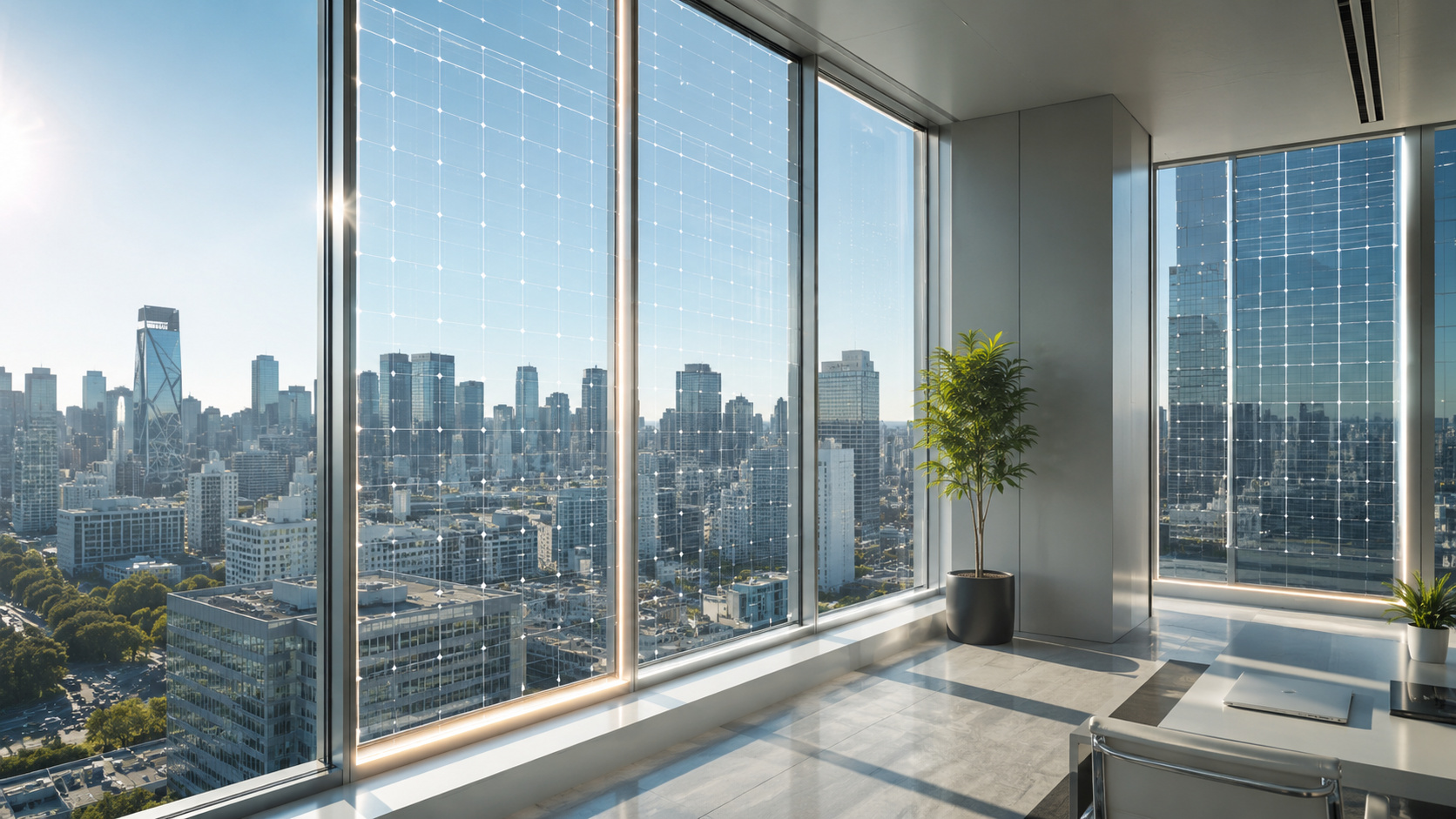


Transparent photovoltaic glass transforms windows, facades, skylights, and greenhouses into solar surfaces, with perovskite, OPV, and LSC competing for the next phase of urban energy.
According to Ecohome, transparent solar panels, also known as photovoltaic glass or BIPV, Building-Integrated Photovoltaics, are among the most promising solar technologies in 2026. In December 2025, Panasonic and YKK AP began testing office windows with perovskite panels applied to glass, with customizable transparency.
These panels function as a thin film over conventional glass, allowing for semi-transparent, decorative, graduated privacy, or almost fully transparent configurations. At the same time, they capture part of the sunlight and transform the glazed surface into an energy-generating area.
The commercial efficiency of photovoltaic glass available in 2026 varies between 5% and 12%, depending on the level of transparency. In the lab, semi-transparent perovskite cells already exceed 14% to 15% efficiency with visible light transmission above 70%, a range in which the glass still appears transparent to the observer.
-
Farmers swapped diesel for solar panels in Pakistan, powered irrigation pumps almost cost-free, expanded rice fields, and now groundwater has become a red alert in the countryside.

-
NGO opens slots for free solar energy course exclusively for women in São Gonçalo
-
How much does it cost to install solar energy at home in 2026? This method of generating energy attracts attention for allowing a reduction in electricity expenses and an estimated financial return between four and seven years, with residential systems costing between R$ 15,000 and R$ 28,000.

-
Surprising study by Scatec reveals that recycling solar panels in Brazil can return R$ 3.18 for every R$ 1 invested, transforming photovoltaic energy waste into a new source of economic value and strengthening the circular economy in the sector.


Transparent photovoltaic glass can transform facades into solar energy generators
The conventional solar panel solved part of the clean generation problem on rooftops, but left unused the largest available area in modern cities: glass facades, skylights, greenhouses, stations, shopping malls, and commercial buildings.


A tall office building usually has much more facade area than roof area. Common solar panels cannot occupy these surfaces without blocking light, compromising the architectural design, and altering the original function of the glass.
Photovoltaic glass precisely solves this limitation. They allow windows and facades to continue illuminating spaces while also starting to generate electricity.
Urban solar energy depends on using surfaces that currently generate nothing
The direct comparison with traditional solar panels may seem unfavorable, as silicon modules reach 20% or 23% efficiency, while commercial photovoltaic glass ranges between 5% and 12%.
But this comparison ignores the function of each technology. The conventional solar panel occupies rooftops or open areas; photovoltaic glass replaces a window that, without this technology, would continue not generating energy.
In dense cities, where rooftops are limited and facades dominate the landscape, the gain is in the available area. Even with lower efficiency, thousands of square meters of glass can become a distributed solar power plant integrated into the building.
Buildings consume energy and can become part of the solar solution
Buildings account for a significant share of global energy consumption, especially when considering air conditioning, lighting, elevators, equipment, and electricity used daily.
Glass facades are common in financial centers, hotels, airports, hospitals, shopping malls, and corporate towers. Today, most of these surfaces only let light and heat pass through, without generating electricity.
With transparent solar glass, the logic changes. The building’s own skin can help reduce grid demand, without requiring new areas, large rooftops, or aggressive visual changes.
LSC, OPV, and perovskite compete for the future of transparent solar glass
Photovoltaic glass is not a single technology. At least three paths compete for space: luminescent solar concentrators, organic photovoltaics, and semitransparent perovskites.
The Luminescent Solar Concentrators, or LSC, use fluorescent dyes or quantum dots embedded in the glass. They mainly absorb ultraviolet and infrared light, reemit this energy to the edges, and send the light to solar cells in the frame.
The advantage of LSC is maintaining a very transparent appearance. However, commercial efficiency is still lower, generally between 2% and 5%, which limits applications where higher generation is needed.
OPV uses lightweight organic films to generate energy in windows and facades
The second technology is organic photovoltaic, known as OPV. It uses organic compounds applied as a thin film, capable of absorbing part of the sunlight while maintaining good visual transmission.
OPV is lightweight, flexible, and relatively cheap to manufacture. This allows applications on curved surfaces, special facades, building retrofits, and projects where weight and flexibility are more important than maximum efficiency.
The limitation lies in durability. Organic films tend to degrade faster with ultraviolet radiation, humidity, and prolonged exposure, requiring advances in encapsulation and lifespan.
Semitransparent perovskite is the most promising technology for solar windows
The third technology is semitransparent perovskite, considered one of the most promising in efficiency. It uses thin layers of photovoltaic material adjusted to capture part of the light and allow the passage of the visible range.

Perovskite has an important advantage over silicon: its chemical composition can be adjusted to change the bandgap. This allows it to absorb more ultraviolet and blue light, letting part of the visible light perceived by the human eye pass through.
This control is essential for solar windows. The more transparent the glass needs to be, the lower the generation tends to be; the higher the desired generation, the lower the light transmission can be.
Transparency and efficiency define the ideal use of transparent solar panels
The biggest technical challenge of photovoltaic glass is balancing clarity and energy generation. An office window needs to maintain high visual comfort, while a skylight or secondary facade can accept lower transparency.
In windows that require maximum clarity, visual transmission can be above 70%, with efficiency between 5% and 8%. In skylights or areas where slight shading is acceptable, transmission can drop to 50%, raising efficiency above 10%.
This balance allows for customized application. The same building can use more transparent glass in work areas and more generating glass in facades less sensitive to internal lighting.
Panasonic and YKK AP test perovskite solar windows in Japan
The test announced by Panasonic and YKK AP in December 2025 shows the current stage of the technology. The companies have started evaluations with office windows made with perovskite panels applied to glass.
The project in Kokubunji, Tokyo, uses four windows with different levels of transparency and decorative patterns, installed in treated wood frames. Each unit measures 723 mm by 1,080 mm.
The initial focus is to test installation and operational viability, not just energy generation. This stage indicates that the technology has moved from the laboratory to the validation phase in real construction environments.
Photovoltaic glass should advance first in commercial buildings
Widespread adoption should still start with commercial buildings, airports, business centers, shopping malls, and corporate projects. In these cases, the cost per square meter can be justified by aesthetics, innovation, and partial reduction of the energy bill.

In the residential market, the options are still more limited and expensive. Common houses have less glass area and greater sensitivity to the initial price, making the financial return more difficult in the short term.
Even so, the trend is for gradual expansion between 2026 and 2027. As perovskite improves efficiency, durability, and scale production, solar glass tends to become more competitive.
Conventional solar panel and photovoltaic glass do not compete for the same space
Photovoltaic glass is not expected to replace conventional solar panels on roofs. The two technologies occupy different spaces and solve different problems.
The silicon panel remains more efficient for roofs, solar plants, and areas where opacity is not an issue. Meanwhile, photovoltaic glass is used where the common panel cannot be installed: windows, facades, skylights, and greenhouses.
This complementarity is the central point. The future of urban solar energy may combine roofs with traditional panels and facades with transparent photovoltaic glass.





What are the pros and cons of this new alternative solar development mostly to human in terms of health radiation
This is awesomely amazing. Its a peep into what the future has in stock for the universe