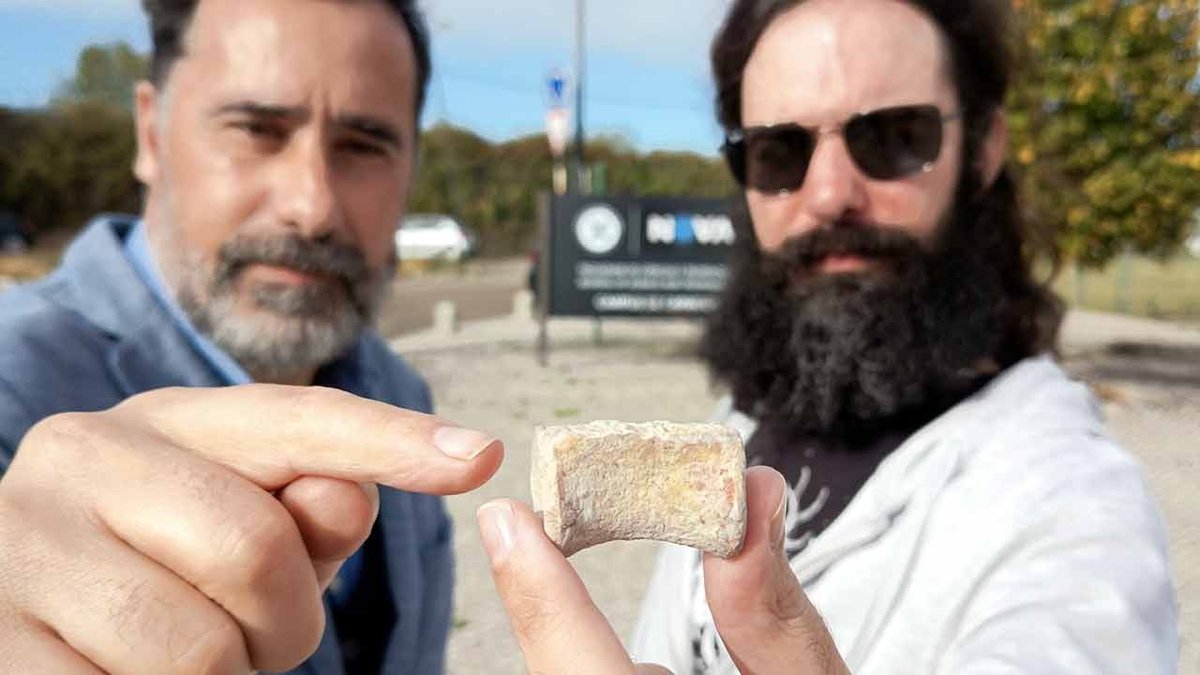
Student Maciej Ruciński found a 3.7 cm dinosaur vertebra in red Triassic rock at Penina, in Portugal’s Loulé municipality, and the NOVA FCT paleontologists who studied it say the bone is about 227 million years old, the oldest dinosaur remains yet identified on the Iberian Peninsula.
The find was made public on November 27, 2026, when the study’s authors sent a note to newsrooms, according to the Algarve newspaper Barlavento. The Lusa news agency also interviewed one of the researchers that day.
Ruciński is a student at the School of Science and Technology of NOVA University Lisbon, known as NOVA FCT. He came across the bone during fieldwork for his thesis, while studying the geology of the area, Público reported.
A bone the length of a thumb
The fossil is a single vertebral centrum, the main body of a back vertebra, measuring 37 millimeters in length. In the scientific paper it carries the collection number NOVA-FCT-DCT-5562, according to the journal’s abstract.
-
With R$12 billion invested in power plants, Porto do Açu targets a third facility and aims to attract data center giants
-
OPEC says oil was not to blame and accuses the EU of derailing COP31 as Turkish summit ends without agreement and two days late
-
Coal in Brazil takes center stage in debate as 71 scientific studies examine cancer risks, billion-dollar environmental liabilities, and workers’ future amid the energy transition
-
Intermoor and Navvik form alliance to compete for offshore contracts in Brazil, combining subsea engineering with anchor-handling vessels capable of up to 259 metric tons of bollard pull
“It is an elongated vertebra from the back, with grooves at the front and rear, making it very distinctive,” Octávio Mateus, a professor in NOVA FCT’s Department of Earth Sciences and a researcher at GeoBioTec, told Lusa, in a quote carried by The Portugal News.
The Lusa report described the discovery as made almost by chance. “Although small, the find was identified because it is clearly distinct from the surrounding rocks,” Mateus said, adding that the anatomical details were then studied in the laboratory.
Where the student was digging
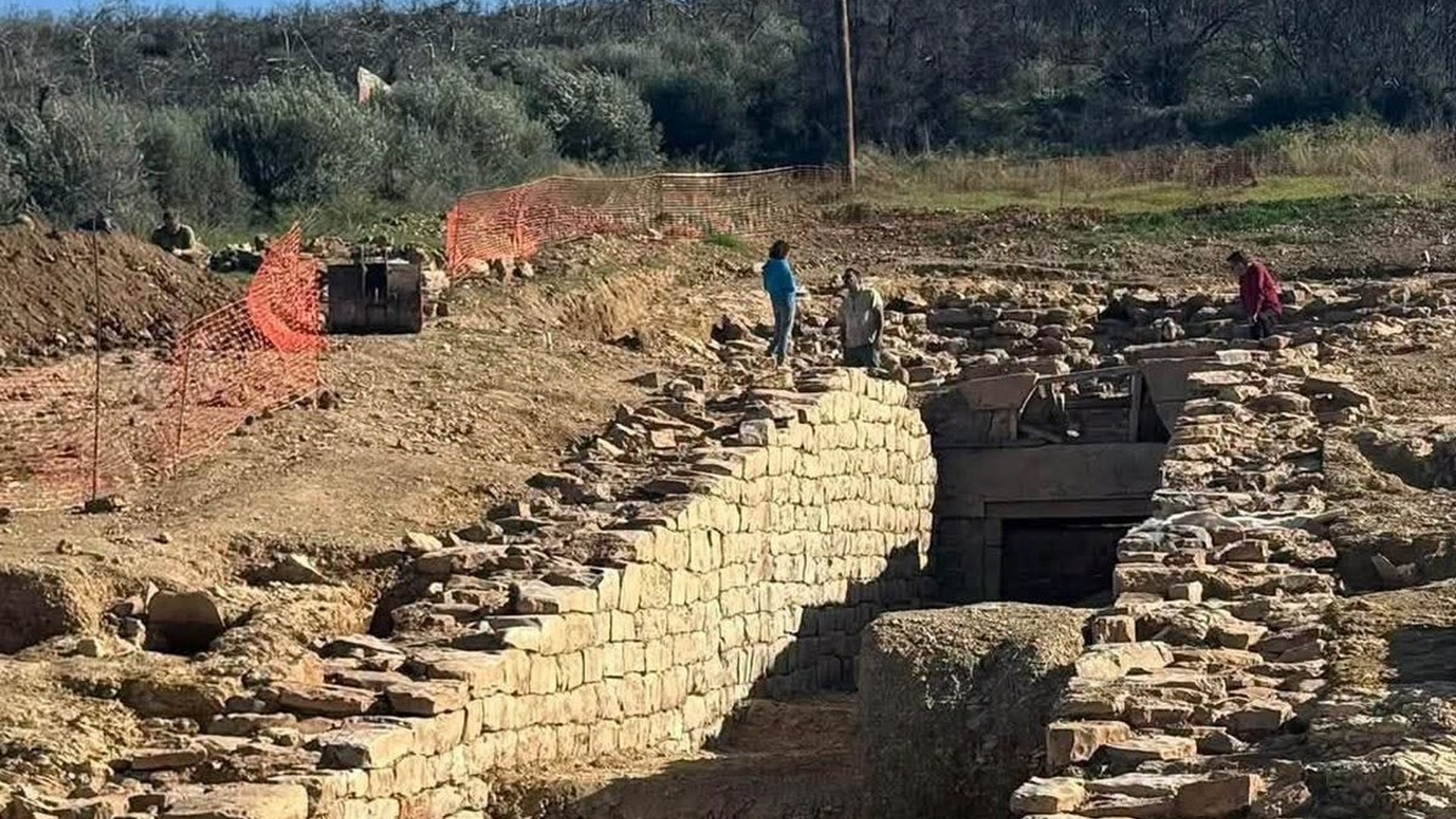
The vertebra came from an outcrop of reddish rock belonging to the Silves Group, dated to the Late Triassic, at Penina, in the parish of Salir. The site sits inside Loulé municipality, in Portugal’s Faro district.
The authors’ statement places the age of the rocks between the end of the Carnian and the start of the Norian stages, or about 227 million years ago. Back then, the first dinosaurs were spreading, and the continents were still joined as Pangaea.
The landscape was very different then. According to the statement, the Algarve was a continental basin with a semi-arid climate, where seasonal monsoon-type rains fed temporary rivers and alluvial plains.
The two scientists who described the fossil
The study was written by doctoral student Rui Tiago dos Santos-Matos, the first author, and by Mateus, who is also linked to the Lourinhã Museum. It was published in the journal Fossil Imprint.
The paper, titled “Theropod vertebra from the Late Triassic of Algarve, Portugal: evidence of the oldest Iberian dinosaur,” appears in volume 82, pages 98 to 109. Sci.News reported on it in October, before the Portuguese announcement this week.
To work out what animal the bone came from, the team compared it with vertebrae of several early dinosaurs and other Triassic reptiles, the statement said. That comparison was followed by an evolutionary, or phylogenetic, analysis.
The analysis covered 64 species and 404 anatomical characters, according to the statement. Thirteen of those characters were created from scratch by the two authors to describe this specific type of back vertebra in early theropods.
A small predator on two legs
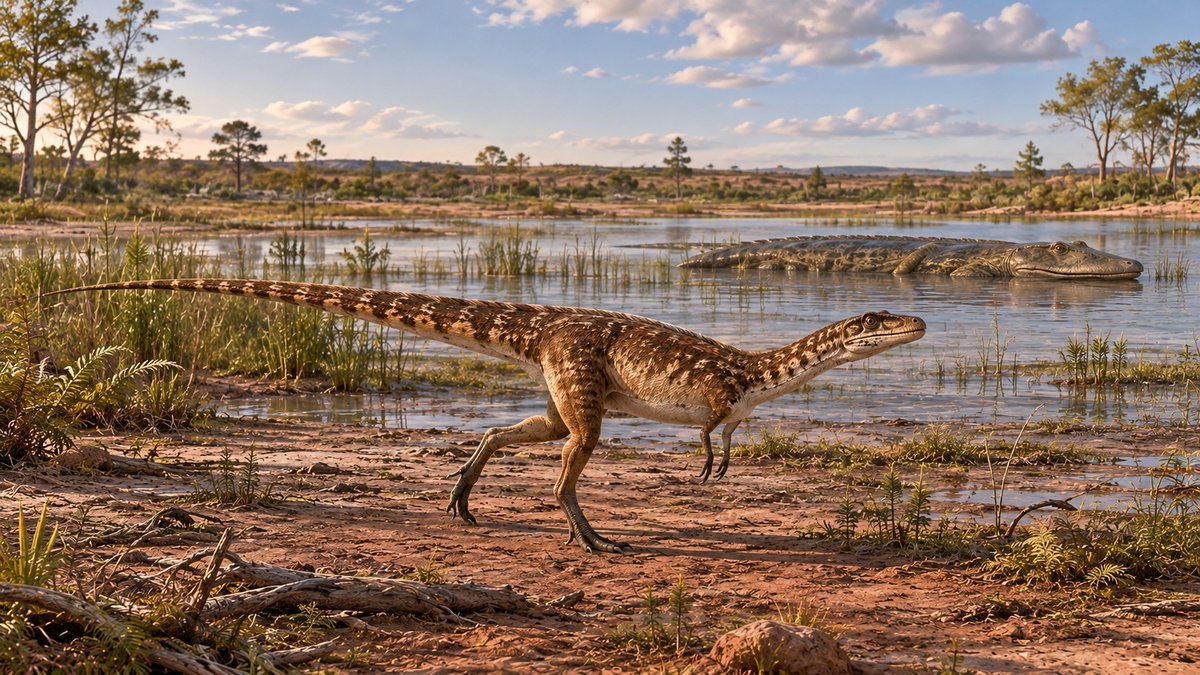
The bone belonged to a theropod, the group of mostly carnivorous, two-legged dinosaurs. The team concluded that it came from “a carnivorous dinosaur that was quite advanced for its time,” Mateus told Lusa.
“Based on comparisons with its closest relatives, the animal is estimated to have measured between 2.5 and three metres in length, including its tail, and around one metre in height. It was a small-to-medium-sized predator,” he said.
“We are talking about the early stages of dinosaur evolution, 227 million years ago,” the paleontologist added in the same interview, as quoted by The Portugal News and Executive Digest.
A distant cousin from England
The results place the fossil among the neotheropods, an early branch of predatory dinosaurs that gave rise to many later carnivores and, ultimately, to birds. Its closest known relative is Sarcosaurus woodi, an Early Jurassic predator from England.
About 20 million years separate the two animals, so the Algarve vertebra and Sarcosaurus cannot be the same species, the statement said. Giving the Portuguese animal a formal scientific name will require finding more bones.
“If the age of the rocks is confirmed, the lineage leading to Sarcosaurus is much older than previously thought, and the origin of this group of predators occurred millions of years earlier,” Santos-Matos said in the statement, translated from Portuguese.
“This reinforces the idea that neotheropods were already spread around the world in the Late Triassic,” the first author added. If the classification holds, the Algarve fossil ranks among the oldest neotheropods in the world, according to the researchers.
The first land animal in these rocks
The Triassic deposits of this region had already produced a long list of fossils, but all of them were aquatic or tied to water. The list includes giant salamander-like amphibians such as Metoposaurus algarvensis, crocodile-like phytosaurs, turtle-like placodonts, fish and sharks.
“Until now, the Triassic fauna of Portugal was known mainly from aquatic animals. This vertebra is the first evidence of a non-aquatic animal in these rocks, and it is from a dinosaur,” Mateus said in the statement.
He was even more direct with Lusa. “It was clearly an animal that walked on land. It was not aquatic, nor did it live in a lake,” the researcher said, according to The Portugal News.
What Portugal had before this bone
Evidence of dinosaurs in the Portuguese Triassic had been only indirect. The statement cites two footprints, possibly from theropods, described in 1974 at Vacariça, in Mealhada, and in 1976 in Anadia, with no associated bones.
Those footprints are probably lost today, the researchers noted. That makes the Penina vertebra the first dinosaur bone from this period found in Portugal and in the whole Iberian Peninsula, Público reported, citing the statement.
Mateus also pointed out that the Algarve already had other dinosaur traces, including footprints on the beaches of Salema, in Vila do Bispo, and Arrifes, in Albufeira. Those tracks come from different geological formations, he told Lusa.
A geopark built on Triassic fossils
Penina lies in the Algarvensis Geopark, which covers the municipalities of Loulé, Silves and Albufeira. The geopark was recognized as a UNESCO Global Geopark in 2026, according to Barlavento and The Portugal News.
Its creation grew out of the discovery of Metoposaurus algarvensis, a giant amphibian more than two meters long found in the same area. For Mateus, the region matters because of the richness and diversity of the fossil remains found there.
The student’s thesis fieldwork has now added the first known land-dwelling vertebrate to that record, in rocks that had previously yielded only animals that lived in or near water.
Could further digging at Penina turn up enough bones to give the oldest dinosaur from the Iberian Peninsula a name of its own?