





 Portuguese
  English
  Spanish
  5 min of reading
  0 comments


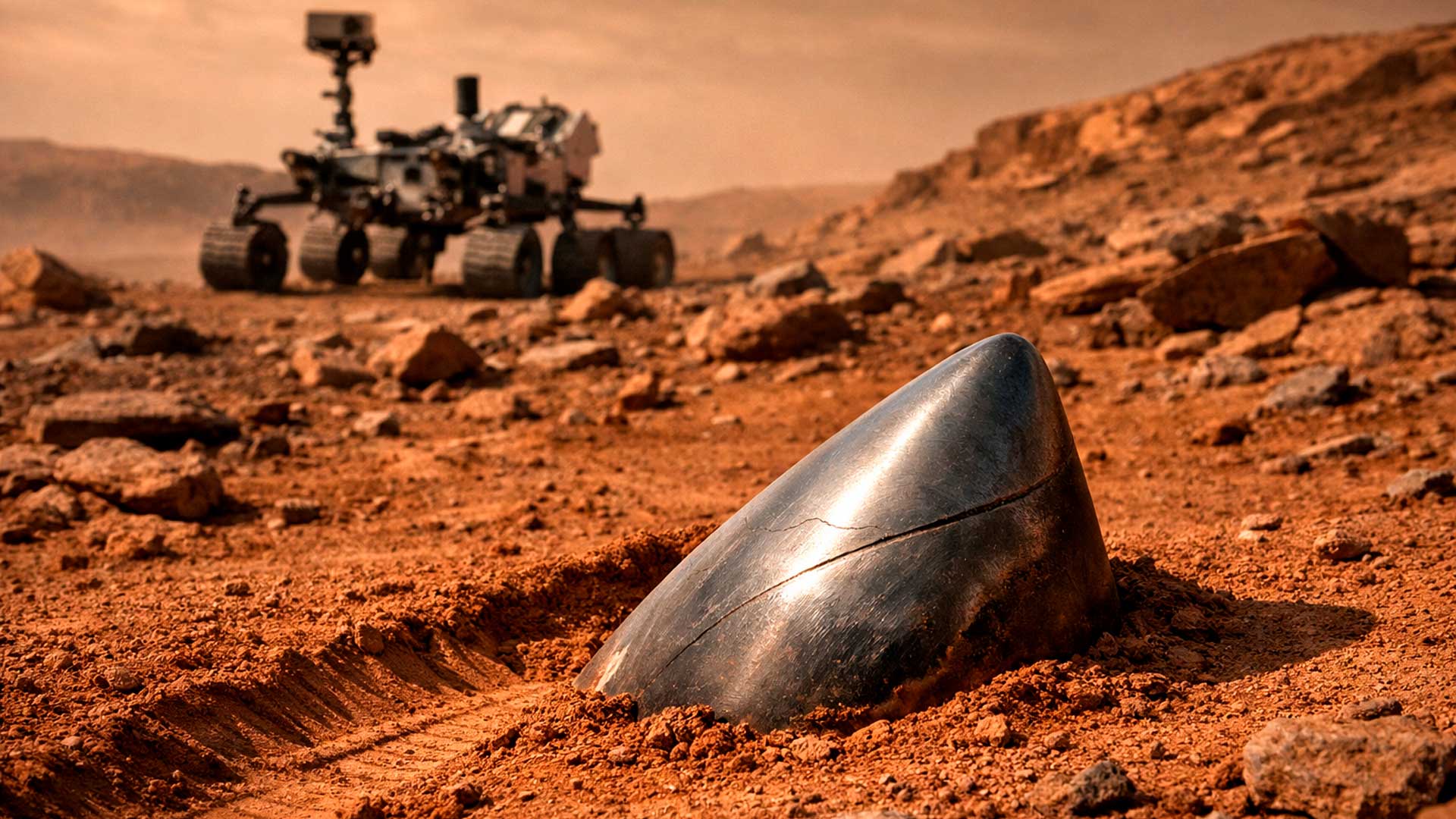
A small structure photographed on Mars became a new focus of scientific dispute and put the official NASA explanation and the challenge from a Harvard researcher on opposite sides.
An image taken by the Curiosity rover on Mars has sparked debate both within and outside the scientific community. The reason is an object that appears smooth, metallic, and conical in shape, compared by many to a party hat.
The NASA maintains that it is merely a rock shaped by the action of Martian winds. On the other hand, astrophysicist Avi Loeb, a professor at Harvard University, rejects this interpretation and claims that the structure has characteristics that are difficult to reconcile with a common natural formation.
The case gained traction because the discussion involves very different measurements, visual reading of the image, and the old boundary between planetary geology and speculation about possible artificial debris.
-
Giant structures 14 meters beneath Egypt are revealed by satellites and expose a millennia-old secret buried in Buto.
-
Children have been making clay pieces for 15,000 years in Southwest Asia, and fingerprints preserved on 142 ornaments helped archaeologists prove this.
-
New semi-autonomous legged robot technology challenges the limitations of space exploration by operating almost without human intervention on the Moon.
-
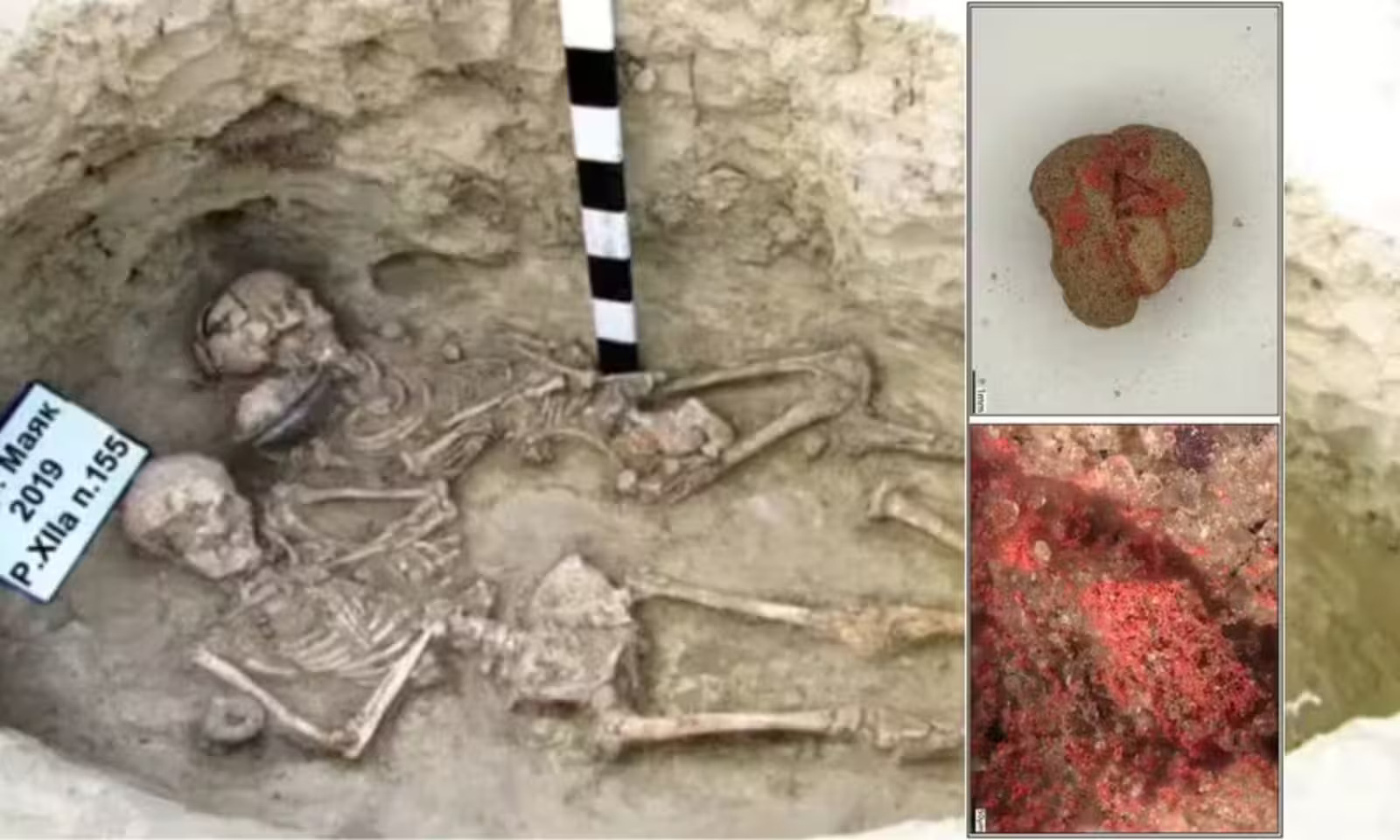
Super toxic red mineral found in the double burial of two women aged 1,900 years near the banks of the Dnieper River in Ukraine.

For now, the official consensus leans towards a natural origin, but public contestation has increased the interest in the record.
NASA says the object on Mars measures only 1 centimeter and may be another classic case of visual pareidolia

The explanation presented by NASA is straightforward. In the reports analyzed by the agency, the object has about 1 centimeter in diameter and was photographed by the Curiosity’s cameras at an approximate distance of 4 meters.
With this scale, the structure would lose the extraordinary aspect suggested in broader interpretations of the image. Experts read the case as falling into the realm of pareidolia, a phenomenon where the brain identifies familiar shapes in random patterns.
This type of visual confusion is common in space images, especially when the framing shows isolated details of the terrain. On Mars, where erosion creates unusual cutouts, seemingly artificial objects often appear in photographs and later receive geological explanations.
Winds of up to 160 km/h help explain strange shapes on the surface of Mars and reinforce the natural rock formation version
The basis of the official explanation lies in the strength of the planet’s winds. A study from the University of Switzerland cited in the debate indicates that air currents on Mars can reach up to 160 km/h, a speed sufficient to sculpt the soil over long periods.
This process of wind erosion has already produced other curious formations observed in records from the planet. Among the examples mentioned are stones that resemble coral reefs, pages from an ancient book, and even the outline of a bear.
In this context, the conical object would not be an exception but rather another effect of natural modeling combined with camera angle and human interpretation.
It is precisely this history of unusual shapes that supports the space agency’s position.
Avi Loeb challenges estimated size and says polished shape and flat base do not match a common rock in a Martian environment
On the other side of the discussion is Avi Loeb, one of the most well-known names when it comes to the search for unusual signals in space. For him, the object does not measure 1 centimeter but about 20 centimeters, a huge difference that completely changes the reading of the case.
Loeb assesses that the structure may be composed of artificial debris. In his analysis, the image shows an object with no clear equivalent among the surrounding rocks, which would weaken the hypothesis of a simple natural formation shaped by the wind.
The researcher stated that the photograph clearly shows the absence of similar rocks in that immediate environment. He also argues that a common stone would hardly have a cylindrical surface so polished and a perfectly flat base.
This combination of symmetry, visual finish, and isolation in the terrain is at the center of the disagreement. For Loeb, the official explanation oversimplifies an object that deserves more careful analysis.
Harvard professor challenges NASA to locate another similar example in Curiosity archives and increases pressure on the official explanation
The challenge did not remain only in the theoretical realm. Avi Loeb publicly challenged NASA representatives to find and display in the Curiosity archives any other rock with equivalent morphology.
The challenge carries weight because it shifts the discussion to empirical comparison. If similar structures are common, the natural thesis gains strength; if they are rare or nonexistent in the records, the anomaly begins to seem more relevant.
So far, there is no confirmation that the object is artificial, nor accepted evidence of non-human technology on Mars. Nevertheless, the divergence between the space agency and a Harvard professor shows how an apparently simple image can open a serious dispute over scientific interpretation.
This episode also helps explain why Mars remains surrounded by fascination. Every detail captured by Curiosity becomes raw material for debates about geology, visual perception, and the still-unproven possibility of finding something unexpected on the red planet.
Why the mystery on Mars continues to attract attention even without proof of an artificial object on the red planet
Cases like this attract interest because they mix cutting-edge science, impressive images, and a question that has never lost its strength. After all, when a photograph shows something out of the ordinary, the tendency is for the discussion to go far beyond technical analysis.
At the moment, the most accepted reading continues to be that of natural origin. But Loeb’s criticism keeps the subject alive and reinforces that, in space exploration, even a tiny object can generate a huge debate.
If you wish, it is worth following the official coverage of the missions on NASA’s website and observing how new images of Mars continue to be interpreted. And here lies the discussion that divides opinions, was it just a rock sculpted by the wind or does the official explanation still leave loose ends? Leave your comment and say which side you are on in this dispute.







Seja o primeiro a reagir!