Portuguese
 Spanish


A business mission in Shanghai brought together more than 100 participants and presented shipbuilding and offshore opportunities to more than 30 Chinese companies. Petrobras stressed the importance of local content, and Transpetro presented fleet plans.
A Brazilian business mission brought Petrobras, Transpetro and representatives of the shipbuilding industry to a business roundtable in Shanghai, China, with more than 100 participants and representatives from more than 30 Chinese companies. The goal was to present investment opportunities in Brazil’s shipbuilding and offshore sectors.
At the meeting, held on November 11, Petrobras made clear to potential suppliers that participation by domestic industry would be crucial to developing new business. The proposal is to attract companies interested in establishing operations in Brazil or partnering with Brazilian manufacturers.
Petrobras makes the case for local content to Chinese business leaders
The mission’s program, held from November 6 to 13, included seven technical visits and 17 presentations. The Brazilian Day event took place at Huiya Tower in Shanghai’s Pudong district, in partnership with the China Chamber of International Commerce (CICC).
-
Santos Port launches R$99.1 million project to reinforce Barnabé Island quay, revamp ship-berthing structures, and maintain an open shipping channel for 21 months

-
Intecnial Opens R$5 Million Shipyard in RS After 2023 and 2024 Floods, Planning to Create 400 Jobs
-
MSC World Asia, a 333-meter, 2,614-cabin LNG cruise ship, will be delivered in Saint-Nazaire on Nov. 25, christened in Le Havre on Nov. 28 and debut in Barcelona on Dec. 4

-
Carnival orders two LNG-powered cruise ships from Fincantieri, each with about 130,000 gross tons and 1,650 cabins, in a $2.2 billion deal, with deliveries from the Marghera shipyard in 2033 and 2035


According to a report published by SINAVAL, one of the initiative’s organizers, Alexandre Alves, Petrobras’s supply management manager, reiterated the company’s position: “Local content is nonnegotiable for Petrobras.”
Local suppliers can be involved at different stages of an offshore project, from manufacturing components and steel structures to assembling modules, providing engineering services and delivering specialized support.
Transpetro outlined prospects related to renewing its fleet and the need for maintenance and technical assistance in Brazil. The initiative opened the door to discussions about direct investment and joint ventures, but no contracts resulting from the meeting were announced.
Brazilian delegation visits shipyards and sees production technologies
Before the business meeting, participants toured Chinese industrial facilities. The Brazilian Association of Marine Economy Companies (ABEEMAR), which took part in the mission, documented a visit to Shanghai Waigaoqiao Shipbuilding (SWS), where the delegation toured production areas and spoke with technical teams.
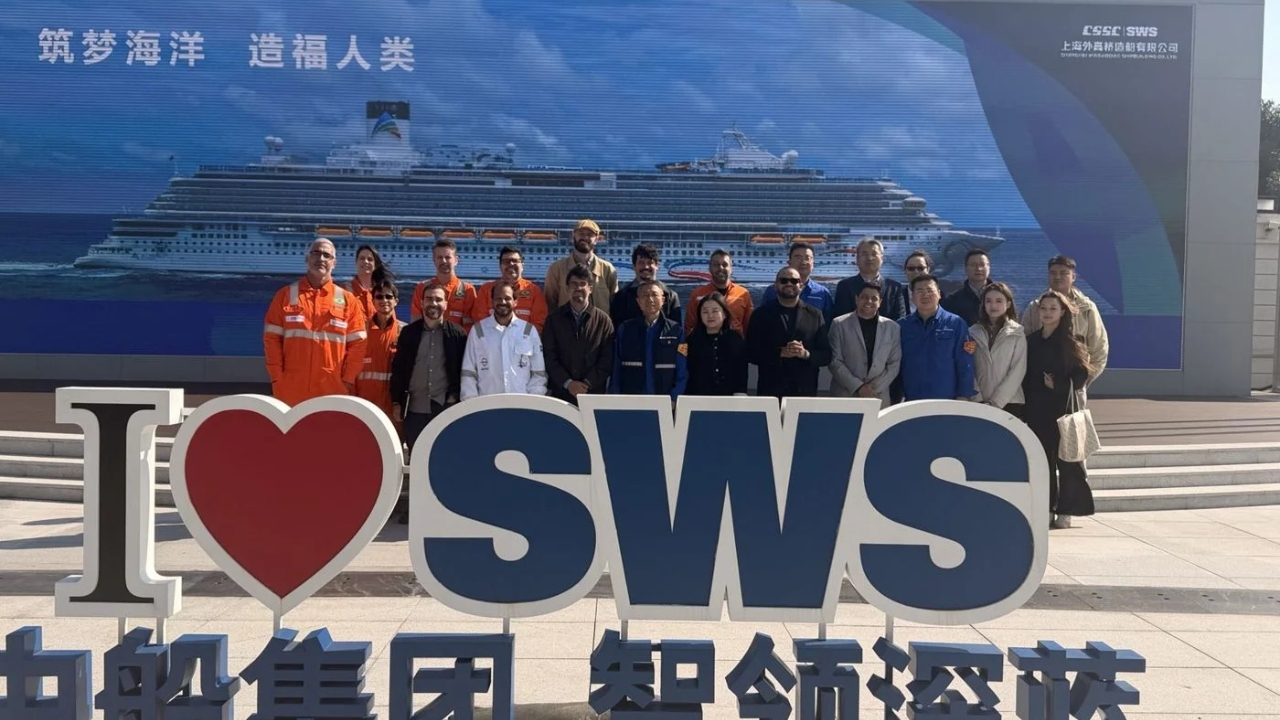
Founded in 1999 and affiliated with state-owned China State Shipbuilding Corporation (CSSC), SWS shipyard builds large merchant vessels and offshore units, including floating production, storage and offloading (FPSO) units.
The agenda also included visits to companies in the CIMC group, which specialize in industrial equipment. In Qidong, the Brazilian delegation saw automation and digital monitoring solutions, as well as systems used to transport and store gases.
These technologies matter to Brazil’s supply chain because building ships and platforms requires equipment that can operate in harsh conditions and meet strict safety, traceability and quality-control requirements.
Petrobras expands investment portfolio to US$122 billion
Days after the mission ended, Petrobras approved its 2027–2031 Business Plan on November 23. The plan calls for US$122 billion in investment, including US$113 billion in projects under development and US$9 billion in projects under evaluation.
In oil and gas exploration and production, the plan includes the start-up of nine new production systems, eight of which have already been contracted. Logistics and marketing are slated to receive US$7 billion in investment over the five-year period.
The portfolio includes initiatives to renew the coastal shipping fleet and new contracts for offshore support vessels. These are opportunities for manufacturers of structures, equipment, engines and electrical systems, as well as companies specializing in the maintenance of offshore assets.
Transpetro has already contracted R$2.8 billion for domestically built vessels
The Mar Aberto Program offers a concrete example of how orders can reach Brazilian shipyards. In January 2026, Transpetro and Petrobras signed contracts worth approximately R$2.8 billion for five gas carriers, 18 barges and 18 pushboats.
The vessels will be built at shipyards in Rio Grande do Sul, Amazonas and Santa Catarina. The companies said they expect the contracts to generate more than 9,000 direct and indirect jobs.
Financing also plays an important role in the industry’s recovery. Brazil’s Ministry of Ports and Airports said the Merchant Marine Fund had accumulated R$17 billion in contracted financing since 2023, while projects approved for priority status during the period totaled R$112.3 billion.
Búzios platforms show how industrial integration works
The P-80 and P-82 platform projects illustrate how construction can be spread across different countries. Contracted by Petrobras for the Búzios field, the two units underwent construction stages in Brazil, China, Indonesia and Singapore.
According to Petrobras Agency, process modules for P-80 were built at the Seatrium BrasFELS shipyard in Angra dos Reis, in Rio de Janeiro state, while structures for P-82 were built at the Seatrium Aracruz shipyard in Espírito Santo state.
Final integration took place at Tuas Boulevard Yard in Singapore. Each platform will have a nameplate capacity of 225,000 barrels of oil per day and will be able to process 12 million cubic meters of gas daily, with production expected to begin in 2027.
The mission to China adds a commercial outreach component to this industrial model. After the meetings, organizers moved on to consolidating business contacts and assessing potential partnerships for projects in the Brazilian market.