Portuguese
 Spanish


Developed for public safety and emergency response professionals, the rugged smartphones are part of a project that has already unified five previously isolated communications networks in Brazil’s Federal District. The devices are built to withstand impacts, water and harsh environmental conditions.
Brazil’s Spectrum Management Entity (EAF) ordered 1,000 rugged smartphones for use on the Private Mission-Critical Mobile Network, a telecommunications infrastructure designed to connect public safety, defense and emergency response teams.
The devices are expected to be delivered and testing to begin in the first half of December in Brasília, according to information published by EAF.
-
From 44-kWh modules to 440-kWh packs, BorgWarner plans battery assembly in Piracicaba with projected capacity of 5,000 units a year

-
Astronomer Julien Wolf and his team used Euclid to find a quasar seen just 630 million years after the Big Bang, powered by a black hole of about 360 million Suns that puts pressure on models of how the first giants grew

-
Planetary scientist Sabina Raducan says the crater NASA’s DART left on the 151-metre asteroid Dimorphos is almost as large as the rock itself, as ESA’s Hera finds it tumbling among hundreds of boulders
-
Space station installs its eighth and final roll-out solar array, raising power-generation capacity from 160 to about 215 kW; NASA astronaut Anil Menon’s spacewalk lasted 6 hours, 59 minutes




One model slated for the operation is the Motorola LEX L11, which combines cellphone and two-way radio functions and has physical controls designed for professionals working in the field.
How a cellphone can also work as a two-way radio
The voice communication feature activated by a physical button is known as Push-to-Talk (PTT), an English phrase meaning “push to talk.”
Unlike a conventional phone call, the system lets a professional transmit voice messages to the communications group set up on the device, using a format similar to that of traditional two-way radios.
The side button eliminates the need to open an app or navigate the screen to start a transmission.
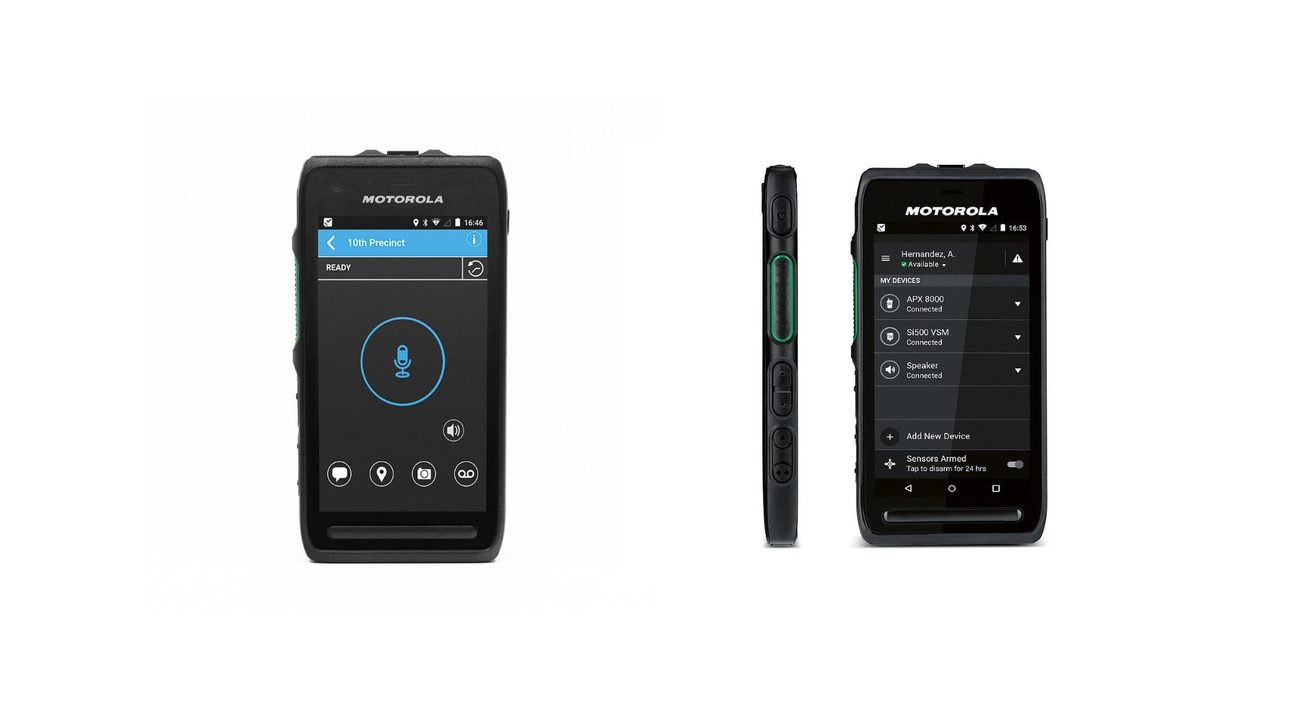
By combining voice and data services in one device, the handset can also run work-related apps and access other digital resources through the communications infrastructure.
EAF’s goal is to give professionals the option of using a single device for these activities without requiring agencies to replace the two-way radios they already own.
Motorola LEX L11 and durability testing
Rugged smartphones are designed to withstand impacts and environmental conditions that can impair conventional cellphones.
One of the physical tests described by EAF for the Motorola LEX L11 involves dropping a 130-gram steel ball onto the five-inch screen from a height of 50 centimeters.
The procedure evaluates the screen’s resistance to the direct impact of a rigid object, while other features of the device address exposure to extreme temperatures and salt spray.
The model also has physical controls for switching between communication groups without requiring users to look at the device, as well as features designed to suppress acoustic interference during transmissions.
Specifications vary among the rugged smartphones presented by the organization, including models designed to withstand submersion in up to two meters of water for one hour.
The advertised features include speakers capable of exceeding 100 decibels, noise-canceling systems and high-capacity batteries that can be replaced in certain devices.
Technology connects five communications networks in Brasília
The smartphone order follows the integration of five radio communications networks that operated separately in the Federal District and used technologies that did not allow their equipment to communicate directly.
To connect these systems, EAF deployed a mission-critical platform linked to converter equipment known as gateways.
These devices receive signals from existing two-way radios and convert them into a data format compatible with the new infrastructure.
With this integration, a professional equipped with a conventional two-way radio can communicate with another using a smartphone, as long as both are connected to the platform.
The system makes it possible to continue using equipment previously acquired by the agencies, adding the new terminals without requiring a full replacement of the existing radio communications infrastructure.
Converting the signals also makes it possible to use different internet access technologies, including Wi-Fi, mobile networks and satellite connections, depending on connectivity availability.
Private network is part of 5G auction commitments
Development of the Private Mission-Critical Mobile Network is part of the commitments set out in the terms of Brazil’s 2021 5G auction. EAF is overseeing deployment, with monitoring by the National Telecommunications Agency (Anatel), Brazil’s telecommunications regulator.
The initiative is part of a broader telecommunications project for the federal government, which also includes the deployment of a fixed fiber-optic network in all 27 Brazilian state capitals.
The Ministry of Communications said the mobile network was officially unveiled in June this year and is undergoing an operational validation phase scheduled to last 12 months.
The infrastructure connects the operational centers of the Military Police of the Federal District, the Brazilian Army, the Federal Senate and the Chamber of Deputies.
For a second phase of the project, EAF plans to implement communications-prioritization mechanisms to preserve contact among security teams when public mobile networks are congested.
As data services on LTE and 5G networks expand, the organization plans to add image sharing, real-time video transmission and access to location maps during operations.