Portuguese
  Spanish


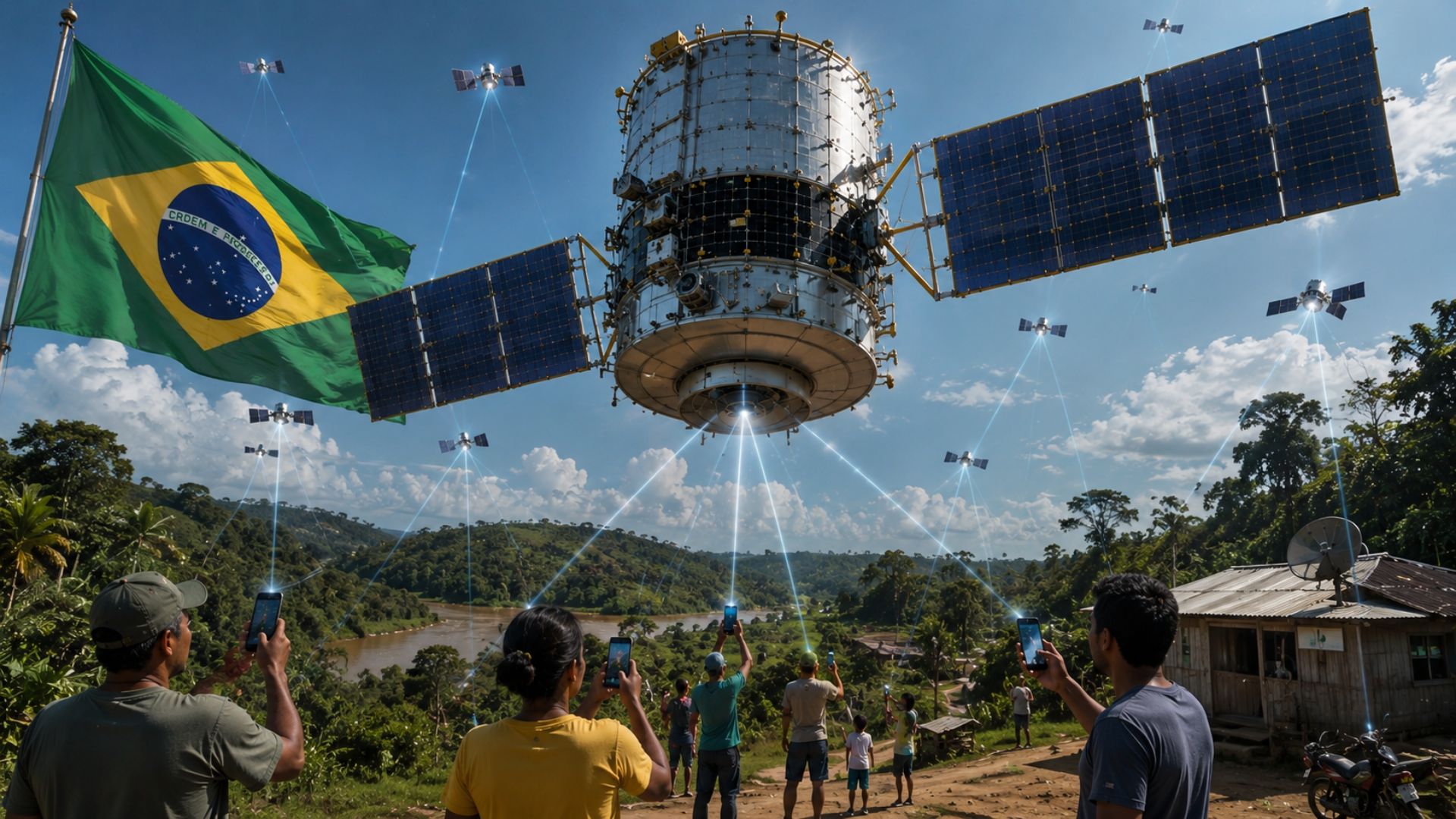


Satellite internet technology that delivers connection directly to cell phones, without routers or ground antennas, attracts billion-dollar investments from global giants and positions Brazil as one of the priority markets for the next phase of sector expansion.
The satellite internet market is undergoing an unprecedented transformation, with the largest technology and telecommunications companies on the planet investing tens of billions of dollars to dominate the technology known as direct to device, or D2D, which allows fast connection directly to cell phones.
Unlike the previous generation, which marketed satellite internet as a kind of fixed broadband and relied on routers installed on the ground, D2D eliminates this need, offering direct connectivity to cell phones, tablets, and computers anywhere on the planet.
The technology has the potential to reach remote areas that traditional operators never covered due to terrestrial infrastructure limitations, as well as becoming a strategic solution in emergency situations and natural disasters when the conventional network suffers severe interruptions.
-
China Builds World’s Largest Power Grid, Generating Enough Energy to Supply 15 Times Brazil’s Needs, Surpassing the US, EU, and India Combined

-
Brazil’s First 3D-Printed House Built in 30 Hours with Two Operators and 20% Lower Costs

-
Parker Solar Probe Discovers High-Speed Dust Grains Near the Sun, Offering New Insights into Solar Corona’s Mysteries
-
Google Revives Historic Hangar for Cutting-Edge Tech in Silicon Valley: Once Built for a “Flying Aircraft Carrier,” Now a Hub for Drones and Robotics


Amazon led one of the largest recent deals in the sector by closing the purchase of Globalstar for US$ 11.6 billion, equivalent to about R$ 58 billion, an acquisition that allows the company to offer direct internet connections for cell phones and other mobile devices.
On the other hand, Starlink, a satellite internet company founded by Elon Musk, consolidated its position by completing the purchase of Echostar for US$ 17 billion, approximately R$ 90 billion, a transaction that includes strategic frequencies for D2D in several countries, including Brazil.
Brazil on the route of major investments in D2D
In Brazilian territory, two companies lead the race for the direct satellite internet market: AST Space Mobile, based in Texas and listed on the Nasdaq stock exchange, which recently obtained authorization from the National Telecommunications Agency to operate in the country.
The other is Starlink itself, which filed a formal request with Anatel in February to operate in the D2D segment in Brazil, reinforcing Elon Musk’s company’s interest in expanding its presence in the lucrative national telecommunications market.
According to AST’s Head of International and Regulatory Affairs, Rodrigo Gebrim, the company has opened its office in São Paulo and is already in advanced talks with local operators to establish commercial partnerships before launching services to the Brazilian public.
The business model of the two companies will be based on partnerships with local operators, complementing the mobile internet offering in regions with little coverage, without directly competing with the traditional telecoms that already operate in the Brazilian telecommunications market.
In the United States, AST Space Mobile has already made agreements with giants like AT&T and Verizon, while in Europe it works with Vodafone, operators that saw so much potential in the business that they became shareholders of the American company.
Network Expansion and Prospects for the National Market
To enable uninterrupted global coverage, AST Space Mobile plans to reach 45 satellites in orbit by the end of 2026, expanding the constellation to 90 units by the end of 2027, which will make it possible to launch commercial internet plans.
Around the world, more than a dozen countries already operate with D2D services, although most are still in an experimental phase, as the current coverage still does not allow continuous and uninterrupted connection for all users in all serviced regions.
According to Mauro Wajnberg, president of Abrasat, the technology is moving from an experimental stage to something genuinely commercial, with more than a dozen countries already using D2D and a global dynamic that changes rapidly every quarter in the sector.
The president of Anatel, Carlos Baigorri, emphasized that the continental size of Brazil makes it impossible to provide terrestrial coverage for the entire territory with only conventional infrastructure, advocating D2D as a strategic solution to solve the historical problem of national connectivity.
In the assessment of Juliano Stanzani, Director of Regulatory Policies at the Ministry of Communications, the technology can reach remote communities and be applied in connectivity policies for public agencies, military applications, civil security, and federal highways spread across the country.
Stanzani also highlighted that encouraging competition among D2D providers is a way to ensure digital sovereignty for the public sector, which will have more supplier options and will not be dependent on a single player for strategic national connectivity services.
The government’s perspective is that digital inclusion in hard-to-reach regions, historically marginalized by traditional operators, will be accelerated by the arrival of D2D on a commercial scale, bringing connection to populations that have never had reliable access to mobile internet.
The sector’s advancement is also expected to positively impact the telecommunications job market, with the creation of specialized jobs in the operation, maintenance, and technical support of these new networks, as well as stimulating the development of applications and digital services adapted to the new infrastructure.