





 Portuguese
  English
  Spanish
  7 min of reading
  0 comments


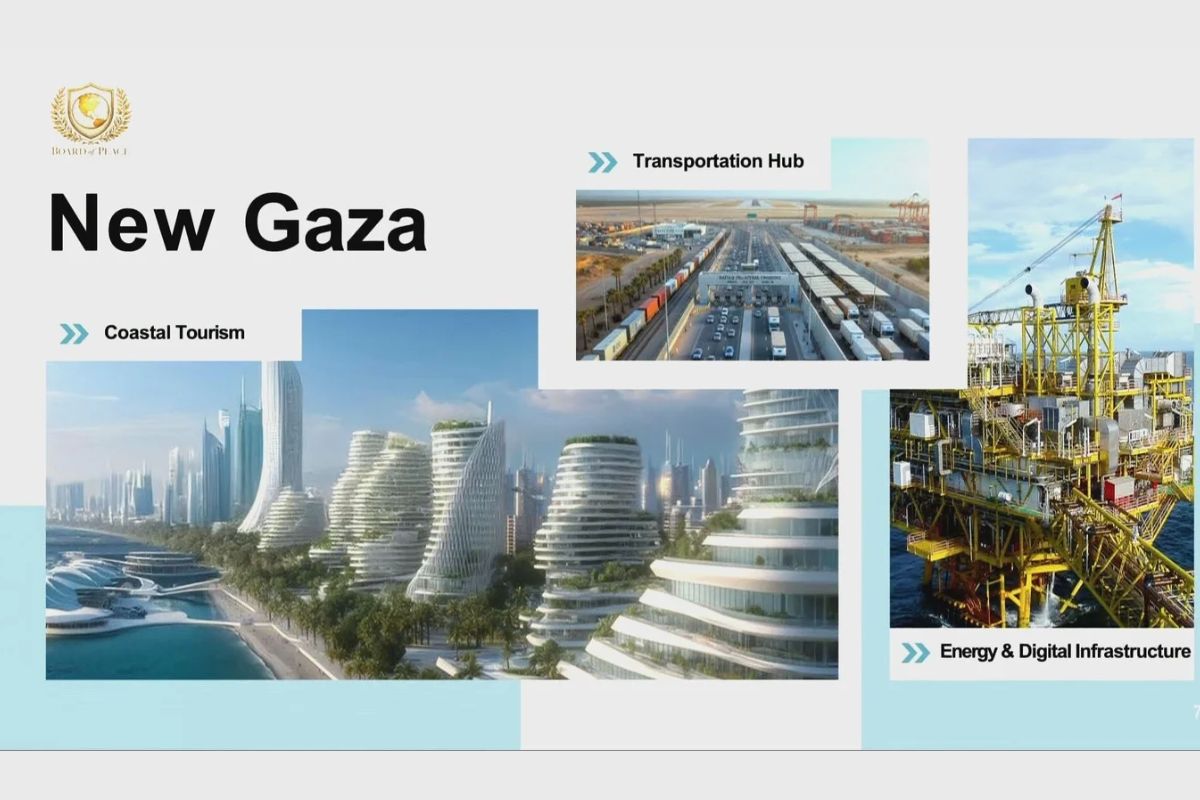
Presented in Davos as a 32-slide PowerPoint, the Sunrise Plan sells the idea of Trump’s New Gaza as a Middle Eastern riviera, with luxury resorts, high-speed trains, and a smart city rebuilt in 20 years, at a cost of 112 billion dollars.
Behind the futuristic images, however, are 68 million tons of rubble, armed tunnels, contaminated soil, and unexploded bombs scattered throughout the Gaza Strip, in addition to a condition deemed non-negotiable by Washington: the complete disarmament of Hamas. Without this, the New Gaza of Trump remains just a slide vision, far from becoming concrete, steel, and real jobs.
From October 7 to the Vision of Trump’s New Gaza
On October 7, 2023, Hamas invaded Israel, killed over a thousand people, kidnapped hundreds of civilians, and triggered a war that, in two years, led to the near-total destruction of the Gaza Strip’s infrastructure.
Entire neighborhoods were devastated, hospitals collapsed, power grids failed, and the territory turned into a mosaic of ruins.
-
Spain challenges the USA and closes its airspace for operations against Iran, raising global tension and provoking the threat of a trade rupture.

-
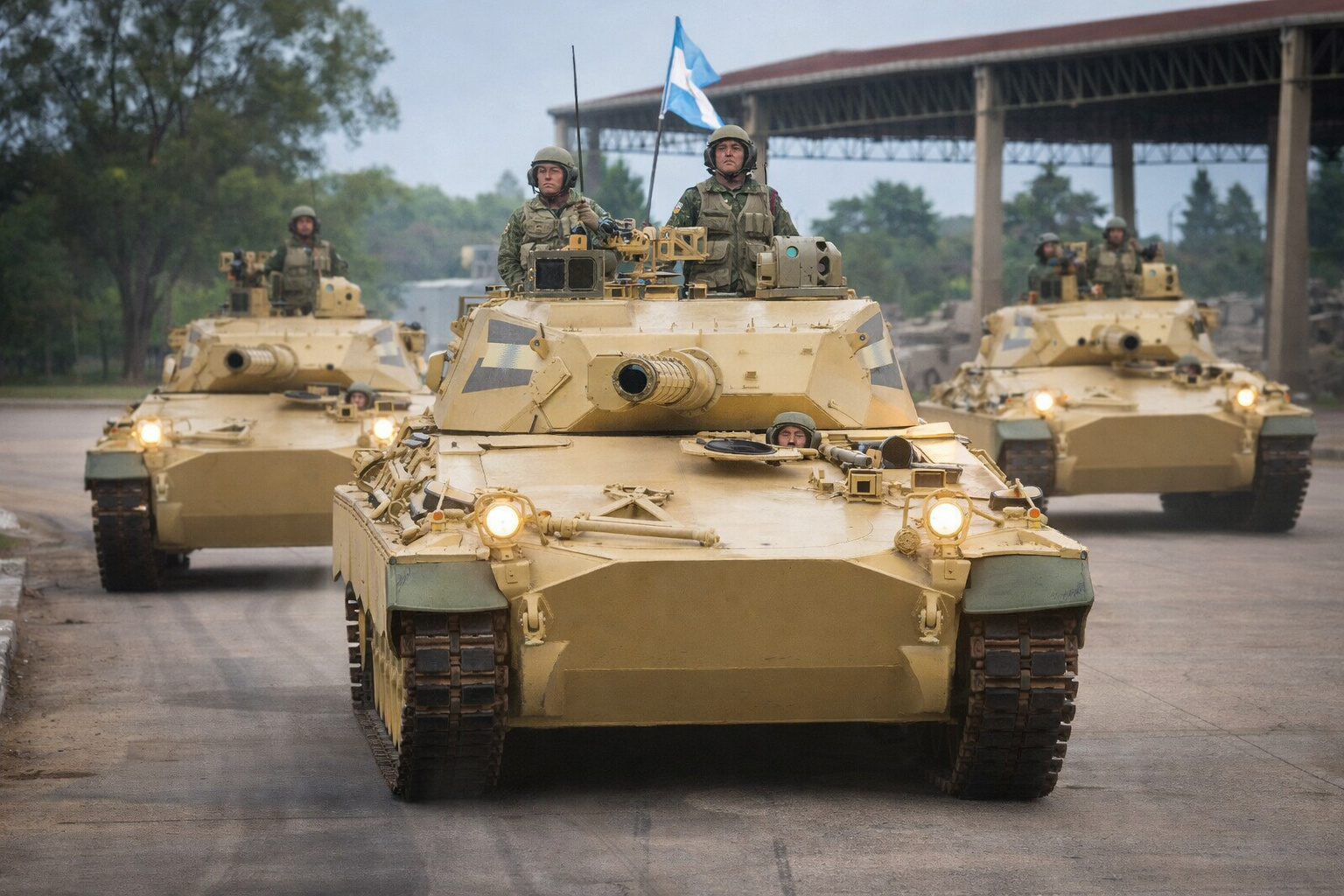
While no other country manufactures tanks in Latin America, Argentina activates the TAM 2C-A2 and raises a curiosity about the technological lag in the region.
-
A Russian ship with 730,000 barrels of oil has just arrived in Cuba while Mexico negotiates fuel sales through private companies: the communist island is desperately seeking alternatives after losing its supply from Venezuela due to American military action.

-
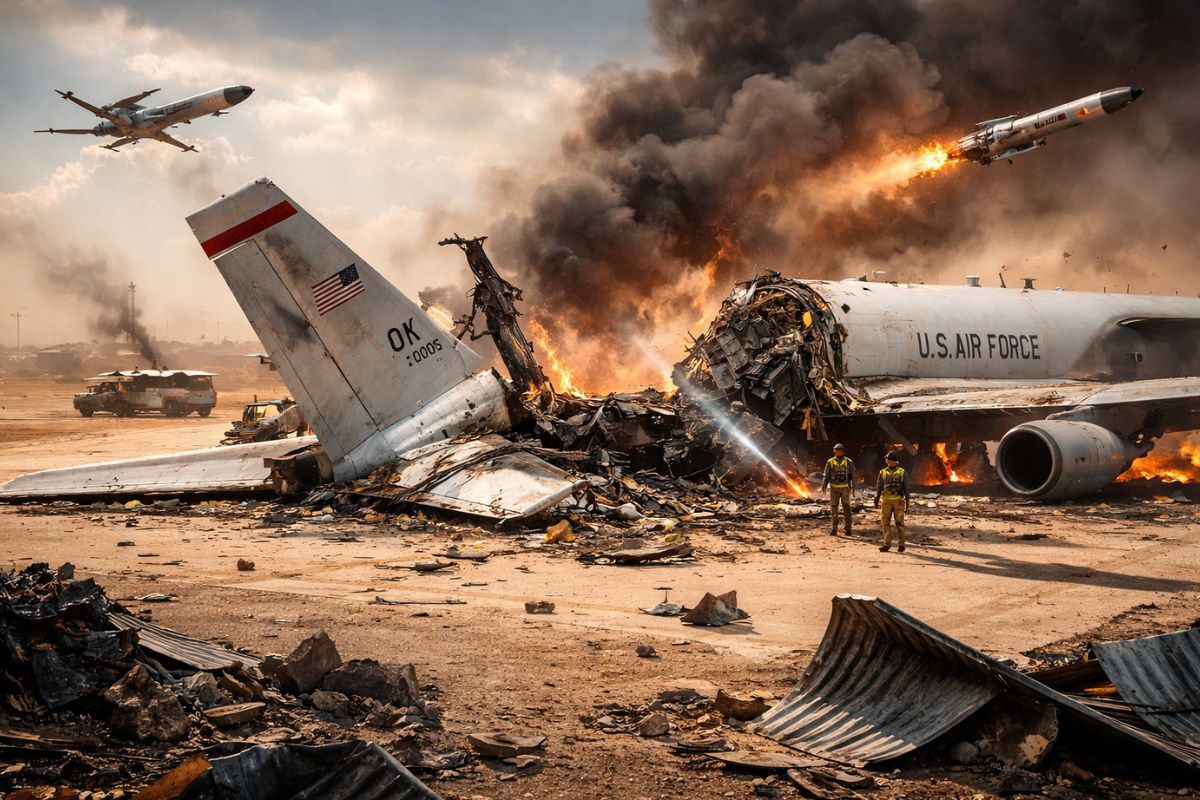
Iranian drones and missiles destroyed a 270 million dollar American spy plane in Saudi Arabia, splitting the E-3 Sentry aircraft in half and injuring 12 military personnel in an attack that exposes the vulnerability of U.S. bases in the Persian Gulf.

In October 2025, a broader ceasefire was finally signed, including the release of the last surviving Israeli hostages. It is in this context that the Trump administration, in coordination with allies, begins to sketch out a reconstruction plan.
The New Gaza of Trump is born as a political, economic, and symbolic response to show that after the devastation, there would be a future project.
What The Sunrise Plan Promises to Build
The Sunrise Plan is the official packaging of the New Gaza of Trump. It is a project divided into four geographical phases over more than 20 years, with a “smart city” narrative by the sea.
The document, developed by Jared Kushner in partnership with the envoy to the Middle East, Steve Witkoff, was presented in Davos in PowerPoint format. It proposes to convert the Gaza Strip into a kind of Middle Eastern riviera, with:
Luxury resorts on the coast, high-speed trains, power grids optimized by artificial intelligence, and a new administrative capital designed to symbolize modern governance and economic prosperity.
The idea is for the New Gaza of Trump to leave behind the image of an enclave surrounded by walls and become a showcase of technology, tourism, and services.
68 Million Tons of Rubble, Tunnels, and Bombs
Before any glass skyscraper or seaside resort, the Sunrise Plan recognizes a monumental foundational problem: the Gaza Strip is buried under ruins, bodies, and unexploded ordnance.
Among the initial challenges, the document cites:
- About 68 million tons of debris
- Thousands of bodies still buried
- Toxic soil, contaminated by war and sewage
- Unexploded bombs and explosive devices
- A network of Hamas tunnels spread throughout the underground
The first phase of the New Gaza of Trump is not glamour, but rather cleanup and security. The priority would be to remove debris, neutralize explosives, deactivate tunnels, and try to make minimally habitable an area that has been under intense bombing for years.
In the meantime, about 2 million displaced Palestinians would depend on temporary shelters, field hospitals, and mobile clinics until permanent structures began to be erected.
Phases of Trump’s New Gaza: From Rafah to the City of Gaza

The timeline of the Sunrise Plan is divided into four geographical phases, moving from south to north in the Gaza Strip.
In the initial stage, the focus is on Rafah and Khan Yunis in the south. Here, the first major planned reconstruction experience would take place.
Only after would the work advance to the central camps and finally to the north, in the city of Gaza, traditionally seen as the capital of the enclave.
The first city to be rebuilt would be Rafah, at the border with Egypt. According to the plan, the New Gaza of Trump would transform Rafah into a new governance center, with:
- Capacity for over 500,000 residents
- About 100,000 housing units
- Administrative structures, schools, hospitals, and religious spaces
In the PowerPoint images, the new Rafah appears with coastal skyscrapers, wide avenues, green zones, and a coastline filled with tourist developments.
It is a utopian vision that brutally contrasts with the real scenario of rubble that dominates the region today.
Who Pays The Bill For The 112 Billion Dollars
The total estimated cost of the Sunrise Plan is around 112 billion dollars over 10 years, including public sector salaries and humanitarian needs associated with the transition.
Of that amount, the plan anticipates something like 60 billion dollars coming from international donations and the issuance of new debt, with the United States acting as an anchor.
Washington would commit to about 20% of this support, equivalent to approximately 24 billion dollars in guarantees.
The World Bank would appear as a financial partner, helping structure loans and lending credibility to the project. The idea is that, after the first years of heavy investment, the New Gaza of Trump would begin to stand on its own.
According to the PowerPoint projections, Gaza would start to monetize about 70% of its coastal area by year 10, with a return on investments that could exceed 55 billion dollars in the long term, driven by:
Local industries, services, tourism, and even the possibility of transforming the New Gaza into a tax haven, targeting international capital in search of tax advantages.
Kushner, Businesses, and The Political Engineering of Trump’s New Gaza
Jared Kushner, Trump’s son-in-law, does not come to the New Gaza of Trump as a novice in real estate ventures.
He has already managed the family empire in the sector, founded an investment firm, raised almost 4 billion dollars from Middle Eastern sovereign funds, and invested in resort projects in locations like the Albanian island of Sazan.
In the Sunrise Plan, Kushner sees a dual opportunity: to reposition Gaza as a success story of reconstruction and, at the same time, to create a large economic project with strong participation from private capital and funds from the region.
The Abraham Accords, negotiated by him during Trump’s first term, are often cited as proof that unlikely realignments in the Middle East are possible.
The New Gaza of Trump is presented as the next big step in this logic of turning enemies into economic partners.
Non-Negotiable Condition: Complete Disarmament of Hamas


Despite the models and graphs, the entire plan rests on a central condition: the total disarmament of Hamas and the complete renunciation of power in the Gaza Strip.
The Sunrise Plan is part of a three-phase peace roadmap:
- Phase 1: ceasefire, release of hostages, and negotiation of basic terms
- Phase 2: complete withdrawal of Israel from the Gaza Strip after Hamas lays down arms and relinquishes political control
- Phase 3: effective start of reconstruction and implementation of the New Gaza of Trump
As of the point described in the base, the process would still be stuck in the initial phase, with pending matters regarding the delivery of hostages’ bodies and, primarily, on the issue of demilitarization.
Hamas has repeatedly stated that it does not intend to disarm, making this condition an almost insurmountable obstacle.
Without this guarantee, no long-term construction, no luxury resort, and no high-speed train is sustainable. Investors do not put billions into an area where the possibility of another war in two or three years remains high.
Skepticism, Risks, and The Abyss Between Slides and Reality
Security experts and economic analysts are divided between viewing the New Gaza of Trump as a necessary dream or as a promise too distant from reality.
On one side, critics openly state that Hamas will not disarm and that, without this, the Sunrise Plan is just a set of well-produced slides.
Others question the economic viability, recalling that transforming a recurrent conflict zone into a tourist and service hub requires stable security, political predictability, and long-term trust, conditions Gaza has not seen for decades.
Officials like Secretary of State Marco Rubio emphasize that no one will invest heavily if they believe the conflict could return in a few years. For these skeptics, the geopolitical risk undermines any projection of financial return.
On the other hand, supporters of the plan insist that leaving Gaza submerged in ruins and humanitarian crisis is a recipe for the emergence of new extremist groups.
In their view, the New Gaza of Trump would be more than a real estate project: it would be an attempt to change the logic of the region, replacing despair with economic perspective.
New Gaza of Trump: Bold Vision, Minefield
In the end, the New Gaza of Trump tries to be many things at once: a reconstruction plan, a security strategy, an economic experiment, and a political gesture to show leadership in the post-war period.
The ambition is undeniable. The question is whether the geopolitical reality, the willingness of regional actors, and the behavior of Hamas will allow something close to what is in the Davos slides to start to materialize.
The recent history of the region shows that grand promises often clash with hard facts on the ground.
For now, the Sunrise Plan is a synthesis of this contradiction: a Middle Eastern riviera designed on a map that, in practice, is still dominated by rubble, buried bombs, and mutual distrust.
And you, looking at the current scenario, do you think the New Gaza of Trump has any real chance of leaving the PowerPoint and becoming a real city or is this project doomed to remain forever in the world of ideas?






-

-

3 pessoas reagiram a isso.