





 Portuguese
  English
  Spanish
  3 min of reading
  0 comments


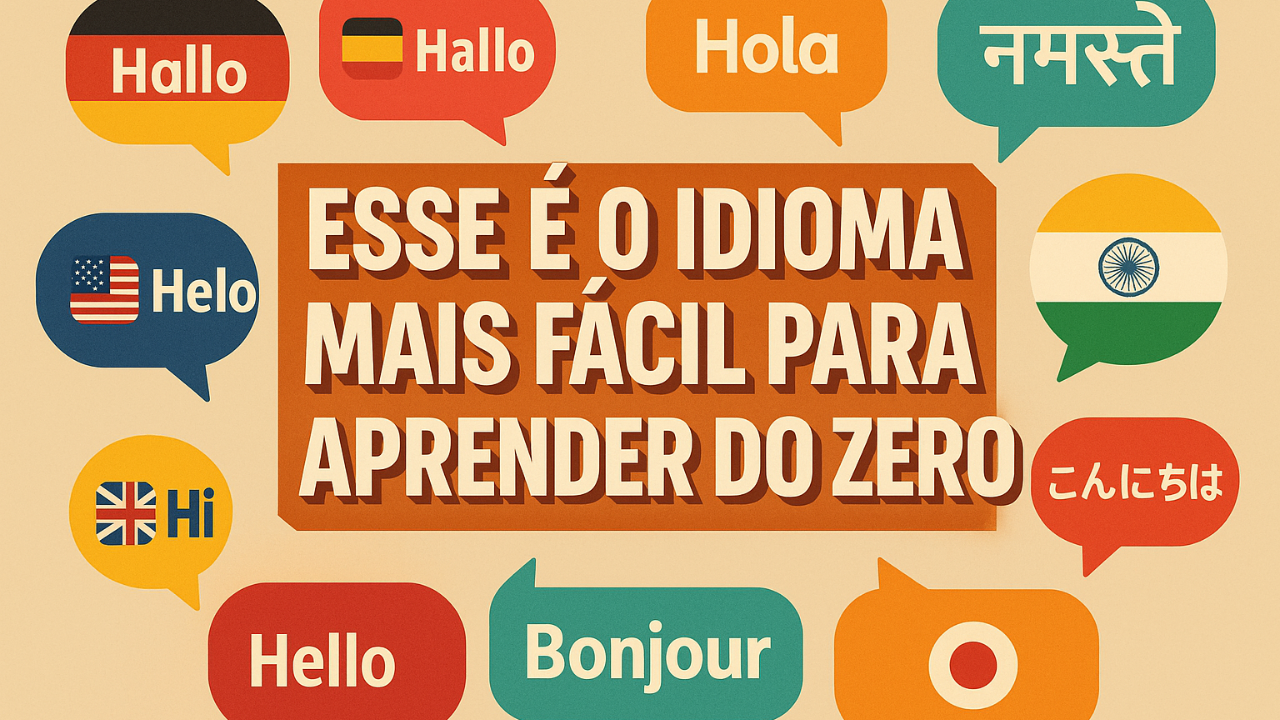
Ranking Reveals The 6 Easiest Languages To Learn For Brazilians — And The First May Surprise You.
When choosing a new language to study, many Brazilians wonder: what is the easiest language to learn? The answer may surprise you. According to experts from Unbabel, Afrikaans, a language spoken in South Africa and Namibia, tops the ranking of simplest languages for beginners.
This recognition is not by chance — the streamlined grammatical structure and similarities to other Germanic languages make it a great option for those wanting to start from scratch.
Afrikaans: The Easiest Language To Learn
Although not as popular as English or Spanish, Afrikaans proves to be highly accessible, especially due to its simplified grammar.
-
(Video): Italian pilot lands plane on moving train at 120 km/h and achieves unprecedented feat in aviation, even with a narrow runway and without direct visual contact.

-
It seems to have come out of a science fiction movie: A Brazilian city where it rains almost every day, recording over 4,000 mm per year, driven by climatic factors — a direct result of its strategic location in the Amazon.

-
The water crisis that could change everything this year has already begun; it’s not just about the climate, it affects technology, raises product prices, and can halt entire companies without warning.

-
A Japanese mason transforms raw granite into small cups and handcrafted utensils, collects giant stones, cuts with precision, and impresses with detailed manufacturing and finishing.


The language does not require complex verb inflections, does not change verbs according to the subject, and uses only three verb tenses: past, present, and future.
Additionally, its Western Germanic origin, close to Dutch, makes it easier to learn for those who already have some exposure to European languages.
Approximately 9 million people speak Afrikaans, making it culturally relevant in the southern part of the African continent.
The absence of verb conjugation and the straightforward structure make the language quicker to master than other traditional European languages.
Spanish: Easy Pronunciation and Regional Utility
Spanish stands out among Brazilians due to its similarities with Portuguese.
With a phonetic pronunciation and Latin roots, learning Spanish is usually a quick process. Words like escribir, conocer, and escuchar are easily recognizable to native Portuguese speakers.
Although the grammar requires attention to verb tenses and gender usage, Spanish offers the advantage of being widely spoken in neighboring countries, increasing its practical utility in Latin America.
French: Familiar Vocabulary, But With Traps
Also derived from Latin, French shares a lot of vocabulary with Portuguese.
However, the grammar includes more complex rules for conjugation and gender usage, which can be a challenge for beginners.
Moreover, false cognates (words that look similar but have different meanings) require extra attention.
Despite this, being spoken in over 30 countries and representing an influential culture, French remains one of the most sought-after languages by Brazilians.
Italian and Dutch: Familiar Sounds and Friendly Structures
Italian is often chosen by Brazilians for its pleasant sound and familiarity with Portuguese.
The grammar is more regular than French, and the pronunciation is clear and phonetic, which facilitates learning.
Dutch, on the other hand, surprises with its structure similar to English and being simpler than German.
Primarily spoken in the Netherlands and Belgium, it is a viable alternative for those who already have some background in Germanic languages.
Norwegian: Scandinavian Simplicity
Less spoken in the world, Norwegian attracts with its straightforward structure: verbs do not change with the subject and there are few definite articles.
A bonus is that learning Norwegian aids in understanding Swedish and Danish, due to the proximity between the Scandinavian languages.
And What About English?
Although Afrikaans holds the title of easiest language to learn according to technical criteria, English remains the most sought-after language for those wishing to learn a new tongue.
With a wide presence in movies, music, social media, and corporate environments, English offers constant exposure and multiple practice opportunities, speeding up the learning process.
Its grammar is not the simplest, but everyday familiarity with the language — especially among Brazilians — makes English one of the most natural choices for beginner students.
Additionally, its vocabulary is widely used in other languages, including Portuguese.
Choice Depends On Your Goal
When deciding which language to learn, it’s important to consider not only grammatical ease but also your goal with the new language: travel, career, culture, or immigration.
While Afrikaans may be the technically easiest language to learn, English still reigns as the most functional in the modern world.
With information from the site Concursos no Brasil










-

-

-

4 pessoas reagiram a isso.