





 Portuguese
  English
  Spanish
  5 min of reading
  0 comments


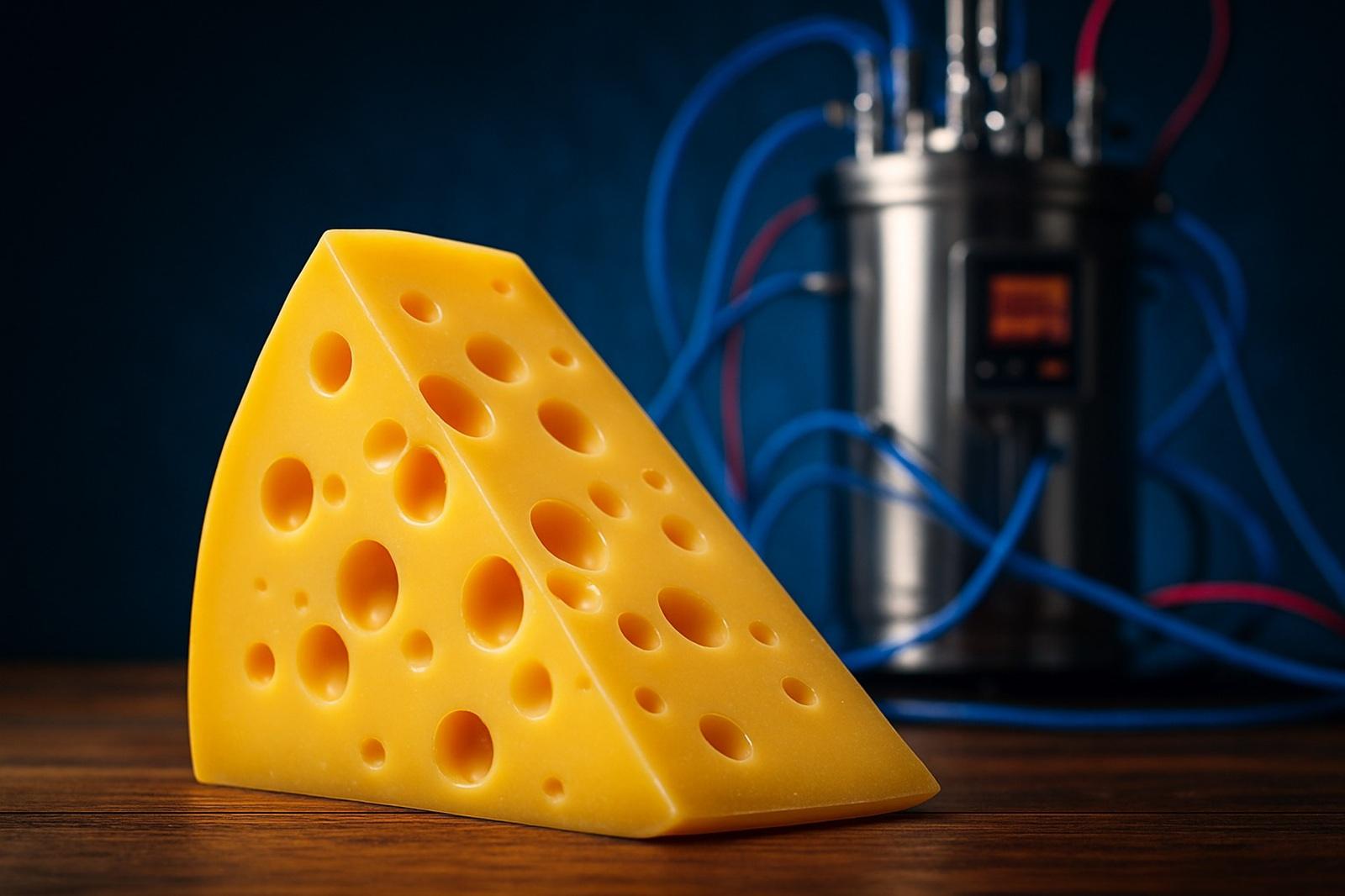
Nutropy Develops Animal-Free Casein to Create Powdered Milk Capable of Producing Cheeses, Yogurts, and Ice Creams with the Flavor and Texture of Traditional Dairy, Focusing on Precision Fermentation and Sustainable Industrial Scalability
France has decided to boost a new generation of dairy proteins by supporting the production of non-bovine casein. The startup Nutropy, founded in 2021, plans to launch a functional powdered milk in 2027 capable of producing fermented cheeses using ingredients that do not rely on animals.
This initiative marks an important technological advance because it offers an alternative to traditional dairy while meeting sustainability and industrial efficiency demands.
Nutropy has managed to raise 7 million euros to develop this project. According to the company, the produced casein will be identical to that found in cow’s milk, but made through biotechnological processes.
-
Mysterious object on Mars divides NASA and Harvard after Curiosity image reignites suspicions about what was really found on the planet.
-
Giant structures 14 meters beneath Egypt are revealed by satellites and expose a millennia-old secret buried in Buto.

-
Children have been making clay pieces for 15,000 years in Southwest Asia, and fingerprints preserved on 142 ornaments helped archaeologists prove this.
-
New semi-autonomous legged robot technology challenges the limitations of space exploration by operating almost without human intervention on the Moon.

The focus is to deliver a functional substitute for real cheeses without the need for livestock farming, eliminating waste such as whey and enabling cleaner industrial scalability.
The commercial objective extends to markets such as Europe, North America, Asia, and the Middle East, regions where dairy consumption and environmental concerns grow simultaneously.
Precision Fermentation as the Basis for Innovation
The startup has joined a small, yet growing group of companies that use precision fermentation to produce animal-free proteins. This process follows a logic similar to beer production because it utilizes genetically modified microorganisms to generate specific ingredients.
In the case of Nutropy, these microorganisms receive sugars and nutrients in bioreactors to excrete casein proteins directly into the broth.
The company did not disclose the microbial strain used but indicated that it works with first-generation raw materials and intends to incorporate more sustainable materials in the future, such as agricultural waste or industrial by-products.
This strategy represents a relevant differentiation compared to plant-based products, which still face challenges in replicating the flavor, texture, or melting characteristics of cheese.
With this approach, Nutropy seeks to fill an important gap because many plant alternatives fail to reproduce essential properties of traditional dairy.
The protein obtained via precision fermentation promises to deliver results closer to the original product.
Functional Casein in the Right Measure
Cow’s milk contains four types of casein that form micelles, small spheres responsible for fundamental properties of cheese. Some companies attempt to replicate these four proteins in full, resulting in more expensive processes. Nutropy has adopted a different strategy by demonstrating that it does not need to reproduce all of them to achieve functional results.
According to Maya Bendifallah, the team identified an efficient combination that creates micelle-like structures and exhibits similar behavior to bovine milk. This choice reduces costs and accelerates scalability, even if the structures are not identical to the natural ones. The decision also allows meeting industrial demands without compromising the expected performance in texture, elasticity, or melting.
From the Laboratory to Culinary Use
After producing and extracting casein, Nutropy performs a functionalization process. This step, which remains confidential, defines characteristics such as texture, creaminess, and sensory profile. These properties will determine consumer acceptance of the product and its suitability for different uses.
The result is a powdered milk with cheese flavor, composed of casein and plant-based ingredients. When mixed with water, the product mimics cow’s milk behavior: it ferments, curdles, and melts, without generating by-products like whey, which is often problematic for the industry due to environmental issues.
The powdered format simplifies logistics and facilitates integration into existing production lines. Nutropy develops the product as a B2B ingredient, allowing manufacturers to create cheeses, yogurts, or ice creams without altering their infrastructure. This enables quick adoption, avoiding high adaptation costs.
Economic Path and Market Goals
The company understands it needs to achieve economic viability to compete with the current model. Therefore, the primary focus is to achieve price parity in the cheese segment, which has a higher concentration of casein. As the process is optimized, Nutropy plans to compete in other categories of dairy products.
Key markets are in Europe, North America, parts of Asia, and the Middle East. These regions combine strong demand for dairy with greater sensitivity to environmental issues. At the same time, projections indicate a global deficit of 30 million tons of milk by 2030, caused by a reduction in the number of producers. This scenario opens space for alternative solutions such as casein produced through fermentation.
Potential to Transform the Food Production Chain
Non-bovine casein goes beyond technological innovation. It represents a structural shift in how food can be produced. This alternative can significantly reduce the use of land, water, antibiotics, and methane emissions, all associated with animal farming.
The elimination of whey waste and the use of closed-loop processes also reinforce the sustainability of the proposal. For every kilogram of cheese produced with this technology, the environmental impact decreases, including a smaller climate footprint and greater energy efficiency.
In the short term, this solution can support countries facing water scarcity, high demand, or strong reliance on imports. In the medium term, it can bring dairy production closer to urban centers, reducing refrigerated transport and other energy-intensive stages.
Additionally, this technology allows rethinking the role of dairy in the diet. Products with flavor, texture, and functionality similar to traditional ones, but produced without animals, help maintain culinary traditions without the issues associated with the current model.
The Future of Nutropy and Its Challenges
Nutropy aims to scale up its production without losing focus on real impact. The proposal goes beyond protein manufacturing: it contributes to building a more resilient, efficient, and sustainable food system.
The challenge will be to maintain the balance between scalability, market access, and environmental commitment. If successful in meeting these goals, non-bovine casein could occupy an important space in the global transition to cleaner and more accessible food.








Seja o primeiro a reagir!