






 Portuguese
  Spanish
  4 min of reading
  1 comment





Announcement by Rosatom Describes Plasma Propulsion Technology in Electric Prototype, with Magnetic Accelerator, 300 kW and Thrust Close to 6 N, Aiming for 30 to 60 Days to Mars. The Next Step is a 14-Meter Vacuum Chamber, Critical for Validating the Promise Beyond the Laboratory.
The plasma propulsion technology announced by scientists from Rosatom, the Russian state nuclear company, rekindles the discussion about fast crewed trips to the Red Planet by promising to reduce the journey to Mars from almost a year to 30 to 60 days, based on an electric motor prototype.
The announcement, made on February 4, 2026, puts numbers and a testing schedule on the table, but still depends on verification outside the laboratory. If the performance chain holds in an environment that simulates space, deadlines, costs and biological risks could be rewritten, with direct geopolitical impact.
What Rosatom Claims to Have Achieved in the Prototype

Rosatom describes a plasma electric motor based on a magnetic accelerator, operating in a pulsed-periodic mode.
-
WhatsApp prepares messages that disappear after a single reading and tests on iPhone a feature that could change the way users send private, temporary texts that are harder to keep saved in conversations.

-
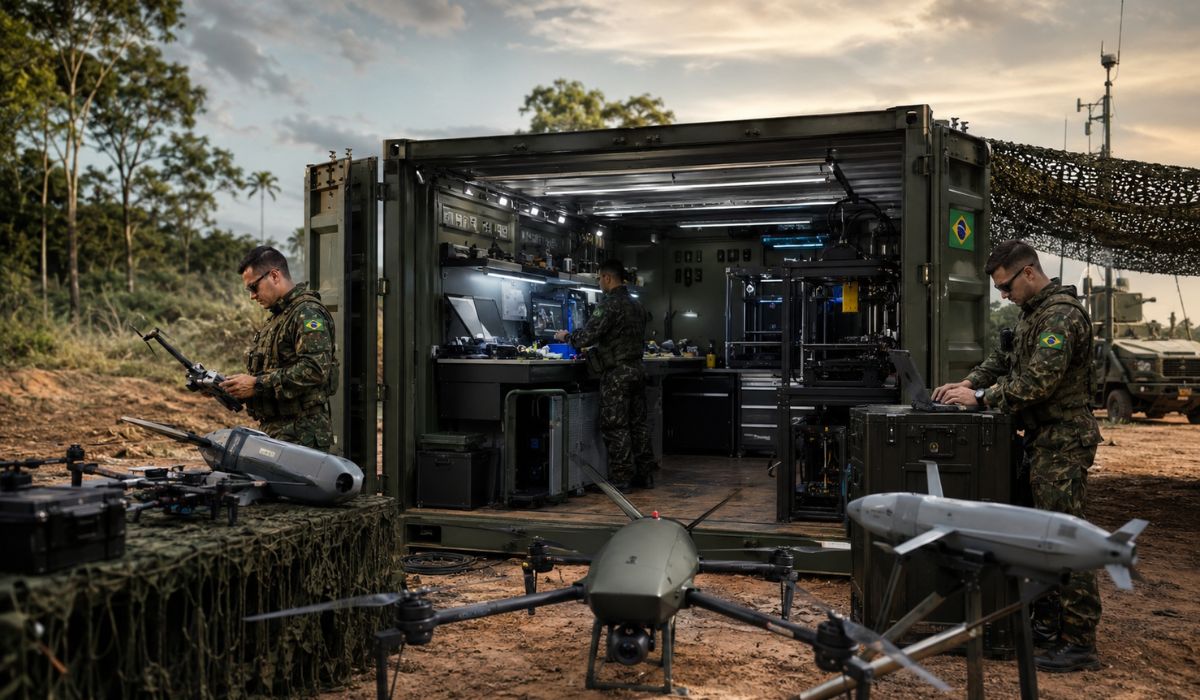
The factory that fits in a container: Brazilian Army wants to produce bomber and kamikaze drones on the front line with 3D printing, seeks partners to set up a mobile combat unit, and tries to shorten in Brazil the war logic that exploded in Ukraine.

-
Man creates homemade system with laptop batteries and reduces dependence on the power grid; the project has been operating since 2016 with reused batteries, 24 solar panels, and more than 10 kW.

-
China’s logistical rise raises an alert for Brazilian infrastructure: AI-driven ports handle 47 million TEU, Beijing invests R$ 285 billion in Africa and threatens up to US$ 60 billion of Brazilian agribusiness while Santos faces historical bottlenecks.



The ambition is clear: to transform plasma propulsion technology into a system capable of sustaining interplanetary trajectories with efficiency superior to chemical engines, which are currently the standard in Mars missions.
In the technical narrative presented, the prototype is a laboratory milestone that aims to make the leap to a controlled validation stage.
This detail changes the weight of the announcement: the promise of 30 to 60 days to Mars relies less on slogans and more on repeatable, instrumented, and comparable tests.
Power, Thrust, and Speeds That Redefine the Scale
In the parameters disclosed, the motor operates at an average power of 300 kilowatts and an estimated thrust of around 6 newtons.
Rosatom also claims that accelerated particles, such as electrons and protons, can reach speeds of up to 100 km per second, a figure that helps explain why plasma propulsion technology targets speed regimes unattainable by conventional chemical propulsion.
Even with flashy numbers, the reading needs to be careful: low thrust and continuous operation often go hand in hand in electric systems.
The central point is the accumulated acceleration time, and not an immediate “start,” which requires stable energy, thermal control, and spacecraft architecture compatible with long operating periods.
Why the Deadline to Mars Affects Health, Logistics, and Politics
The reduction in travel time is presented as a direct safety gain. Alexey Voronov, the first deputy director-general for science at the Rosatom Research Institute in Troitsk, states that a trip to Mars with conventional engines could take almost a year and that this is dangerous due to prolonged exposure to cosmic radiation, while plasma engines could reduce the journey to 30 or 60 days.
In practice, shortening the journey to Mars changes the mission’s engineering: less time for critical supplies, a smaller window for psychological wear, and the potential to reduce the accumulated radiation dose.
But the gain only materializes if the engine’s performance remains verified outside the laboratory, on real trajectories, with variables that do not appear in test benches.
The Vacuum Chamber as the Frontier Between Promise and Demonstration
To move from discourse to evidence, Rosatom says it is setting up a large-scale experimental structure.
The core of this stage is a vacuum chamber 14 meters long and 4 meters in diameter, designed to simulate deep space conditions and observe the motor’s operation in a controlled environment.
The vacuum chamber also serves to measure what typically undermines prototypes: plasma stability, component integrity, material behavior under prolonged operation, and compatibility with electrical power systems.
In other words, the vacuum chamber is the filter that separates physical viability from operational viability, a decisive step before any concrete planning for travel to Mars.
Nuclear Tugs and the Competition for the Next Space Infrastructure
Rosatom associates the development with possible applications in future spacecraft, including nuclear tugs, a concept that, in theory, combines energy generation at scale and electric propulsion systems to move payloads and modules over long distances.
If plasma propulsion technology matures, nuclear tugs could cease to be an abstract hypothesis and become part of the infrastructure.
The announcement is also situated within a national program launched in 2025 to strengthen Russia’s technological leadership in nuclear and energy areas.
At the same time, the competition is international: the United States and the European Space Agency (ESA) are also maintaining projects aimed at reducing travel time to Mars and improving conditions for human missions, raising the competition for standards and routes.
The plasma propulsion technology presented by Rosatom reshapes the debate because it sets aggressive deadlines and verifiable technical details, but the outcome depends on what the vacuum chamber and subsequent stages can prove.
Between the announcement and application lies a valley of tests, costs, and political decisions that often define the fate of space technologies.
If you had to choose a path to accelerate missions to Mars, what would weigh more in your decision: reducing travel time, prioritizing human safety, or betting on infrastructure like nuclear tugs even if it takes more years to be ready?







Não acredito em nada que a Rússia fale, mas essa notícia tem uma vibe de For All Mankind Bem maneira.