Portuguese
 Spanish


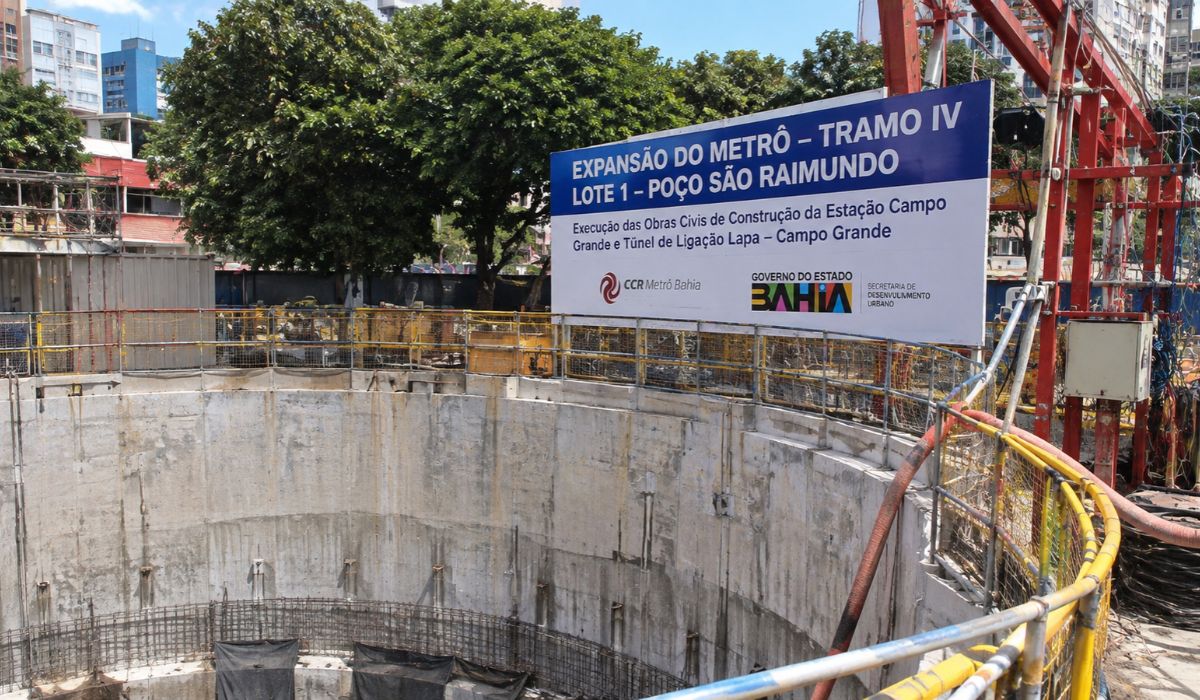

The São Raimundo Shaft reached 22.20 meters in November 2026, preparing for the underground route between Lapa and Campo Grande. The expansion involves engineering challenges, urban construction work and archaeological discoveries in central Salvador.
More than 22 meters below the streets of the Barris neighborhood in Salvador, an excavation is preparing the way to extend the metro to Campo Grande. Work at the São Raimundo Shaft has reached a depth of 22.20 meters, according to an update released by the Bahia state government on November 10, 2026.
The structure is one of the main construction sites for Segment IV of Line 1, an approximately 1.1-kilometer underground extension between Lapa Station and the future Campo Grande Station. The project has an estimated total budget of R$1.518 billion and is part of federal and state investments in urban mobility.
Construction is already underway at several sites in the city center. As crews continue excavating the shaft, other workers are preparing the site for the new station, carrying out infrastructure work and monitoring archaeological remains found during construction.
-
Singapore Transport Minister Jeffrey Siow broke ground on Tuas Port’s third and largest finger, almost 400 hectares of reclaimed land with 21 mega berths 23 metres deep and an 8.6 km wharf that will start operating in 2028.

-
Brazil’s first immersed-tube tunnel requires six 48-hour closures of the Port of Santos shipping channel during R$6.8 billion project

-
Brazil to Develop Dubai Mall-Inspired Shopping Center with R$400 Million Investment in Santa Catarina
-
São Paulo plans a R$2.8 billion electric tram to run without tracks, covering 17.4 km and carrying 120,000 passengers daily


São Raimundo Shaft reaches 22 meters, preparing for tunnel excavation
The first challenge in building a tunnel beneath a busy urban area is reaching the required depth. That is the purpose of the São Raimundo Shaft, located in Barris.
The shaft provides access to the underground construction site. It will allow crews to carry out the work needed to advance horizontally toward the future Campo Grande Station.
Progress in recent months shows how the excavation has deepened. In September 2026, Eracy Lafuente, Bahia’s state chief of staff, said the shaft had reached approximately 14 meters.
At the time, he said about 10 more meters of vertical excavation would be needed before the tunnel could advance lengthwise. Two months later, a new update put the depth at 22.20 meters.
That amounts to an increase of about eight meters from the depth reported in September. The figure should not, however, be confused with the final depth of the future station, which will be built at another point along the route.
The work involves more than removing soil and rock. Crews must ensure the shaft walls remain stable, monitor ground conditions and prepare the structures that will support the next stages.
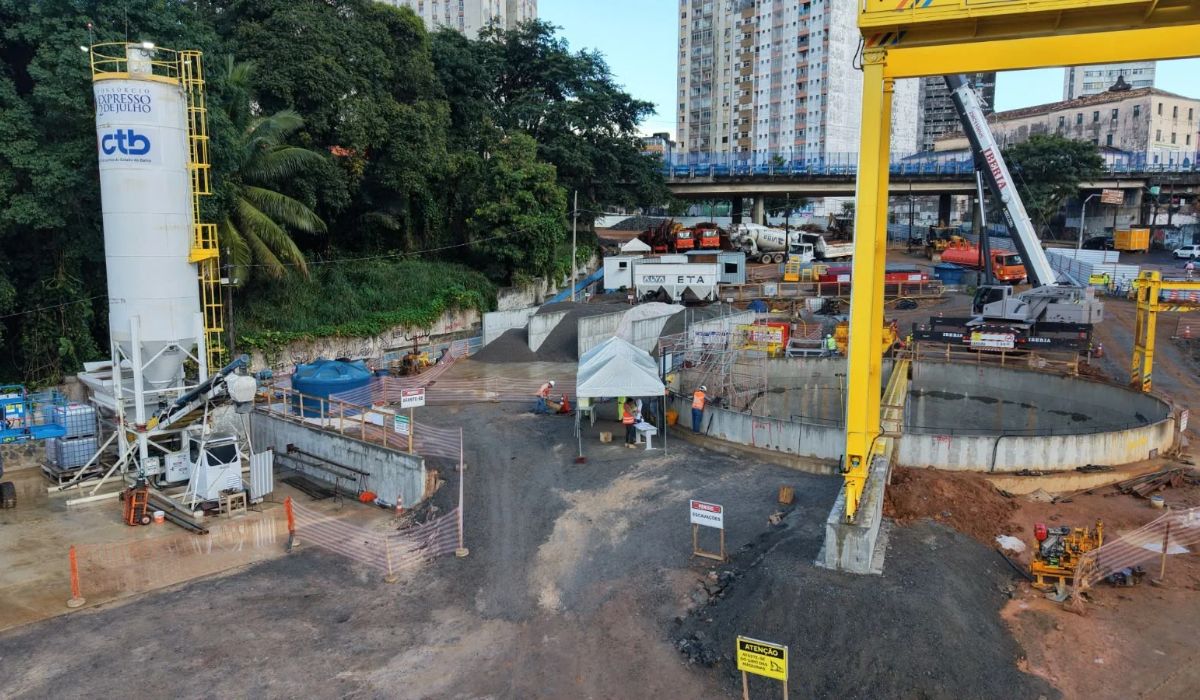
According to Bahia’s Department of Urban Development (Sedur), preparation of the São Raimundo Shaft included 160 rotary-drilled piles installed in 45 days. These elements are part of the structures needed to ensure suitable conditions for underground construction.
Once the shaft reaches the depth required by the project, the construction site is expected to allow excavation to advance toward Campo Grande.
New underground segment will connect Lapa to Campo Grande
Although relatively short, Segment IV is being built in one of Salvador’s most historic and busiest areas.
The new connection will begin at Lapa Station and continue underground toward Campo Grande, passing through the areas around Joana Angélica Avenue and Politeama.
The Bahia state government has cited a length of 1.06 kilometers in its most recent announcements. Earlier documents from the Bahia State Transport Company (CTB) give the underground segment’s length as 1.105 kilometers, a difference reflecting design references published at different times.
The goal is to extend Line 1, which currently connects Águas Claras to Lapa, providing a new travel option to an area with a high concentration of businesses, services, cultural institutions and government activities.
The future station will be near the Castro Alves Theater and Campo Grande Square. The project includes access points and urban improvements to integrate the new facility into pedestrian and vehicle traffic.
Before trains can reach the site, however, the station and tunnel must be completed, and systems needed for safe operations must be installed.
In October, Sedur, Bahia’s urban development department, said demolitions planned for the future station site had been completed, clearing the way for the next stages of construction.
The work also includes drainage, grading, accessibility improvements and upgrades to public spaces. Another major component is the Narandiba power substation, where grading was reported complete in the November update.
The extension is expected to make Campo Grande easier to reach without relying solely on bus or car trips. Its actual benefits, however, can only be measured once the new connection is in service.
Excavations uncover historical remains and require archaeological monitoring
Building underground in a city with more than four centuries of history also means dealing with traces of earlier settlements.
In the Campo Grande area, work uncovered the Residência Campo Grande archaeological site, associated with the area’s historic settlement. The discovery required specialized monitoring and measures to protect the heritage found there.
In October 2026, the National Institute of Historic and Artistic Heritage (Iphan) approved the Segment IV Archaeological Heritage Management Program, allowing work to continue under the conditions it established.
CTB said the program includes the recovery of 235 archaeological artifacts already collected, which will be sent to the Archaeology and Paleontology Laboratory at the State University of Bahia (Uneb).
Monitoring also covers new excavation fronts and heritage education initiatives.
These safeguards help explain why underground construction in historic areas requires special planning. In addition to addressing geological and structural challenges, crews must preserve materials that could help shed light on the city’s history.
Iphan’s approval of the program marked a step forward for construction of the future station. CTB said the decision allowed work to proceed according to the plan without changes to the schedule then in place.
Expansion has a R$1.5 billion budget and multiple construction fronts
The government of Bahia is carrying out Segment IV through CTB and Sedur, with the participation of Brazil’s Ministry of Cities and funding associated with the New Growth Acceleration Program (PAC).
The overall investment of R$1.518 billion appears in planning documents for the expansion between Lapa and Campo Grande. The civil works tender was won by the Consórcio Expresso 2 de Julho, with a bid publicly announced at approximately R$1.107 billion.
The figures refer to different budget benchmarks and should not be added together. In later announcements, the government also cited investments exceeding R$2.1 billion when discussing the broader set of initiatives tied to the metro expansion and the purchase of new trains.
Construction involves more than digging a tunnel. In addition to the São Raimundo shaft, crews will need to build the Campo Grande Station structures, install electrical and operating equipment, and adapt parts of the surrounding area to the new traffic conditions.
In October, CTB announced a road intervention near the Wish Hotel, changing access to Rua Forte de São Pedro. Drivers were advised to take the route around Campo Grande Square and follow the posted signs.
The project schedule calls for approximately 40 months of work, but the actual delivery date still depends on construction progress and the implementation phases.
The São Raimundo shaft reaching a depth of 22.20 meters marks progress on an important part of the project, but it does not mean the tunnel is complete.
The next decisive phase will be advancing the underground excavation toward Campo Grande, while station construction and the work needed to connect the new section to Line 1 continue.