Portuguese
 Spanish


The project aims to bring trams back to downtown São Paulo, but with electric rubber-tired vehicles and magnetic guidance. The system will have two lines, 37 stations and an initial phase scheduled for December 2027.
Trams could return to the streets of downtown São Paulo, but they will look very different from those that shaped the capital’s history. In place of the old steel rails, the city government plans to put articulated electric vehicles into service that run on tires and follow routes guided by magnetic technology.
Called Bonde São Paulo, the project has an estimated investment of R$2.8 billion, with 17.4 kilometers of routes and 37 stations. The city government says the system could serve more than 120,000 passengers a day, connecting neighborhoods, transit stations and some of the city’s best-known tourist attractions.
Authorization to begin construction was signed by Mayor Ricardo Nunes on November 13, 2026. The first phase is scheduled for December 2027, although a firm start date for construction has not yet been set.
-
São Paulo plans to demolish two overpasses and invest R$2.1 billion to transform 200,000 square meters downtown

-
Sabesp invests R$1 billion to more than double capacity at São Paulo wastewater plant without expanding its site and serve 3 million people
-
USP study uses slab tests to understand bridge failures amidst increasing vehicle weight considerations

-
University of São Paulo evaluates soil-cement bricks with quartzite tailings from Minas Gerais for strength and absorption


How does a tram that does not need tracks work?
The project’s biggest surprise lies beneath the asphalt. Rather than relying on metal tracks like traditional trams, the new vehicle will use a digital guidance system to travel along predetermined routes.
The technology, called Digital Rail Transit (DRT), combines articulated rubber-tired vehicles with magnetic markers embedded in the pavement. Sensors and control systems help identify the route, allowing the vehicles to follow it without conventional tracks.
From the outside, the tram resembles a small urban train. Underneath, however, its design is closer to that of a road vehicle, since it runs on tires.
The planned models will also have driver-assistance systems, 360-degree cameras and equipment-monitoring systems. The goal is to make maneuvering easier and better adapt operations to the busy streets downtown.
The choice marks a significant departure from the original design. Bonde São Paulo was planned as a Light Rail Vehicle (VLT), but in April 2026 the city government announced it would replace that design with an Electric Light Vehicle (VLE).
The city government says the change is intended to reduce construction challenges on narrow, older streets, where installing traditional tracks would require more complex work.
That does not mean the tram can begin operating without construction. The pavement will need to be prepared, the guidance system installed, stations built, electrical infrastructure put in place and dedicated sections arranged for the vehicles.
The difference is that the new system does not require steel tracks, one of the most prominent elements of building urban rail lines.
Two lines will connect Bom Retiro, Liberdade and the heart of São Paulo
The route was designed to serve an area where distances may look short on a map but are not always easy to travel. Major avenues, rail lines and rivers make some connections between neighboring districts difficult.
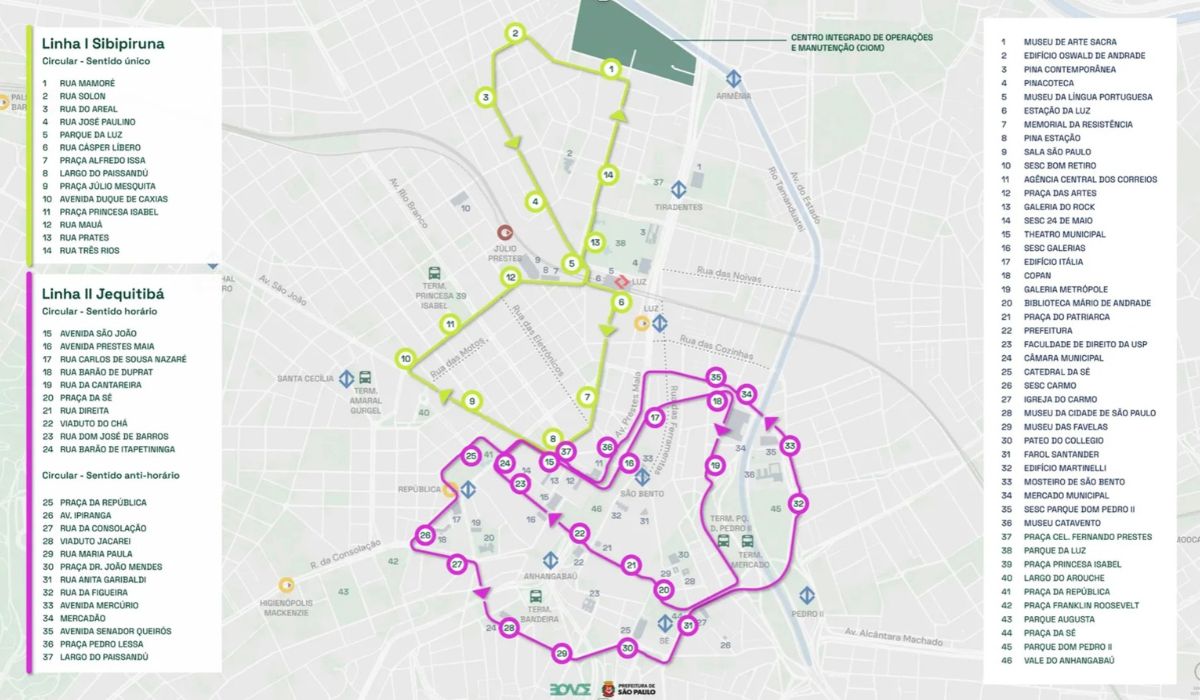
Bonde São Paulo will have two lines: Sibipiruna and Jequitibá. Together, they will form a 17.4-kilometer network, with planned connections to five bus terminals, eight subway stations and two commuter rail stations.
The Sibipiruna Line will be 6.3 kilometers long and have 14 stations. Its route will serve part of Bom Retiro and other areas near the Luz district, helping connect commercial, service and transit destinations.
The Jequitibá Line will have 23 stations, with two routes running in opposite directions: 6.2 kilometers counterclockwise and 4.9 kilometers clockwise. The proposal aims to create more direct links between areas of the Historic Center and nearby neighborhoods.
The locations expected to be served include the Municipal Market, 25 de Março Street, the Municipal Theater, Sala São Paulo and the Mário de Andrade Library.
The project also includes connections to Anhangabaú Valley, Luz Park, Sé Square and Dom Pedro II Park. In addition to trips for work and school, the tram could serve people traveling through the area to shop or visit cultural venues.
The city government estimates that the new network could remove about 11,000 vehicles from downtown streets. That figure, like the projected capacity of 120,000 passengers a day, is a forecast for the project, not a result already achieved.
First section is scheduled to open in 2027, but downtown still needs construction work
The schedule presented by the city government divides the rollout into four stages, starting with the Sibipiruna Line. Its first section is expected to be delivered in December 2027, followed by a second phase in June 2028.
The third stage is scheduled for December 2028, while completion of the final loop of the Jequitibá Line is expected in March 2029.
These dates are targets announced by the municipal administration. Before the first stations can open, engineering plans, street work, contracting and permitting must be completed.
The rollout is also expected to bring changes to the street layout. Some routes will be reserved for the tram, requiring adjustments to car, bus, bicycle and pedestrian traffic in parts of downtown.
The proposal is part of a broader urban renewal program. In announcing the project, the city government outlined related improvements, including more green space, better sidewalks and connections to bike lanes.
The announced urban planning targets include 30,000 square meters of green space, the planting of more than 1,000 trees, and the expansion or renovation of 200,000 square meters of sidewalks.
These changes are expected to be detailed in the implementation plans. There is not yet a final schedule for the road closures and detours needed to build the system.


R$2.8 billion investment still hinges on contract terms
The city government lists R$2.8 billion as the estimated investment to build the São Paulo Tram, including the infrastructure, vehicles and systems needed to operate the network.
The contracting model, however, has come under scrutiny. City officials plan to add the project to the existing contract with the TransVida consortium, which operates bus and trolleybus services in the city, rather than hold a separate tender for the tram.
The proposal would extend the concession by another 15 years, with the company and the public sector expected to contribute funding.
In a report published on November 19, Folha de S.Paulo reported that the Municipal Court of Accounts (TCM-SP), São Paulo’s municipal audit court, requested additional documents from the city government to assess the alternative. The court’s review found that the initial justification for adding the new system to the bus contract was insufficient.
The city government said it had submitted the requested information and argued that a contract amendment would be the most advantageous option for the public administration. The report said the court had not yet completed its review.
The outstanding issue does not mean the project has been canceled, but it shows that the approval announced in November is not a definitive order to begin construction.
Planning will also need to account for environmental permitting requirements following the shift from rail-based technology to a rubber-tired system.
For people who use public transportation daily in the downtown area, the next milestones will be finalizing the contract terms, detailing the roadwork and announcing the actual start date for construction. The city government has pledged to put the first section of the São Paulo Tram into service by the end of 2027.