Portuguese
 Spanish


The Turing cargo ship has received approval for trials at the Port of Qingdao, where it is expected to combine electric propulsion, replaceable batteries and remote control from shore, with crew members ready to intervene.
A 71.8-meter-long cargo ship powered by batteries installed in containers has received approval to conduct experimental shipping operations in China. Named Turing, the vessel was designed to carry the equivalent of 206 twenty-foot containers and receive commands from a shore-based control station.
Developed for Shandong Ocean Shipping Group, the vessel will be operated by Shangang Express in the Port of Qingdao region, in Shandong province. The license for its first experimental routes was announced this month, following the ship’s delivery by Hubei Jiangrun Shipbuilding.
Two electric motors provide a combined 900 kilowatts of power
The Turing uses a configuration that differs from that of many conventional cargo ships, which rely on internal combustion engines for propulsion. China Communications News reports that the vessel has two 450-kilowatt electric motors and energy-storage units housed in containers.
-
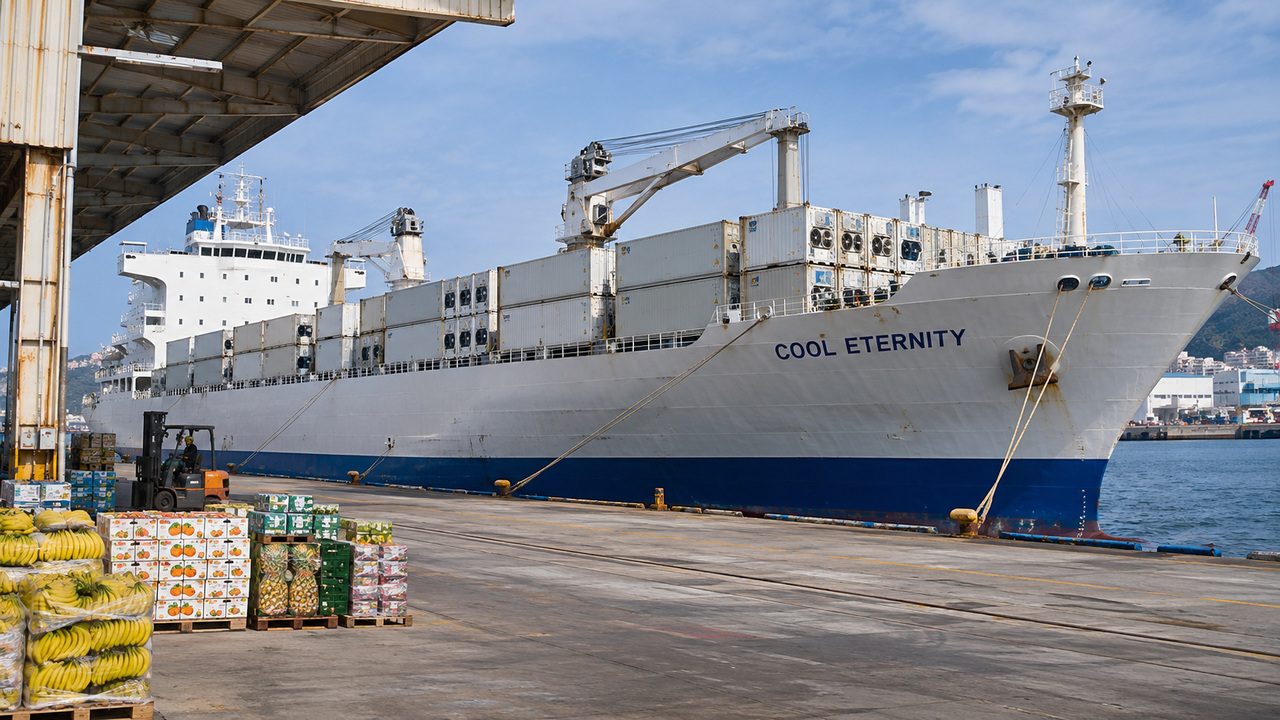
To carry bananas and other fruit across oceans, nearly 190-meter ship launched in Japan gets five refrigerated holds and room for about 300 containers on deck

-
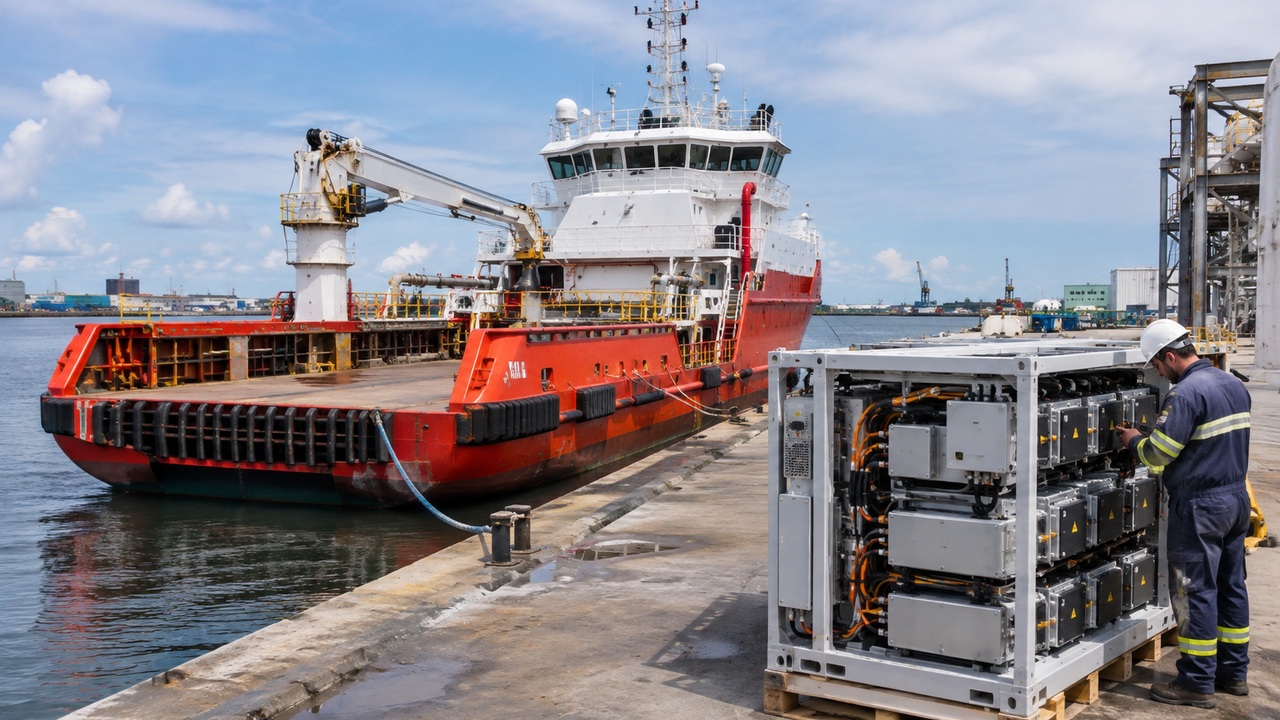
Two Diesel Tanks Become Battery Rooms on Refitted U.S. Support Vessel, Adding 11 MWh of Storage and an Estimated Electric Range of 926 Kilometers
-
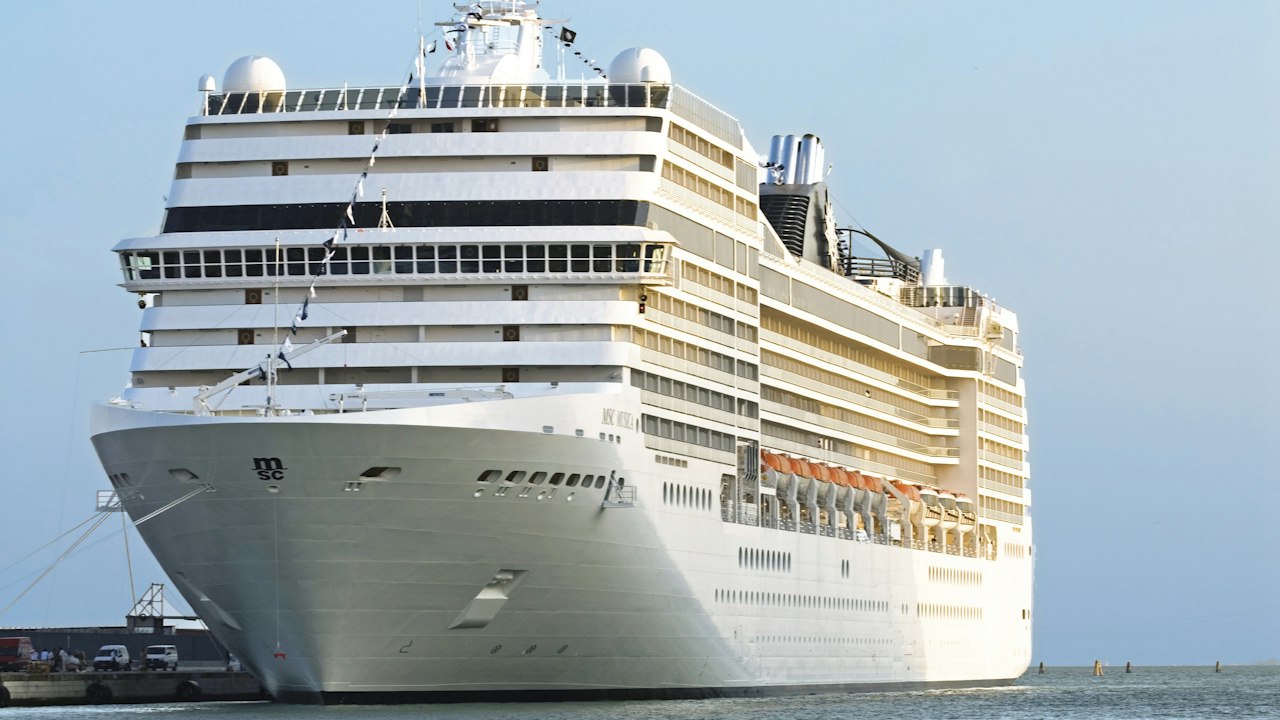
20-year-old cruise ship swaps nightclub for gym, turns cabins into 63 luxury suites, and returns to Santos after nearly two months of work in Malta
-
Two cranes lift over 70 metric tons of equipment onto a 333-meter ship in Santos as 250 workers convert the central pool area into a stage for shows
The reported capacity of 206 TEUs uses the standard unit for comparing the capacity of container ships worldwide. One 20-foot container equals one TEU; a 40-foot container equals two TEUs. The actual number of containers carried therefore varies depending on the dimensions of each unit loaded aboard.
The vessel has a deadweight tonnage of 2,904 metric tons. This measures its capacity to carry cargo, people, supplies and other variable loads, not the weight of the empty hull. The ship was designed for regional service between terminals rather than intercontinental crossings.
Replaceable batteries could take up space equivalent to eight containers
The electric system uses storage units installed in modules compatible with container port logistics. Dazhong Daily reports that the initial configuration takes up the equivalent of two TEUs and can be expanded to as many as eight.
The modules allow operators to plan battery charging and replacement around operational needs. Industry publication TrasportoEuropa reported that the power system combines shore-based charging with the option to swap out battery packs.
The reported maximum range is 240 nautical miles, or about 445 kilometers. The range on each mission will depend on the battery configuration, cargo load, speed and conditions encountered during navigation. The ability to draw power from shore makes terminal infrastructure an important part of the project.
Commands may come from shore, but crew members will remain aboard
The China Classification Society, which inspected the vessel’s construction, said on November 23 that the Turing is the first fully electric, smart seagoing vessel in the country to apply for the organization’s additional R1 notation.
The classification society said the concept allows the main functions to be operated from a shore-based remote-control station. Crew members monitor operations and can take command in an emergency. The trial approval therefore covers a vessel with human supervision aboard, even when commands are transmitted remotely.
In addition to remote operation, the design incorporates autonomous navigation, decision-support tools and equipment diagnostics. Integrating these technologies requires the ship’s systems and the shore station to exchange enough information for operators to monitor the vessel’s status.
Qingdao’s automated port to host the electric cargo ship’s first routes
Smart Maritime Network reports that the trial will begin on routes connecting the Dagang and Qianwan terminals, as well as Qianwan’s northern and southern areas. Performance on these routes is expected to guide any expansion to other ports in the region.
Qingdao’s container terminal already uses automated cargo-handling systems and remotely operated equipment. A report published in September by China’s Ministry of Transport detailed the integration of crane control and berth-planning systems.
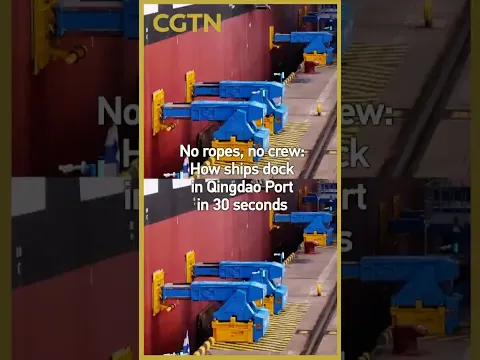
In January 2026, CGTN documented another technology deployed at the port: an automatic vacuum mooring system. The following video shows Qingdao’s infrastructure, not the Turing’s tests.

The expectation announced by Chinese authorities is that the vessel’s operation will cut associated carbon emissions by more than 1,600 tons per year. The result will depend on commercial use and the electricity source. The next step is to build operational experience on the approved routes before expanding the service.
Could electric vessels with shore-based remote control serve coastal shipping routes between Brazilian terminals? Comments are welcome.