





 Portuguese
  English
  Spanish
  4 min of reading
  0 comments


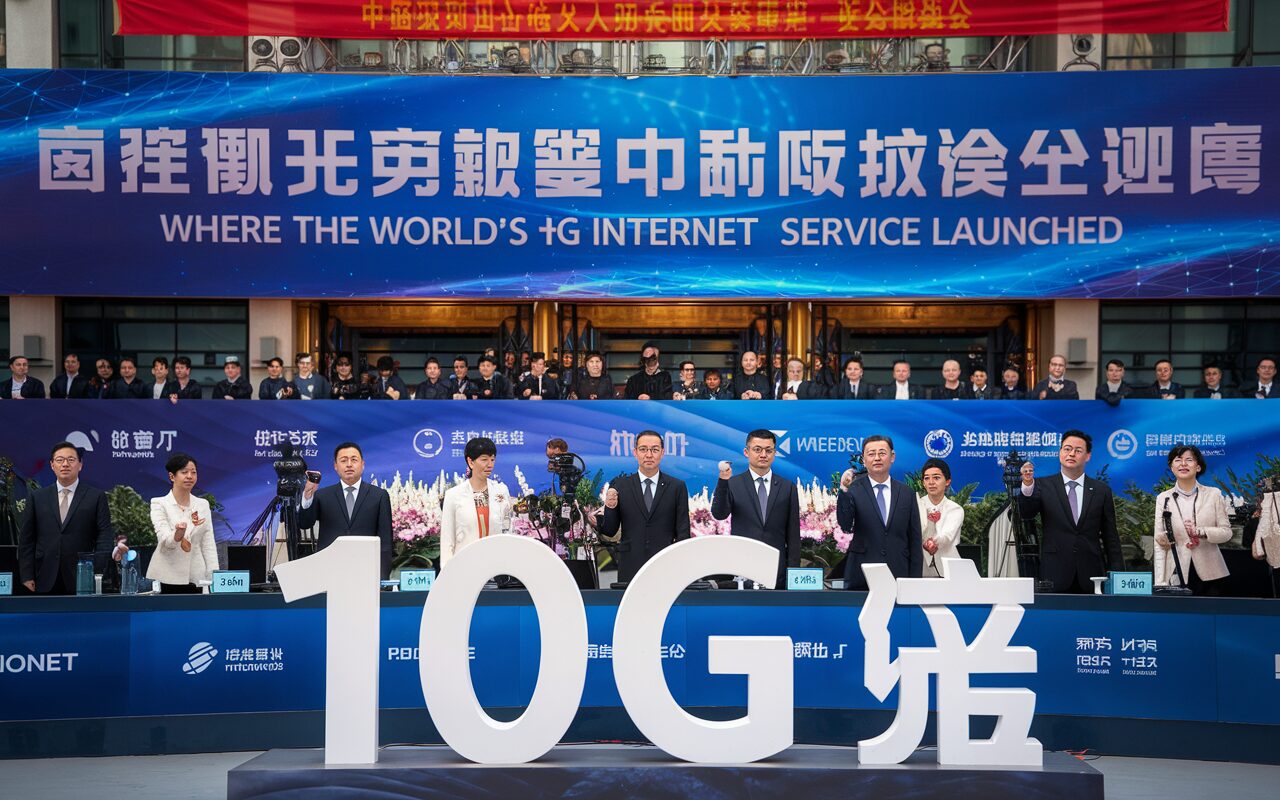
China’s Innovation with the World’s First 10G Internet Promises to Revolutionize Urban Connectivity, Propel Smart Cities, and Consolidate the Technological Leadership of the Asian Country.
In a move that reinforces its leading position in technology, China has officially activated the world’s first 10G internet. The innovation was implemented in the city of Xiong’an, near the capital Beijing, and promises to transform the way the world views connectivity, productivity, and smart urbanism. With a speed of 10 gigabytes per second, the new standard allows for downloading 4K movies in under 20 seconds and paves the way for applications in smart cities, such as the massive operation of autonomous vehicles, real-time artificial intelligence, and fully digitized urban infrastructure.
How the 10G Internet Implemented in China Works
Despite the similarity in name, the 10G does not refer to mobile networks like 5G, but rather to fixed internet of ultra-high speed. Utilizing 50G-PON (Passive Optical Network) technology, the system offers not only extremely fast data transfers but also ultra-low latency and unmatched stability.
These characteristics enable the advancement of essential solutions for the urban future, such as:
-
A country surrounded by scarcity transforms treated sewage into an “agricultural weapon” while the river that supplied generations becomes a regional dispute: Israel recycles almost 90% of its wastewater for irrigation and exposes the water abyss of its neighbors who still depend on what’s left in the Jordan River.

-
Climate change and pollution elevate heart risks: analysis with over 8 million people links extreme heat to 7.5% more complications and 9.5% more deaths, while pollutants already appear in 13% of cardiovascular deaths.

-
An online tool recreates the position of your house on Earth over up to 320 million years and shows how tectonic plates, lost continents, and geological collisions changed the planet’s map up to the present day.
-
China proposes to transform the rarefied atmosphere of Mars into electricity, heat, and fuel with CO₂, nuclear microreactors, and a Sabatier reactor, in a study that could reduce dependence on cargo sent from Earth and pave the way for more autonomous human missions.




- 8K Content Streaming;
- Cloud Gaming with instant response;
- High-Fidelity Virtual and Augmented Reality;
- Real-Time Traffic Management;
- Public Services Operated by AI;
- Integration of IoT Sensors Throughout the City.
The city of Xiong’an was chosen as the “laboratory” for this technology due to being a planned urban project from scratch, designed to be a showcase of smart cities.
Xiong’an: The First City with 10G Internet
Planned to be China’s “city of the future,” Xiong’an is receiving billion-dollar investments to transform into a fully connected urban ecosystem. With the world’s first 10G internet, the city aims to:
- Reduce Dependence on Private Vehicles, prioritizing autonomous public transport;
- Ensure Universal Digital Access, with 100% online public services;
- Optimize Energy and Water through smart grids;
- Monitor Health and Safety in real-time.
Although the project was initially criticized as a “ghost city” due to its low population, the activation of 10G internet signals that China is determined to transform Xiong’an into a new model of urbanism for the 21st century.
The Impact of 10G Internet on the Revolution of Smart Cities
The arrival of 10G internet in China enhances the entire ecosystem of smart cities. With a speed of 10 gigabytes per second, the expansion of systems for:
- Networked Autonomous Cars;
- Coordinated Smart Traffic Lights;
- Hospitals with High-Definition Remote Care;
- Digital Schools with Access to Virtual Reality;
- Self-Managing Electrical Grids;
- Real-Time Environmental Monitoring.
The infrastructure is also essential for the growth of emerging technologies such as the metaverse, Industry 4.0, and high-precision telemedicine.
The Strategic Significance of 10G Internet
The activation of the world’s first 10G internet is part of China’s strategy to use technology as a tool of global power and influence. The Chinese government has invested over US$ 92 billion in digital infrastructure to ensure that projects like Xiong’an serve as demonstrations of the country’s technological capabilities.
With 10G, China widens the gap compared to other countries in the race for smart cities and digital sovereignty.
In contrast, over 20 million Brazilians still lack access to fixed internet at home, highlighting the digital divide between nations.
Differentiation Between Technologies
Many confuse 10G with an evolution of 5G, but they are distinct technologies:
- 5G: Focused on mobile networks, used in smartphones and cellular connections;
- 10G: Intended for fixed residential and commercial internet, focusing on extreme bandwidth and stable connections.
Both will be fundamental for the digital future, but 10G will be crucial to ensuring that smart cities can operate reliably and with high data capacity.
The expectation is that other Chinese cities will adopt the technology in the coming years, especially in industrial and logistical centers. Beijing, Shanghai, and Shenzhen are already in the study phase for the implementation of 10G internet.
Moreover, with the success of Xiong’an, it is possible that other countries will start adopting similar projects, accelerating the development of smart cities globally.
For China, the inauguration of the world’s first 10G internet is more than a technological achievement: it is a declaration of leadership in a new era of urbanism, connectivity, and digital sovereignty.








-

-

3 people reacted to this.