






 Portuguese
  Spanish


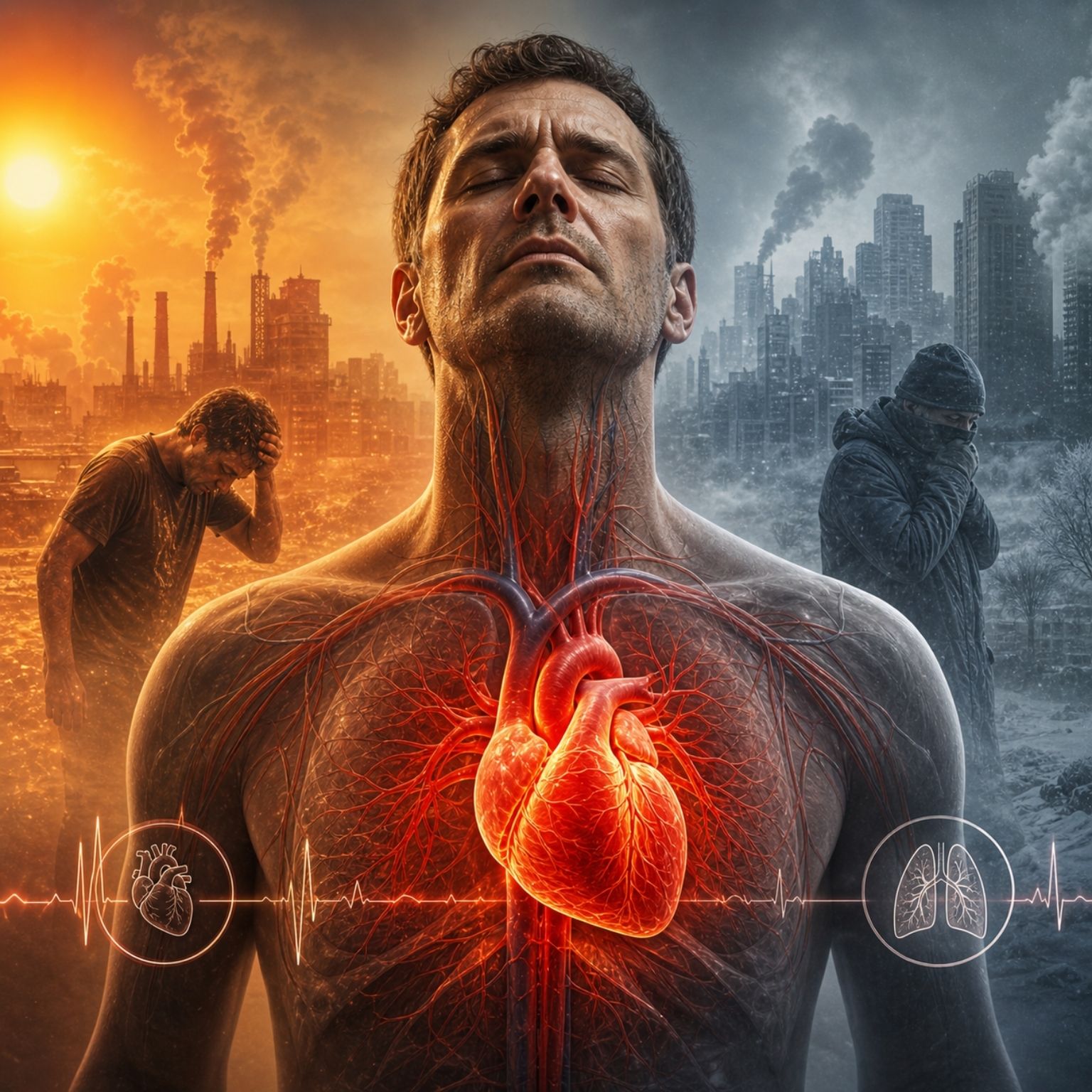

Climate change amplifies the burden of air pollution on cardiovascular health and helps explain why extreme heat and extreme cold are already linked to an increase in complications and deaths.
Climate change has also moved to the center of the debate on cardiovascular health after the European Society of Cardiology released an analysis on the impact of extreme heat and cold waves on heart problems. The data was presented at the annual congress of the European Association of Preventive Cardiology and gathered information collected in Poland between 2011 and 2020, with over 8 million people evaluated and 573,000 serious cardiovascular and cerebrovascular events recorded.
What stands out is the magnitude of the impact shown by the numbers. Exposure to extreme heat was associated with 7.5% more cardiovascular complications and 9.5% more deaths from heart problems. At the same time, air pollution emerged as a significant aggravating factor, linked to about 13% of deaths from cardiovascular complications, which amplifies the warning at a time of more frequent and intense climatic events.
Climate change and cardiovascular health are already linked in major analyses

The analysis presented by European cardiology reinforces that climate change is no longer a distant topic and has begun to have a concrete effect on human health. The advance of extreme heat and cold waves, combined with the worsening of air quality, creates a more favorable environment for an increase in cardiovascular complications and deaths.
-
James Webb Telescope Uncovers Unexpected Clues on Mysterious Moon, Potentially Redefining Planetary Origins

-
$1.5 Billion Sleipnir Vessel Transforms Ocean into Floating Construction Site with 12 Hybrid Engines and Capacity to Lift 20,000 Tons

-
23 Years After Tragedy, Brazil’s Alcântara Space Center to Launch New Suborbital Rocket in 2026 with South Korean SEBIT Project Targeting Near-Space Tests
-
Entrepreneur Turns Neighbor’s Coffee Grounds Waste into Eco-Friendly Pellets, Earning Up to $40,000 Monthly in Brazil


This scenario gains even more weight because the data was collected on a very broad basis. The sample of over 8 million people and 573,000 serious events gives dimension to the problem and shows that the impact is not restricted to isolated cases, but appears on a population scale.
The numbers that explain why extreme heat is so concerning
The analysis results show that extreme heat had a direct association with the worsening of cardiovascular conditions. During these periods, complications rose by 7.5%, while deaths from heart problems increased by 9.5%.
This data is noteworthy because it reveals that rising temperatures do not only affect comfort and routine, but also the risk of serious outcomes. In a scenario of more intense global warming, this type of relationship gains even greater importance for public health.
Extreme cold also raises risks and can have more prolonged effects
Cold waves also appeared as an important risk factor in the analysis, although with a different behavior than heat. The study indicates that cardiovascular events increased from 4% to 5.9% during these periods.
In the case of deaths, the increase was from 4.7% to 6.9%. Another important point is that the effects of cold were described as more delayed and prolonged compared to extreme heat, which suggests a more lasting pressure on cardiovascular health during periods of intense temperature drop.
Air pollution acts as an aggravating factor and is already linked to 13% of deaths
In addition to temperature extremes, air pollution was identified as an important factor in the worsening of cardiovascular health. According to the analysis, about 13% of deaths from cardiovascular complications were associated with exposure to atmospheric pollutants.
This data makes the problem even broader, as it shows that the risk comes not only from climate change itself, but also from the environmental degradation that accompanies this process. When extreme heat, intense cold, and polluted air combine, the impact on the heart tends to become even more concerning.
What this means for Brazil and for air quality
The warning is not restricted to the European scenario. The 2025 Air Quality Report, released by the Ministry of Environment and Climate Change, shows that the air in Brazil frequently concentrates pollution levels higher than the maximum limit allowed by the World Health Organization.
In practice, this indicates that the effect of pollution on cardiovascular diseases should not be treated as an abstract risk. If air quality is already above recommended parameters, the country also enters the radar of concern when it comes to the worsening of heart problems.
Women and people under 65 appear among the most affected groups
The data also shows that the impact of pollution is not equally distributed among all groups. Among women, the risk was about 5% higher compared to men.
Among people under 65, the effects appeared approximately 9% higher. This broadens the scope of the alert and indicates that the problem is not limited only to the elderly or groups traditionally seen as more vulnerable.
Why climate change intensifies this scenario
The pressure on cardiovascular health occurs at a time when the global temperature has already consolidated at 1.2°C above pre-industrial temperature in the period between 2015 and 2024. This advance brings the planet closer to the 1.5°C limit established in the Paris Agreement.
Furthermore, the UN climate panel clarified in a recent report that there is a significant increase in extreme heat waves, rainfall, and droughts with each additional 0.5°C rise in temperature. This helps explain why extreme events tend to become more frequent and intense and why the impact on health gains urgency.
What changes in practice for those following this debate
The main practical effect of this analysis is to show that climate, pollution, and heart health can no longer be treated as separate issues. What once seemed like a broad environmental discussion now appears directly linked to measurable medical complications and an increase in deaths.
With more extreme heat, intense cold, and poorer air quality, the need to view the problem as a matter of public health, prevention, and monitoring grows. The numbers presented by European cardiology indicate that the heart is already feeling the effects of this new scenario.
Do you believe that extreme heat, cold, and air pollution are already changing how the population needs to face cardiovascular health risks?


