





 Portuguese
  English
  Spanish
  4 min of reading
  0 comments


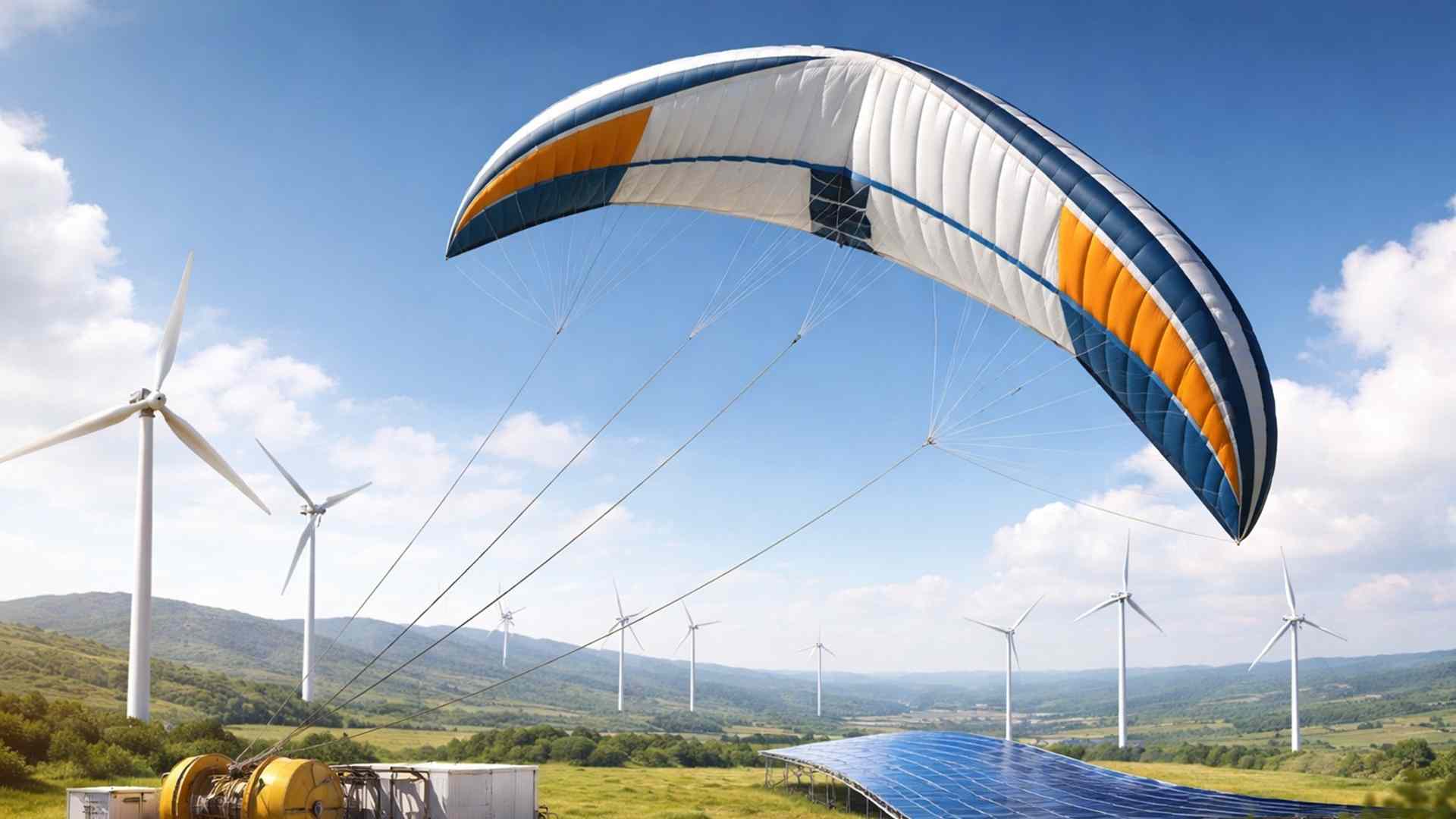
Airborne Wind Energy Technology Uses Kites Tethered by Cables to Capture Stronger and More Stable Winds Between 300 and 500 Meters Altitude, Already Registers Dozens of Test Flights in Europe and the US and Advances from the Experimental Stage to Projects with Grid Connection
Kites tethered by cables and designed to generate electricity at high altitudes are moving beyond the experimental phase and entering serious renewable energy development, with ongoing testing in Europe and the United States and a focus on autonomous operation and grid integration.
These systems, known as airborne wind energy systems (AWES), replace steel towers and concrete foundations with lightweight kites that operate hundreds of meters above the ground, where the winds are stronger and more predictable, converting aerodynamic force into mechanical and electrical energy via a cable connected to the ground.
Why Height Is Decisive for Energy Generation
The central principle of AWES lies in the direct relationship between wind speed and altitude. Physical models of the lower troposphere indicate that, between 300 and 500 meters, average winds are more intense and stable than near the ground, increasing the available energy potential.
-
A country surrounded by scarcity transforms treated sewage into an “agricultural weapon” while the river that supplied generations becomes a regional dispute: Israel recycles almost 90% of its wastewater for irrigation and exposes the water abyss of its neighbors who still depend on what’s left in the Jordan River.

-
Climate change and pollution elevate heart risks: analysis with over 8 million people links extreme heat to 7.5% more complications and 9.5% more deaths, while pollutants already appear in 13% of cardiovascular deaths.

-
An online tool recreates the position of your house on Earth over up to 320 million years and shows how tectonic plates, lost continents, and geological collisions changed the planet’s map up to the present day.
-
China proposes to transform the rarefied atmosphere of Mars into electricity, heat, and fuel with CO₂, nuclear microreactors, and a Sabatier reactor, in a study that could reduce dependence on cargo sent from Earth and pave the way for more autonomous human missions.




Initial studies conducted by Miles L. Loyd from the Lawrence Livermore National Laboratory demonstrated that the crosswise motion of a kite in crosswind significantly elevates power density compared to stationary systems tethered to the ground.
Experts from AWESCO explain that the essence of the technology is to replace passive material limitations with active control algorithms, which expands the energy potential but imposes significant technical challenges.
In the pumping cycle, the most common mode in systems with a ground generator, the kite flies in figure-eight patterns to maximize cable tension during the unwinding phase, when energy is produced, and returns with minimal expenditure in the retrieval phase.
Autonomous Control as the Core of AWES Systems
The main physical advantage of high-altitude winds requires extremely precise control. Cable tension, trajectory stability, and instantaneous adaptation to gusts need to be managed by robust autonomous systems to avoid operational failures or structural losses.
At the center of each AWES is a complex control architecture that coordinates flight patterns, cable behavior, and generation cycles hundreds of times per hour, ensuring repeatability and operational safety.
Currently, projects with ground generators predominate, in which the force exerted by the kite drives a winch linked to a generator. In contrast, some exploratory concepts envision turbines installed on the kite itself, with electricity transmission via conducting cables.
Sensors, Models, and Integrated Flight Logic
Modern systems combine sensor fusion, including inertial units, GNSS, and cable angle encoders, to accurately estimate position, speed, and flight dynamics in real time.
Predictive control techniques based on models are used to plan trajectories that maximize energy production while keeping risks within acceptable limits and respecting clear transitions between generation and repositioning phases.
Dynamic models developed at TUDelft illustrate typical flight trajectories and support the refinement of control algorithms employed in the field by several developers.
Real-Scale Tests Off the Coast of Ireland
In 2023, the company Kitepower partnered with RWE to establish a dedicated airborne wind energy testing area in Bangor Erris, County Mayo, Ireland, focusing on grid-compatible operation.
The Falcon system used on-site employs a 60-square-meter kite, weighing about 80 kilograms, with embedded sensors and a control unit near the cable, able to generate up to 100 kW and reach maximum altitudes of 350 meters during tests.
According to Johannes Peschel, then CEO of Kitepower, flights began to occur on average five times a week, with over 35 accumulated hours and an individual record of five hours and forty-five minutes, indicating progress toward continuous and automated operation.
By the end of 2024, the site had recorded more than 90 flights and 100 hours of testing, signaling the transition from intermittent experiments to a more stable and predictable operating regime, although some data are still undergoing technical validation.
Mobility and Other International Initiatives
The rapid deployment, possible in less than 24 hours, and ease of relocation are cited by engineers as significant advantages of AWES systems over conventional turbines, which require long construction timelines.
In Germany, SkySails Power is progressing with intelligent kites equipped with autopilot and control systems to optimize routes and energy distribution.
Other European companies, such as EnerKite, Kitemill, and TwingTec, are working on modularity and autonomy, seeking to move from proof of concept to commercialization.
In the United States, research is supported by the DOE and ARPA-E, focusing on modeling, control, and deployment, leveraging knowledge generated by previous projects like Google’s Makani.
Material Costs and Long-Term Challenges
The economic viability of AWES relies on more efficient use of materials and smaller ground stations, in contrast to the large towers and foundations required by traditional turbines, reducing embedded energy costs.
While there are currently no consolidated long-term data, preliminary studies suggest orders of magnitude reductions in the use of structural materials, while tests indicate that 100 to 200 kW units can be combined modularly.
Comprehensive evaluations of levelized cost of energy depend on years of operation, including maintenance and wear of cables, factors that are still being analyzed in Bangor Erris and other testing locations, where reliability and grid integration remain central challenges for the technology.







-

-

-

-

-

11 people reacted to this.