





 Portuguese
  English
  Spanish
  5 min of reading
  0 comments


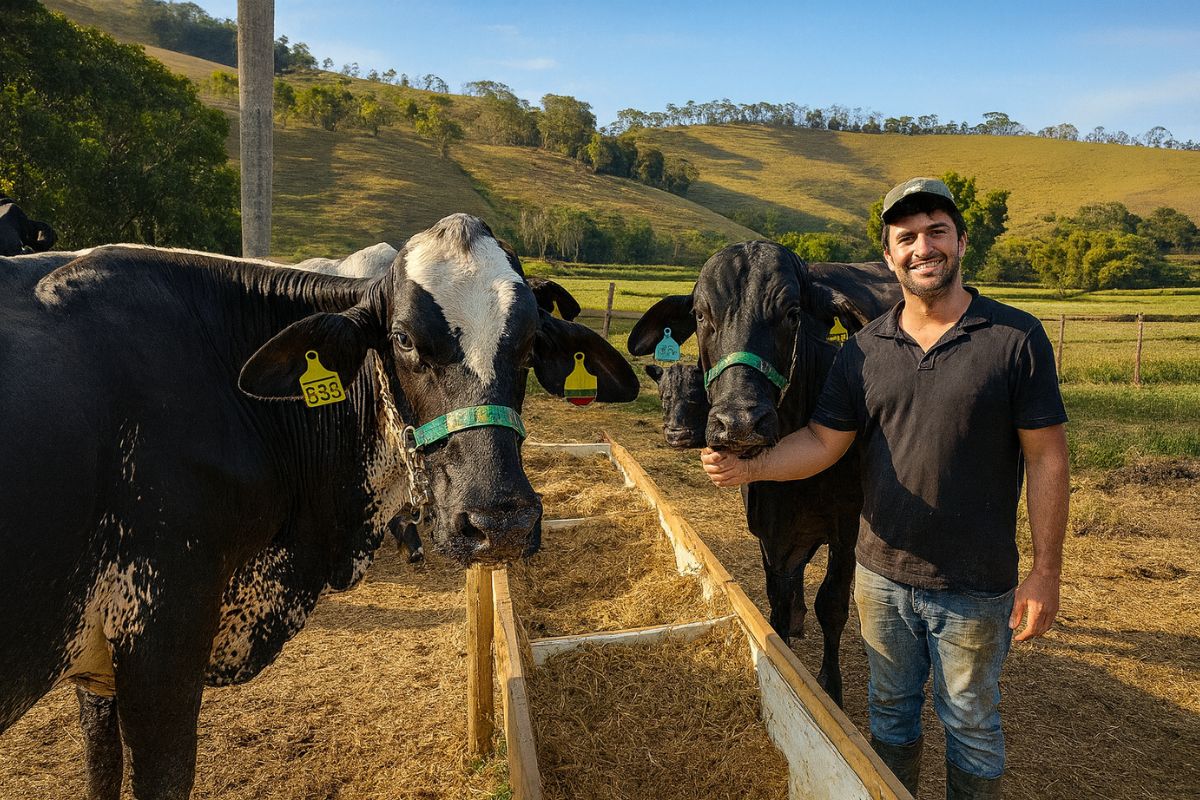
In Paiva, In The Mining Zone Of Mata, The Dairy Farming Of A 26-Year-Old Young Man Shows How Strong Genetics, Crossbred Cattle, High-Production Cows, And Simple Confinement Can Multiply The Herd And Reach Nearly 900 Liters Of Milk Per Day On The Property.
The milk that arrives in the carton at your home may well have previously passed through a simple corral, dirt road, and plenty of strong genetics chosen by eye. In Paiva, Minas Gerais, a young producer went from 10 cows at the start to a herd of over 30, delivering high-production cows on a rented piece of land with a tight budget, but with a lot of good stubbornness from the countryside.
In just one year, the turnaround was significant: what started as a test with help from his father became a life project in dairy farming, averaging between 880 and 900 liters per day, a heavy routine, and a simple confinement that shows how well-managed crossbred cattle can yield more than many systems filled with iron and concrete.
From Zero To 38 Cows In The Corral

Luiz Adriano’s story in dairy farming started in a very Brazilian way: father who always worked with commercial cattle, son who fell in love with milk.
-
Ship carries 40,000 tons of sustainable Brazilian soybeans to Bangladesh in COFCO’s first sale to the country, with certification involving traceability, satellites, and audits against deforestation in agricultural trade between Brazil and Asia, expanding the grain route.

-
Even with a weak domestic market, Brazil’s swine industry grows abroad, earning US$ 324.1 million in April and making the Philippines the largest destination for pork.

-
Dependent on imports, Brazil sees fertilizers becoming a concern in agriculture as the conflict involving Iran pressures freight, insurance, and agricultural production.
-
Bayer chooses Brazil to test a new pesticide to be launched in 2028 as a complement to the controversial glyphosate. The company has already received approval from Anvisa, but still depends on the approval of the Ministry of Agriculture and Ibama to start sales.


The father provided the first 10 calving cows, the son brought the desire to work and learn, and from then on the business never stopped.
With family support and a focus on strong genetics, the young man rented an area in Paiva, in the Mining Zone, set up the corral in the existing structure, and started organizing the herds.
In a year, the herd grew from the initial 10 cows to about 38 in the corral, with daily production nearing 900 liters. For the region’s standard, that’s a considerable amount for someone just starting out.
Today, the herd mixes crossbred cattle with three-quarters animals and some cows from embryos, all heading towards an increasingly uniform herd.
Among this group are some high-production cows, including a champion from the corral that has already reached 50 kilos of milk per day, proving that it is possible to achieve results even without the structure of a soap opera farm.
Simple Confinement, Special Feed

No mega installations full of concrete and expensive equipment. Luiz’s system is based on simple confinement, the type of “use what you can afford,” but very well organized.
The cows spend the day with the feeding trough always nearby and have access to pasture, but most of the nutrition comes from the feed mix, designed to keep up with the rhythm of the high-production cows.
In the simple confinement, the rule is clear: full trough, full belly, calm cow. Silage, citrus pulp, corn, soy, cotton seeds, and supplements are included in the recipe, always adjusted according to the herd.
The producer separates the herd into three groups: the top-producing cows, with more milk, receive more feed; the intermediates eat a little less; and the lowest-producing cows are adjusted even more economically, without losing body condition.
This care is important because crossbred cattle respond significantly to diet. Eating well yields good production. Eating poorly leads to a rapid decline.
That’s why the producer prefers to see feed left over in the trough than cows lacking food, even knowing that this tightens the budget every month.
Crossbred Cattle And A Focus On Strong Genetics
Luiz’s project is clear: to form a worthy crossbred cattle herd, with track-worthy looks and grounded in farmland.
The majority of the cows that currently fill the bucket are crossbred, with some three-quarters animals, and the idea is to refine the herd over time, always raising the bar for strong genetics within the property.
He uses artificial insemination, works with the municipality’s inseminator, and selects bulls with this exact balance in mind: animals that produce milk without compromising the hardiness of the crossbred cattle that thrive in the region.
Some cows that arrived merely as “commercial cattle” surprised and became high-production cows that are now permanent in the farm.
In the producer’s mind, strong genetics is as valuable as expensive infrastructure. The difference is that good genetics through semen or embryo can fit the budget if applied gradually, while building everything all at once with concrete, tiles, and top-notch equipment can hinder the dream.
Thus, he prefers to invest more in the right bred and gradually improve the rest, but always.
Heavy Routine In Mining Dairy Farming
In practice, what the dairy farming that appears in the statistics involves is this: waking up early, two milkings a day, dirt roads between the city and the farm, and a lot of time spent in the corral.
Luiz does not live on the property; he travels about 4 kilometers twice a day to get there, milk, care for the cows, and check on the calves.
While the cows are being milked, they eat in the trough to stay calm. After milking, they return to the simple confinement and continue to have access to pasture.
The goal is to keep the herd of high-production cows always well-fed and stress-free, because any slip shows directly in the volume of milk delivered to the dairy.
Even with his father’s help and a worker, the routine is heavy. There’s drying of pregnant cows, calves suckling directly from their mothers, crossbred cattle scattered between the corral and rented pasture, pigs just for expenses, a marching horse for a break, and amid it all, the worry about the milk price, which recently came in at 2.74 reais per liter. It’s nice to see the cows full, but the bills also arrive full every month.
Plans For The Future In Milk
Even with the difficulties, the young producer does not talk about leaving the sector. On the contrary, he wants to increase volume, reinforce the strong genetics of the herd, and continue betting on high-production cows that perform well in the current system.
The idea is to grow within dairy farming without losing control of costs, maintaining a focus on simple confinement and efficient management.
Further down the line, he dreams of forming partnerships to work more embryos and accelerate the formation of an even more even crossbred cattle without losing the hardiness that allows the cows to withstand the daily grind.
The property is rented, but the long-term plan is to gather results, gain scale, and, who knows, reach the moment to establish a piece of land of his own.
Until that happens, what’s missing is the will to work: every day, rain or shine, the milk keeps flowing, the bills keep arriving, and the project keeps moving at the steady pace of the cows in the corral. It’s the real life of Brazilian dairy farming, made up of young people, strong genetics, and a lot of perseverance.

And you, would you face such a routine in dairy farming to bet on strong genetics in the field or would you prefer to just watch high-production cows on your cell phone screen?


-

-

-

-

-

-

43 people reacted to this.