






 Portuguese
  Spanish


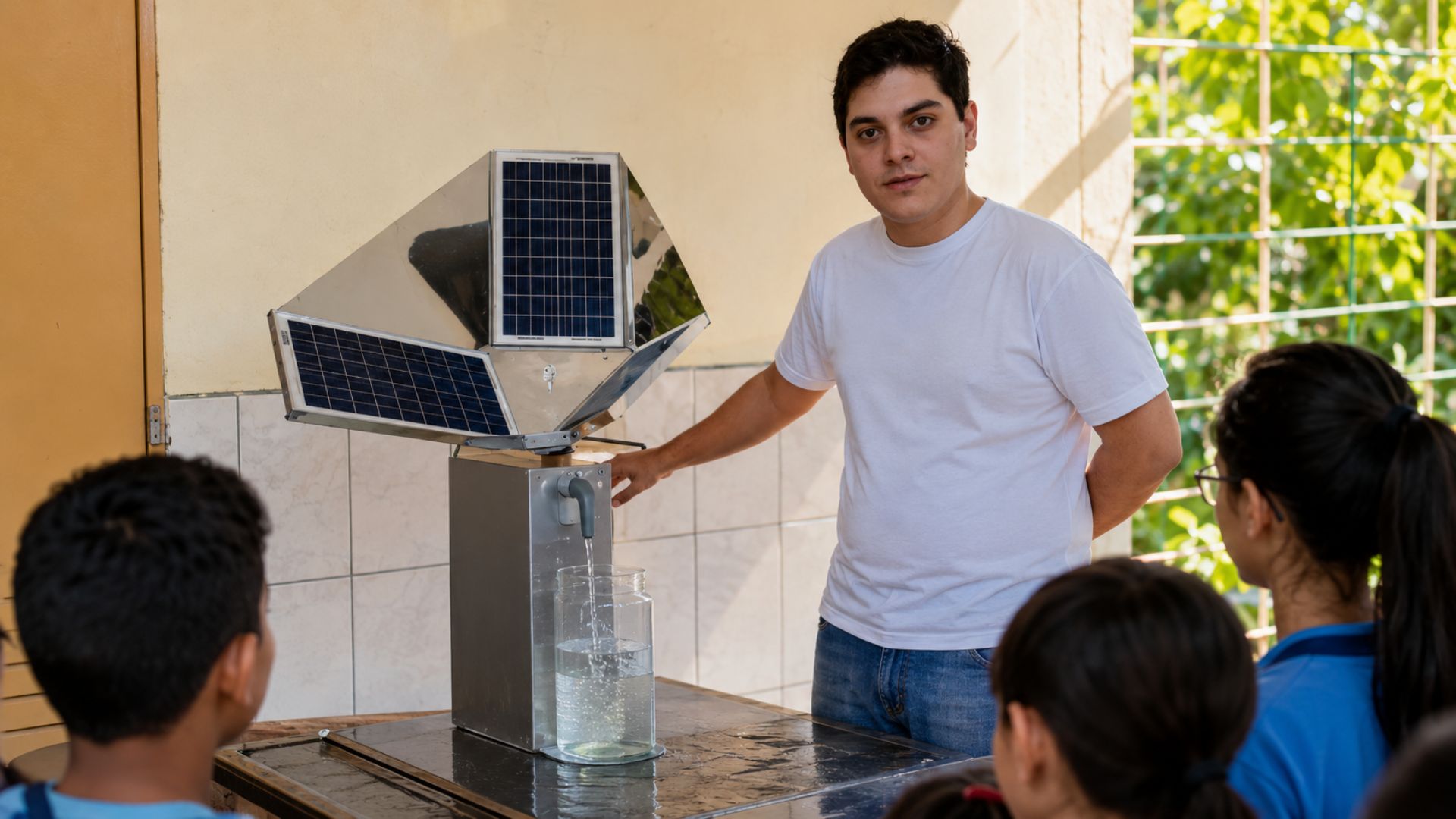


Ygor Requenha Romano, in 2016, created the equipment with riverside communities in the North Region in mind, which lacked access to treated water. The project costs about R$ 1,000 to assemble and won third place in the Environmental Engineering category at Intel ISEF.
A Brazilian public school student managed to transform the lack of treated water in his region into an internationally recognized invention. Ygor Requenha Romano created a water treatment machine that runs exclusively on solar energy, serves a community of up to 50 people, and costs about R$ 1,000 to assemble.
The equipment was awarded at the Brazilian Science and Engineering Fair of the University of São Paulo (Febrace) and presented at Intel ISEF (Intel International Science and Engineering Fair) in the United States. The project won third place in the Environmental Engineering category and a thousand-dollar prize, alongside inventions by pre-university students from all over the world.
How the machine created by the student works

The prototype developed by the young inventor is not limited to filtering water. According to Ygor himself, the device performs physical, chemical, and microbiological treatment, in addition to removing heavy metals present in raw water collected from rivers and wells.
-
The Trap of Modern Technology: How Screen Overload and Digital Connections Can Impact Your Mental Health and Well-being

-
Wyoming Couple Grows Tropical Fruits Year-Round in -40°C Using Geothermal Greenhouse, Demonstrating Earth’s Heat Can Produce Oranges and Lemons in Snow Without Traditional Heating

-
Ship Returns from Brazilian Coast with Thirty Newly Discovered Life Forms
-
Nigerian Professor Invents Electricity-Free Refrigerator Using Clay Pots and Wet Sand, Extending Shelf Life of Vegetables to 27 Days; 7,000 Units Distributed in Energy-Deprived Villages


The entire operation takes place without conventional electricity consumption, as the equipment was designed to run exclusively on solar energy. This autonomy is what makes the invention viable for communities far from the electrical grid, common in the riverside regions of Northern Brazil.
Another differential is the simplicity of maintenance. The project was designed so that people without technical training can operate the system daily, without the need for frequent visits from specialists to ensure its functioning.
What motivated the creation of the project

The inspiration for the invention came from the reality experienced by the student’s own community. In an interview released at the time, Ygor cited a stark fact: 94% of the people in the region where he lived did not have access to sewage and treated water.
The solution adopted by many families is the installation of artesian wells, an expensive and not always accessible alternative. The price of these wells can reach R$ 10,000, a prohibitive amount for low-income families in riverside and rural communities.
In comparison, the machine created by the student costs about R$ 1,000. The difference opens up space for small communities to adopt the technology with an investment ten times lower than that of a traditional well.
The partnership with the school caretaker


Despite being the sole creator of the invention, Ygor insists on sharing the credit with an unexpected figure: the school’s own caretaker. The professional lent the metalworking shop he had at home so the student could work on the prototype.
The effort was intense. At various points during development, the young inventor spent up to twelve hours a day assembling, testing, and adjusting the equipment inside the improvised workshop.
“He had already experienced precarious situations during his childhood due to lack of water. I think that’s what motivated him to help me so much. He’s a born engineer, has a sparkle in his eyes; I learned how to be a good human being from him,” the student said about the caretaker.
Recognition at Intel ISEF, in the United States
Intel ISEF is considered one of the largest science fairs in the world for pre-university students. Every year, the event brings together projects selected in national competitions across dozens of countries.
Brazil usually sends a delegation of young scientists selected by Febrace. It was through this channel that Ygor’s work reached the United States and competed with inventions from other students worldwide.
The machine won third place in the Environmental Engineering category, along with a thousand-dollar prize. The award was a direct result of the technical evaluation carried out by judges specializing in sustainability and socio-environmental impact.
The impact for riverside and isolated communities
From the beginning, the project’s focus was on populations living in remote regions without sanitation infrastructure. Riverside communities in northern Brazil are the most affected by this lack, as they depend directly on rivers and streams for water supply.
The combination of low cost, energy autonomy, and simplicity of operation created a social technology profile rarely seen in academic projects. Professional equipment with a similar function usually costs tens of thousands of reais and requires an electrical grid to operate.
The student’s invention tackled these two problems simultaneously. The result is equipment that can, in theory, be replicated on a small scale in any location in the country with strong solar incidence and a need for treated water.
What the case teaches about science made by young people in Brazil
Ygor’s journey shows that public school students have the capacity to generate relevant innovation when given space, support, and encouragement to put their ideas into practice. The story also highlights the role of science fairs as a bridge between school projects and national and international visibility.
The case also points out how much the environment matters: without the janitor’s metalworking shop, without the school’s support, and without Febrace’s structure, the prototype probably would not have materialized. Basic support structure, even if improvised, is often what separates a good idea from a realized invention.
Ygor himself summarized the motivation that led him to spend months dedicated to the project. “I hope to use science to do something that surpasses my physical ability to help someone. A better world will only exist when people do something better for other people,” he stated in an interview released at the time.
Ygor Requenha Romano’s invention reinforces the potential of Brazilian science in public schools, even when laboratories, equipment, and investments are lacking. When there is initiative, community support, and a good idea, relevant projects can emerge from the most unexpected places.
And you, what do you think about this story? Do you believe that school science fairs should receive more public support? Do you know of other inventions created by Brazilian students? Leave your comment, share your opinion, and tag someone who needs to know this story.




I think this is a great achievement for the inventor’s community and world at large.
Therefore school science fairs should be encouraged, not only in Brazil but other countries too.Especially, those countries with communities that need portable water supply.
Which project got the first prize?
Excellent work, it will certainly help third world countries,once produced on commercial platform