






 Portuguese
  Spanish


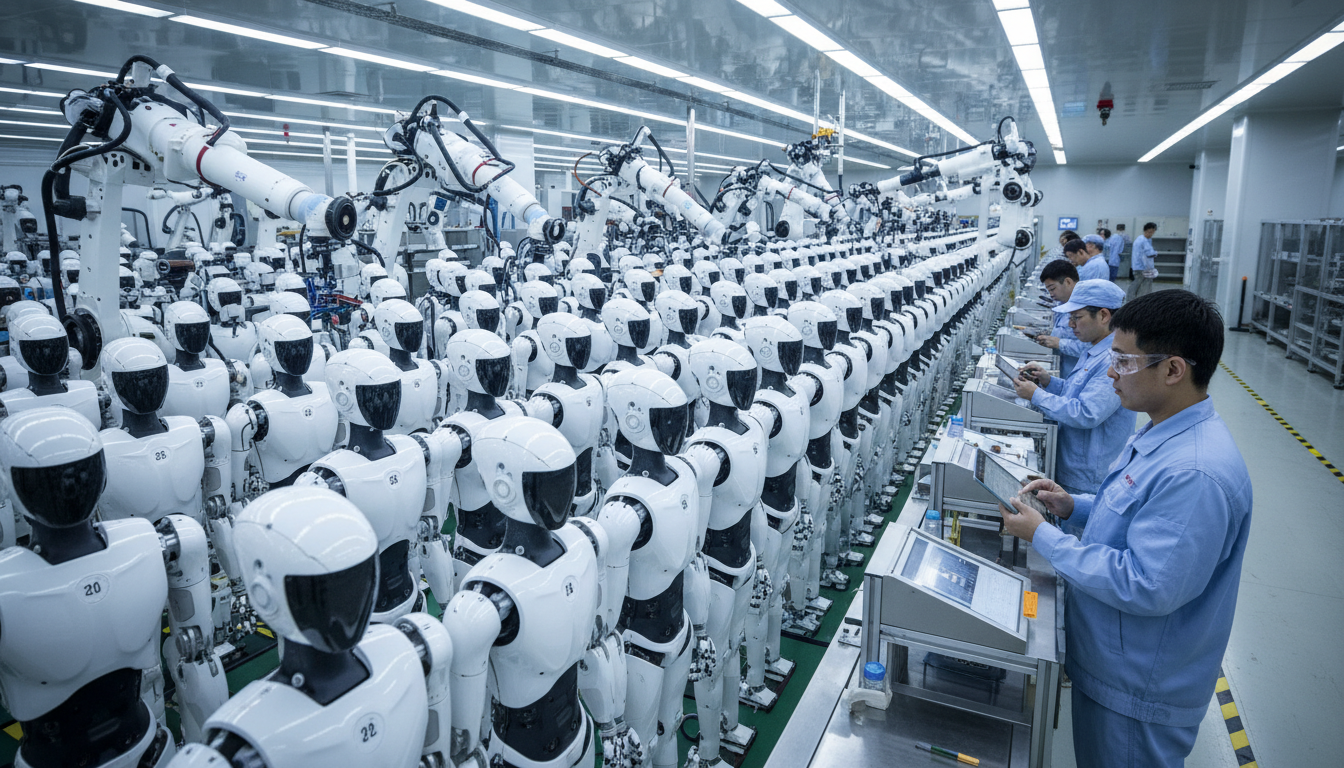


On March 29, 2026, the joint venture Leju Robotics + Dongfang Precision inaugurated in Foshan, Guangdong province, the world’s first factory to produce a humanoid robot every 30 minutes. The stated goal is 10,000 units per year, a capacity that places the plant above the sum of the main Western competitors.
According to Interesting Engineering, the line has 24 precise assembly stages, 77 inspection points, and 41 simulated real-condition tests before each robot is delivered to the customer. The declared efficiency gain is 50% over traditional methods.
The robot manufactured is Leju’s Kuavo-5, with 360 Nm torque in the joints, omnidirectional walking at 4.6 km/h, and an international price of around US$ 50,000. Units have already been delivered in volume to FAW Hongqi, Nio, and Haier.
-
Inspired by Brazilian termites, researchers develop microrobots capable of sensing their environment, exchanging signals, and acting collaboratively without relying on a central command

-
SpaceX Prepares Starship for Orbit Completion and Steps Toward Large Cargo Orbital Transport
-
Researchers Develop Densified Wood Structural Nails, Increasing Wall Rigidity and Paving the Way to Reduce Metal Connectors

-
Scientists Create New Cement Type Inspired by Elephant Skin, Absorbing Water in 50 Milliseconds and Cooling Buildings by Up to 20 °C Without AC


The numbers from the Guangdong factory, according to Leju, Dongfang Precision, and Morgan Stanley, tell the story in five points:
- 10,000 units/year declared capacity, equivalent to 70% of the global humanoid market in 2025
- 30 minutes assembly time per robot, compared to 2 hours in the Roban 2 pilot in Shenzhen
- 14,000 units was the total shipped worldwide in 2025, with China accounting for 90%
- US$ 50,000 unit price of the Kuavo-5, with a downward trend to US$ 15,000 by 2050 (Morgan Stanley)
- US$ 5 trillion estimated total humanoid market in 2050, according to Morgan Stanley

How the Chinese factory assembles a humanoid robot every 30 minutes
The plant is located in Foshan, in the southern industrial corridor of Guangdong. According to a report by China Daily, the operation combines automated guided vehicles (AGVs) and a real-time industrial digital platform.
In parallel, each of the 24 stations performs a specific task: joint assembly, electronic integration, limb fitting, sensor calibration. Therefore, the bottleneck time drops to 30 minutes per ready unit.
The 77 inspection points span the entire line, from start to finish. Meanwhile, the 41 pre-delivery simulated tests subject each robot to real-use conditions (stair walking, fall recovery, object manipulation) before release for sale.
According to published data, the line’s flexibility allows switching between different models without long stoppages. In parallel, this is possible due to the modular architecture of the Kuavo: arm, leg, hand, and torso are interchangeable.
The line is not fully autonomous. Human workers still perform supervision and fine precision tasks. In parallel, the goal is to gradually reduce human participation as the AI control system calibration advances.
Who are Leju Robotics and Dongfang Precision
Leju Robotics was born in 2016 as a spin-off of the Harbin Institute of Technology, in Shenzhen. According to CEO Lin Chang’s profile, PhD from Harbin, the company was recognized as a “high-level talent” in Shenzhen’s innovation ecosystem.
Leju’s portfolio includes the AELOS (small educational humanoid), the ROBAN (medium, research), and the KUAVO (full-size, commercial). In parallel, Leju developed its own gait control algorithms and ROS (Robot Operating System) implementation.
Dongfang Precision Science and Technology was founded in 1996 by Tang Zhuolin, in Foshan. The company gained a reputation as a supplier of high-precision corrugated packaging equipment.
According to Yicai Global, Dongfang takes on the role of contract manufacturing, debugging, deployment, and post-sale service of delivered Kuavo units. Meanwhile, Leju focuses on design, software, and AI integration.
Leju raised a funding round of 1.5 billion yuan (US$ 200 million) in 2025, with use intended for R&D, mass production preparation, and strategic partnerships with Huawei, Alibaba, and Haier.

The Kuavo-5: the humanoid robot every 30 minutes from the inside
According to the Humanoid Press database, the Kuavo-5 is Leju’s flagship full-size model, with proprietary electric actuators capable of generating up to 360 Nm peak torque.
The omnidirectional locomotion operates at up to 4.6 km/h. In parallel, the robot can climb stairs, recover from stumbles, avoid obstacles, and, in controlled demonstrations, run and jump.
The operating system is KaihongOS, derived from Huawei’s HarmonyOS, and supports integration with large-scale AI models (LLM), imitation learning, and real-time multimodal control.
In parallel, perception is multimodal: front cameras, 360-degree sensing, and sensor fusion for integrated decision-making in locomotion and manipulation. Therefore, the Kuavo operates with “agent” autonomy and not as a pre-programmed sequence.
According to Leju, the Kuavo is already in use in factories of FAW Hongqi (Chinese luxury car manufacturer), Nio (electric cars), and Haier (appliances). In parallel, units operate as instructors in schools in Sichuan.

Tesla, Figure, Boston Dynamics, 1X: what the West delivers
According to data from Robot Report, Tesla announced on March 12, 2026, the 10,000th unit of the Optimus, the first Western humanoid to reach this mark. In parallel, Elon Musk projects 10 million units per year at Gigafactory Texas, with ground broken at the end of 2025.
Figure AI announced in May 2026 that its Figure 02 contributed to the assembly of over 30,000 BMW X3 vehicles in Spartanburg, South Carolina, over 11 months of pilot. The metrics: 1,250 operational hours and a 99% success rate in sheet fitting with a tolerance of 5 millimeters.
Boston Dynamics, in parallel, launched the new electric Atlas at CES 2026, with 56 degrees of freedom, a reach of 2.3 meters, and a load capacity of 50 kg. According to the company, all 2026 deployments are already allocated (Hyundai Robotics Metaplant + Google DeepMind).
Norwegian 1X Technologies opened a factory in Hayward, California, with 5,400 m² and a capacity of up to 10,000 robots per year. In parallel, the domestic NEO costs US$ 20,000 + US$ 499/month subscription.
In sum, the West combines many announcements with little physical delivery. Meanwhile, China ships the robot from its own factory to the customer on the next street.

Why China leads: 150 companies and explicit five-year plan
According to 2025 data, more than 150 Chinese companies are active in humanoids. In parallel, the ecosystem includes Unitree (G1 at US$ 16,000, H1, 20,000 units planned in 2026), AgiBot (Expedition A3, 10,000 cumulative units in Mar/2026), UBTECH (Walker S2, orders of 800 million yuan), Xiaomi (CyberOne in internal use), and Fourier Intelligence.
The regulatory scenario also helps. According to the 15th Five-Year Plan (2026-2030), robotics and corporeal artificial intelligence are at the top of China’s “modern industrial system.” Meanwhile, Made in China 2025 brought sustained subsidies and tax exemptions.
In parallel, in 2023, China installed 276,288 industrial robots, equivalent to 51% of the global installation that year. Therefore, there is a decline in the supply chain of components and accumulated know-how of automated manufacturing.
The partnership between Leju and Alibaba Cloud, formalized in January 2026, completes the package. According to Alibaba, the agreement covers computational infrastructure, AI platforms, and foundation models (Qwen LLM) integrated into humanoid systems.
This arrangement eliminates technological dependence on Western providers. In parallel, it ensures that Chinese humanoids have access to world-class computational substrates and LLMs without the blind spot of imported cloud.
What changes for Brazil and where Petrobras can enter
Brazil still does not have significant humanoid manufacturing. In parallel, Reflex Robotics announced the first Latin American factory in Mexico, in partnership with NVIDIA, without a corresponding operation in the country.
According to market analysis, the realistic expectation is that Brazil will become an importer of humanoids, with China as the dominant supplier. In parallel, sectors such as agribusiness, mining, and the automotive industry are the first target market.
In the oil and gas chain, there is direct application. In parallel, Brazilian offshore platforms like pre-salt FPSOs could absorb humanoids for inspection, maintenance, and operation in confined environments, as already discussed in CPG coverage on critical minerals of the EV chain, where Brazil faces a similar risk of becoming a raw exporter and importer of the final product.
Petrobras has a robotics program for pipeline inspection. In parallel, integration with humanoids does not yet have a public schedule.
According to Morgan Stanley, low-income markets will have access to humanoids at US$ 15,000 by 2050. Therefore, the window for Brazil to build its own industrial capacity is open now, before the consolidation of the Chinese oligopoly.
It is worth noting, however, that the declared capacity of 10,000 units/year is nominal and has not yet been confirmed by real production data. The international unit price of the Kuavo-5 at US$ 50,000 is at a comparable level to the Tesla Optimus but substantially above the US$ 15,000 projected by Morgan Stanley for 2050. The article will be updated as Leju Robotics and Dongfang Precision release real production data.


This is my testimony regarding how I finally joined the New World Order—the Illuminati—after trying for over two years, only to have scammers steal my money on multiple occasions. I had wanted to join the Illuminati for a long time, but scammers kept taking my money until earlier this year, when I met Lord Felix online. I contacted him, explained my situation, and he recommended that I register. I paid for the premium membership to begin the process and was initiated into the New World Order virtually. I received $1,000,000 USD in my bank account instantly following my online initiation ritual, and I will also earn $33,000 USD per month. I am euphoric! I promise to spread the word about Lord Felix’s excellent work. If you are interested in joining the Illuminati’s New World Order today, contact Lord Felix right now—rather than letting scammers steal your money under the pretext of helping you join. Contact Lord Felix via WhatsApp at +44 7353 027456.
10000 and 48×365 are comparable numbersyaz
Fair point on the math, Yaz. 48 cars/day × 365 days = ~17,500 vehicles/year per line, vs. 10,000 humanoids/year from a single facility. The scale is similar, but each humanoid carries far more onboard compute than a car.
How to differentiate btn manufacturing and assembly
Good question, Priest. Manufacturing covers the production of all the components — actuators, sensors, frames, batteries — while assembly is just the final integration. The Guangdong facility runs both stages under the same roof.