






 Portuguese
  Spanish


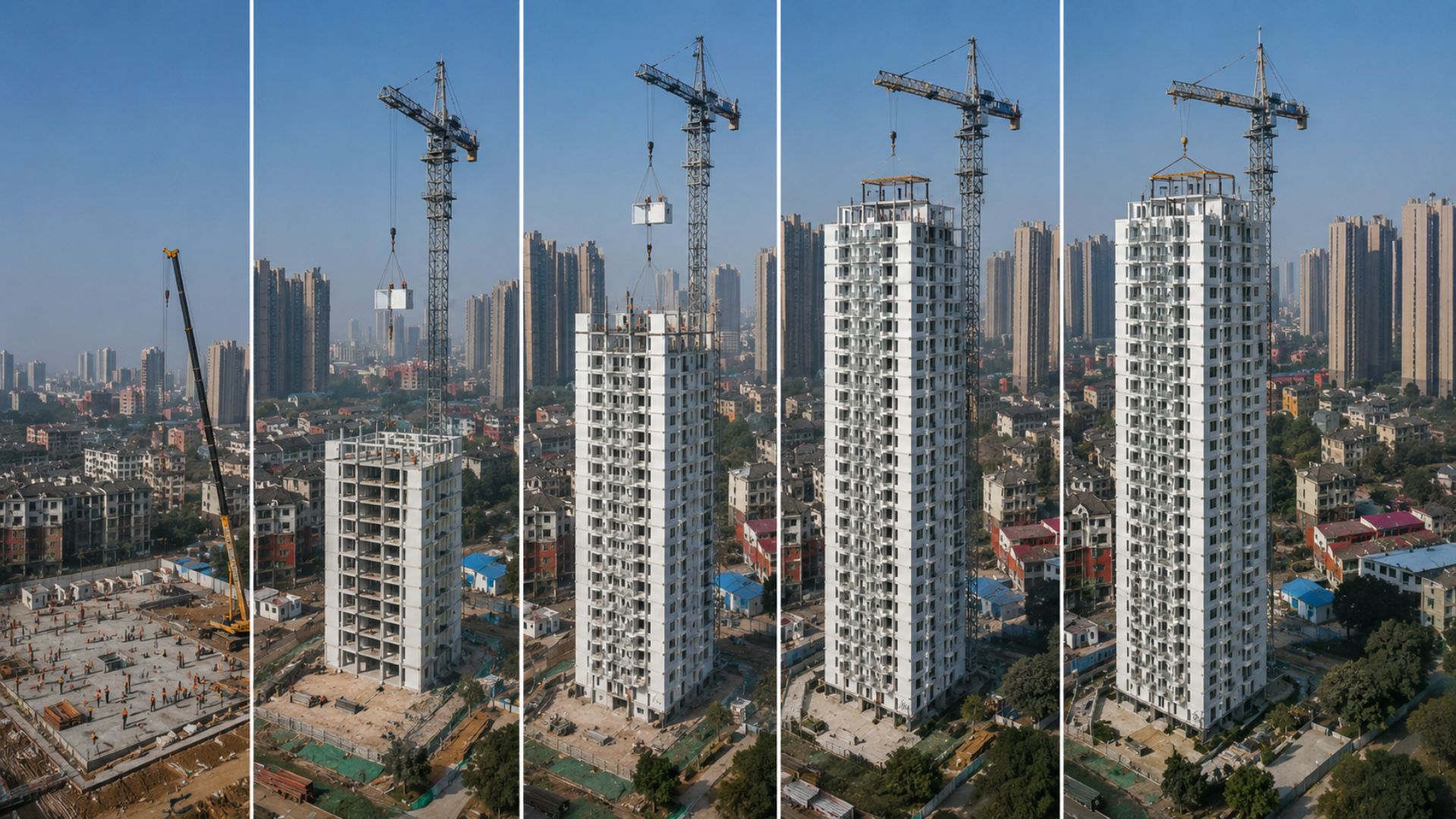


In China, the company Broad Group Holon erected a 26-story building with 14,000 square meters in just five days in Xiangyin County, Hunan Province, using prefabricated stainless steel modules transported ready from the factory. The building, called Jingdu Holon, will have 208 apartments of 68 square meters, and the company claims that the structure lasts more than a thousand years and can be dismantled and rebuilt in another location.
The building was constructed by Broad Group Holon, a company based in Xiangyin with a history of ultra-fast constructions in China. When the construction took place: between January 7 and 11, 2024, totaling five consecutive days of assembly. How the 26-story tower rose so quickly: each apartment was prefabricated in the factory as a stainless steel module with 12 meters in length, 3 meters in height, and 2.4 meters in width, already with electrical wiring and air conditioning piping installed. Why the construction was so fast: the modules arrive at the site ready and are stacked on top of each other like building blocks, eliminating months of work with concrete, masonry, and finishing that characterize conventional construction. After installing all the units, just connect the electricity and water.
The residential building will house professionals hired through a special talent recruitment program in Xiangyin, who will not have to pay rent for the first two years. Each floor consists of eight apartments of 68 square meters and four elevators, and the company is furnishing the units before delivering them to the residents. The case in China is not isolated: the global modular construction market already moves US$ 95 billion a year, and the method that allowed the erection of 26 floors in five days is the most radical expression of a trend advancing on all continents.
How to build a 26-story building in five days

The construction method that China uses to erect buildings at record speed is called Holon and was developed by Broad Group itself. The apartments are manufactured in modular units within a factory, each module with standardized dimensions of 12 meters in length, 3 meters in height, and 2.4 meters in width. Inside each module, electrical wiring, air conditioning piping, and internal finishes are already installed on the production line before the module leaves the factory.
-
Couple Transforms Suffolk’s Last 1891 Windmill into Luxurious Four-Story Home with Zinc Observation Room in England

-
Father and Son Build 97 cm Thick Circular Stone House in Brazil, Inspired by Scottish Architecture, Creating a New Agrotourism Hub
-
Sweden Removes 200-Ton Concrete Gallery to Restore Pjältån River’s Natural Flow in Europe’s Largest Aquatic Restoration Project

-
Key Infrastructure Projects for Brazil’s Next President: Expanding Railways to Cut Transport Costs, Reduce Truck Traffic, Create Jobs, and Boost Industries Nationwide


The stainless steel units are then loaded onto trucks and transported to the construction site, where they are stacked on top of each other like building blocks. About 100 workers participated in the assembly of the Jingdu Holon Building, positioning the modules with the aid of cranes and connecting the structural, electrical, and hydraulic interfaces between the units. When all the modules are installed, electricity and water are turned on, and the building is functionally ready. The company is also including furniture in the apartments, which means that the resident can move in and start using the space without needing renovation or adaptation.
The 2021 precedent: 11 floors in 28 hours

The 26-story building in Xiangyin is not the first demonstration of speed by Broad Group in China. In 2021, the company erected an 11-story apartment building in Changsha, the capital of Hunan province, in 28 hours and 45 minutes. This case became internationally famous and put Broad Group on the map of modular construction as the company capable of delivering results that challenge the conventional conception of how long a construction project takes.
Tony Frost, a modular construction specialist from New Zealand, stayed for a week in the 11-story Holon building in Changsha at the end of last year. He described the experience as positive, stating that the building is very sturdy, clean, and incorporates cutting-edge technology, including a water filtration system that makes tap water drinkable and pleasant. “Walking around the building, the feeling is of robustness, almost like a concrete structure,” reported Frost, adding that small improvements in interior design would make the result even better.
Stainless steel versus concrete: China’s structural bet
The choice of stainless steel as the structural material for the modules is what allows both the assembly speed and the durability that the company promises. Li Shun, general manager of Broad Group Holon, states that the building is earthquake-resistant because the stainless steel structure is more durable than concrete, better absorbing seismic waves without cracking or collapsing. For China, where earthquakes are a real concern in several provinces, seismic resistance is as relevant an argument as construction speed.
The company goes further and claims that the building should last over a thousand years. This projection is difficult to verify in practice, as no modern stainless steel construction has even a century of existence to serve as a reference. However, stainless steel is known to be more resistant to corrosion, weathering, and structural wear than conventional reinforced concrete, which in many countries presents deterioration problems after 50 to 70 years. If Broad Group’s projection is even partially confirmed, China’s modular buildings would have a lifespan several times longer than conventional constructions.
Insulation, windows, and air conditioning: comfort inside the module
The apartments in the Jingdu Holon Building are not metal boxes with a bed and sink. The building’s external walls are designed to reduce noise levels and conserve internal heat, while the four-panel windows prevent the sun’s heat from entering on hot days. According to the Broad Group, the insulation system and special windows can reduce air conditioning costs by up to 90%, a significant saving in a region of China where summers are intense.
For residents accustomed to conventional concrete apartments, the most noticeable difference is the water filtration system that makes tap water directly drinkable. In China, where most of the population only consumes boiled or filtered water due to distrust of the public network, having potable water directly from the tap is a differentiator that adds real value to the living experience. The company is installing this technology in all units of the building, along with the furniture that comes with each apartment.
Dismantlable and transportable: the building that changes address

One of the most surprising aspects of the construction system used by the Broad Group in China is that the entire building can be dismantled and rebuilt in another location. The same block logic that allows assembly in five days works in reverse: the modules can be disconnected, loaded onto trucks, and transported to a new site, where they would be re-stacked in the same configuration or a different one. It is the concept of construction as an industrial product taken to the extreme.


This dismantling possibility has practical implications that go beyond technological curiosity. If an entire neighborhood needs to be relocated due to infrastructure work, a flood, or a change in urban planning, the buildings do not need to be demolished: they can be transferred. For governments investing billions in public housing, the idea that the investment is not tied to a specific plot of land completely changes the financial calculation of housing policy.
US$ 95 billion: the market that China dominates
The case of the 26-story building in five days is not just a demonstration of China’s industrial capability. The global modular construction market already generates US$ 95 billion annually and is growing on almost every continent, driven by the shortage of skilled labor in construction, the pressure for shorter deadlines, and the need to reduce material waste on construction sites. China leads this market both in production volume and execution speed.
While a medium-sized building in London or New York takes an average of three years to complete, the Broad Group demonstrates that the same result can be achieved in days. The difference is not just in speed, but in the model: modular construction turns the construction site into an assembly line and the factory into a true builder, reversing the centuries-old logic that buildings are made on the site where they will stand. For countries facing a housing deficit, like Brazil, the Chinese model offers a challenge that is hard to ignore.
Five days, 26 stories, and a question for the world
China erected a 26-story building in five days with prefabricated stainless steel modules, 208 furnished apartments of 68 square meters, and technology that promises to reduce air conditioning costs by 90%.

The company claims that the structure lasts over a thousand years, is earthquake-resistant, and can be dismantled and reassembled elsewhere. Meanwhile, conventional construction sites around the world continue to measure deadlines in years and budget overruns in millions.
Do you believe that a building constructed in five days can be safe and durable? Tell us in the comments what you think of the Chinese construction method, if you would live in an apartment assembled with factory modules, and how you evaluate the claim that the structure lasts over a thousand years. We want to hear your opinion on the future of construction.


Personally I think it’s an amazing concept. China is leading the world on so many fronts. Congratulations.
Amazing… Hi tech
The buliding regs willbe very differant there