






 Portuguese
  Spanish
  6 min of reading
  4 comments


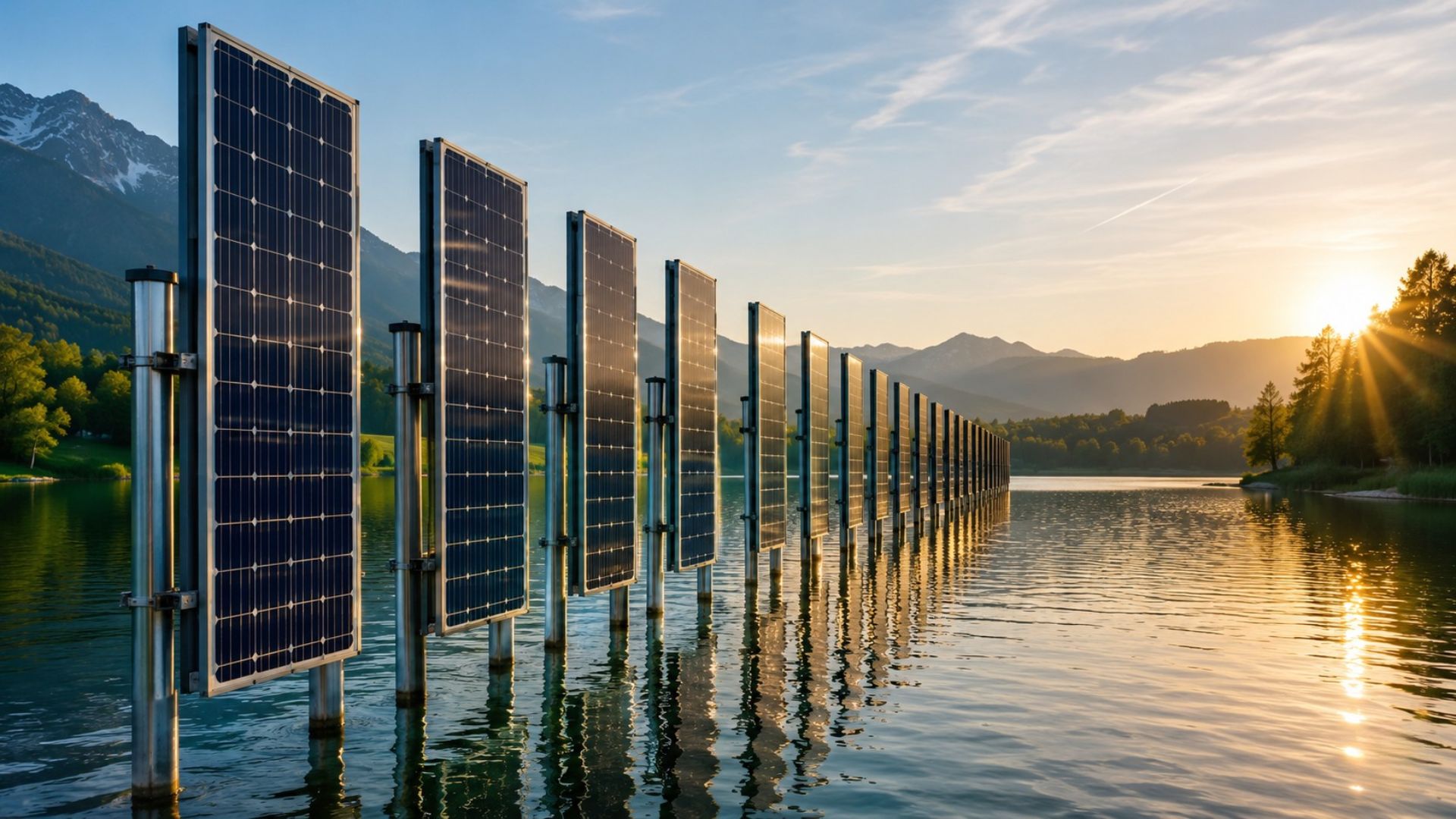


According to information from the Canal Solar portal, Germany activated a plant with vertical solar panels floating on a lake in Bavaria that generates energy during peak real consumption hours for families and factories, early in the morning and at dusk, instead of the traditional midday peak, using bifacial modules that capture light from both sides and harness the reflection from the water to increase production by up to 30%.
The classic image of solar panels tilted towards the sun may be numbered. In Bavaria, the company Sinn Power installed a 1.8-megawatt plant with solar panels positioned vertically on the surface of a lake, breaking with practically everything conventional engineering teaches about solar energy capture. The modules are not tilted south nor do they point to the highest point in the sky. They stand upright, oriented east to west, and the result of this seemingly simple change completely redesigns the energy production curve.
Instead of a single massive generation peak at midday, when the sun is at its highest but domestic and industrial consumption is relatively low, the Bavarian plant produces two energy peaks: one in the early morning hours and another at dusk. These are precisely the times when families turn on their appliances, factories operate at full capacity, and the electrical grid experiences greater pressure. This coincidence between generation and real consumption is not accidental. It is the fundamental principle supporting the decision to place solar panels vertically.
Why vertical changes everything

A conventional solar panel installed on a roof or on the ground is positioned with a southward tilt in the northern hemisphere. This configuration maximizes radiation capture when the sun is at its highest point, generating a production curve with a single peak concentrated between 11 AM and 2 PM. The problem is that this time does not coincide with the moments of highest demand on the electrical grid. The result is excess energy at midday and scarcity during real peak hours.
-
Helicopter Drops 180 Tons of Sand and Gravel on Swedish River to Revive Ecosystem Damaged by Decades of Exploitation

-
Brazilian Company Launches Retro Smartphone with 48 MP Camera, T9 Keyboard, and Privacy Features for Social Media-Free Use

-
Self-Taught Chinese Farmer Builds 5-Ton Submarine from Scrap, Launches It in Anhui River
-
Invisible Induction Technology Enables Wireless Power for Blenders, Coffee Makers, and Air Fryers, Reducing Countertop Cables



The vertical solar panels of the Bavarian plant eliminate this mismatch by creating a dual-peak curve. The east-facing side captures morning light while the west-facing side absorbs late afternoon radiation. Since the modules are bifacial, both sides operate simultaneously, utilizing both direct and reflected light. In practice, the plant generates energy more evenly distributed throughout the day, reducing the need for expensive batteries to store excess electricity produced at midday.
The lake as an ally: reflection, cooling, and efficiency

Placing solar panels on water is not just a matter of saving land, although that factor is also relevant. The lake surface acts as a natural mirror that reflects light back to the underside of the bifacial modules, a phenomenon known as the albedo effect. On cloudy days or when there is snow on the banks, this light rebound can increase energy production by up to 30%, a gain that panels installed on dark soil or roofs simply cannot replicate.
The cooling provided by the water is another technical factor that few know about but that makes a huge difference in the efficiency of solar panels. Photovoltaic modules lose efficiency when they overheat excessively, a common problem in installations on dark roofs or dry land. In the Bavarian plant, the vertical position allows air to circulate freely on both sides of the panels, creating a natural convection current. Combined with the coolness emanating from the body of water, this passive cooling keeps the modules operating at lower temperatures, which extends the lifespan of the components and ensures that every ray of light is converted into electricity with the maximum possible efficiency.
Engineering against the wind: how the plant doesn’t turn into a boat sail
A vertical structure on water faces an obvious enemy: wind. Standing solar panels act like ship sails, offering frontal resistance that could topple or drag the entire installation. The solution found by German engineering is elegant. Each floating unit has a 1.6-meter deep keel that lowers the assembly’s center of gravity, providing stability even under intense gusts.
When the wind blows against the solar panels, the system does not resist rigidly. Instead, it allows for controlled deflection through high-strength cables that absorb the force and redistribute the load without compromising the structure. It’s the same principle that allows modern skyscrapers to sway slightly during storms instead of trying to resist statically. This calculated flexibility ensures that the plant survives adverse weather conditions without needing to retract or protect the modules.
How much does it cost and what are the obstacles
Vertical floating solar panel technology is not cheap. The initial investment is considerably higher than in conventional land-based installations, mainly due to the corrosion-resistant materials required by the aquatic environment and IP68-certified electronic components, capable of withstanding total immersion. For plant operators and investors, the high deployment cost needs to be offset by greater efficiency over the system’s lifespan.
There is also an ongoing debate about the long-term ecological impact on lakes that host floating solar panels. Although the Bavarian project maintains 4-meter spacing between modules to allow light and oxygen to reach the water’s surface, some scientists warn that years of monitoring will be needed to understand how the artificial shade from the panels affects nutrient cycles and ecosystems at the bottom of the lakes. The 1.8-megawatt plant, which supplies about 500 homes, also functions as a living laboratory to answer these questions.
From lake to sea: the next frontiers of floating solar panels


The Bavarian plant is just one of the projects pushing the boundaries of solar energy on water. The French company Heliorec develops platforms designed for coastal marine environments, capable of withstanding winds exceeding 150 kilometers per hour and waves up to 2 meters high, as demonstrated in projects at the port of Brest, France. Bureau Veritas certification validates the technology as safe for port infrastructure worldwide.
Another promising frontier is the combination of floating solar panels with existing hydroelectric power plants. In this hybrid model, photovoltaic modules generate energy during the day while the reservoir water is kept dammed. At nightfall, when the solar panels stop producing, water is released to power the turbines and continue generating electricity. This complementarity leverages the transmission lines already built for the hydroelectric plant, saving millions in infrastructure and eliminating the need for batteries to cover the nighttime period.
A plant that generates energy when you really need it
The German decision to place solar panels vertically on a Bavarian lake might seem counterintuitive at first glance. But data shows that aligning energy generation with actual consumption times solves one of the most expensive problems of the energy transition: storage. Producing electricity when households and industries actually need it reduces reliance on batteries, minimizes waste, and makes the electrical system smarter without requiring additional infrastructure.
Would you install vertical solar panels in your region if the model were viable? Leave your opinion on this technology in the comments and whether you believe Brazil, with its thousands of reservoirs and dams, could adopt floating solar panels as a complement to hydroelectric plants. What caught your attention the most: the double peak curve, the water reflection, or the engineering against the wind?




Ovo vazi za vodene povrsine gde se milioni orelamanja od povrsine vode odbijaju na panele. Zasto ovo ikoga cudi. Kako “izgorite” na moru, reci, jezetu pa i snegu..razmislite
Excellent technology exploration. Yes. Could this be used on the external facade cladding… Cost analysis via return a worthy inquiry.
Coolness emanating – that’s a new take on thermodynamics!! 🤣