






 Portuguese
  Spanish


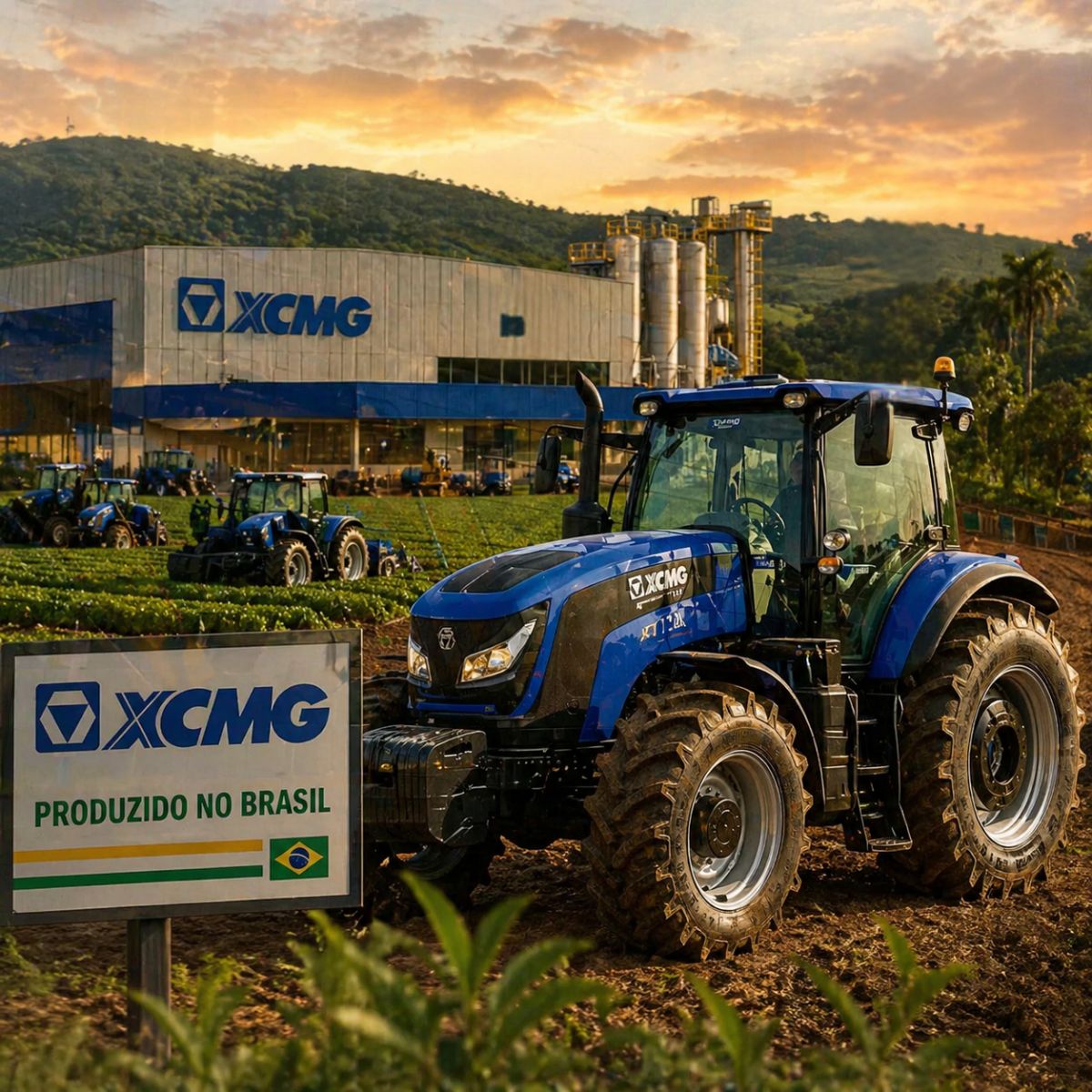


XCMG, a Chinese machinery giant with ties to the Chinese state, is making a strong entry into the Brazilian agricultural tractor market after two decades operating in the civil construction and mining segments. The company presented its models at Agrishow 2026 and plans to commercialize them by the end of the year so they can be operating in the field for the 2026/2027 harvest. XCMG has a factory in Pouso Alegre (MG) with a capacity for 10,000 pieces of equipment per year and its own bank that offers direct credit to rural producers.
The Chinese giant XCMG decided that two decades selling excavators and wheel loaders in Brazil was just a warm-up. Now the company wants to win over the Brazilian rural producer with tractors that it swears are as national as any competitor, manufactured in its Pouso Alegre factory, in Minas Gerais, with increasingly Brazilian components. XCMG presented its models at Agrishow 2026 and the goal is clear: to commercially launch the tractors by the end of the year so they are operating in the field by the 26/27 harvest.
What differentiates XCMG from other Chinese brands trying to enter Brazilian agribusiness is the structure it has already built. The company didn’t just arrive yesterday: it has been in Brazil for at least 20 years and during that time has built a national capillarity that includes a distribution network, technical assistance, and, most tellingly, its own bank. Banco XCMG offers credit directly to rural producers so they can buy the equipment, eliminating dependence on third-party financing lines and creating a closed ecosystem where the company sells the machine and finances the purchase.
The factory in Minas Gerais and the nationalization strategy

According to CNN Brasil Money, XCMG has a factory in Pouso Alegre, Minas Gerais, with an industrial capacity to produce 10,000 equipment per year, and this capacity is practically full. The Minas Gerais unit assembles products from components imported from China, but the company’s strategy is to increasingly ‘tropicalize’ production, incorporating parts manufactured in Brazil by Brazilian companies or by local subsidiaries of international suppliers.
-
Ancient Ritual Circle, Hidden for 5,000 Years, Discovered in Scotland’s Machrie Moor Using Sensors, Revealing a “Phantom Stonehenge”

-
Engineers Develop Fridge-Sized Machine to Produce 95-Octane Synthetic Fuel from Air and Water, Aiming to Sustain Combustion Engines Without Oil
-
Two-Armed Robot Uses AI to Reassemble Destroyed Pompeii Frescoes, Solving an “Impossible” Puzzle
-
New Law in Brazil Requires Breaks for Type 1 Diabetes Management at Work, School, and Public Exams


The nationalization discourse is strong and intentional. XCMG emphasizes that its products are not purely Chinese, but have national content that differentiates them from brands that simply import ready-made machines and resell them in the Brazilian market. The company does not rule out expanding the factory’s operation if demand justifies it, but for now, the focus is on incorporating national components that increase the percentage of Brazilian content and facilitate access to financing lines that require domestic production.
From yellow machines to tractors: entering agribusiness
The Chinese giant built its presence in Brazil with “yellow line” machines: backhoes, excavators, and equipment for civil construction and mining. The company already served agribusiness clients, but indirectly, providing wheel loaders for grain warehouses and heavy equipment for rural property infrastructure. Now, the step is direct: tractors for the producer who plants, harvests, and needs power in the field.
The models presented at Agrishow 2026 are aimed at low to medium power tractors, a segment where competition is fierce but where XCMG believes it can gain ground with competitive pricing, its own financing, and an already established technical assistance network. The advantage of entering agribusiness with 20 years of presence in Brazil is that the company doesn’t need to build the structure from scratch: national capillarity, technicians, spare parts, and relationships with distributors already exist.
The in-house bank that finances the purchase of tractors


XCMG Bank is a competitive advantage that few manufacturers can offer. The Chinese giant’s financial institution provides credit directly to rural producers for the acquisition of equipment, with conditions that XCMG can calibrate according to its commercial strategy. If the goal is to gain market share, the bank can offer more aggressive rates. If the goal is margin, it can balance financing with sales profitability.
For the Brazilian rural producer who faces difficulty accessing traditional bank credit lines, especially in times of high interest rates and restricted credit, having a manufacturer that sells the machine and finances the purchase at the same counter is an attractive proposition. The logic is the same that BYD adopted with electric vehicles: vertical integration from production to financing, creating a buying experience that traditional competitors, dependent on third-party banks, cannot replicate with the same agility.
The electrification of Chinese agricultural machinery
One point that stands out in XCMG‘s strategy is electrification. The company’s machines include electric models, following a trend of Chinese automakers that dominate the global electric vehicle market and are now transferring this technology to heavy and agricultural equipment. Companies like BYD and GWM have already proven that electrification works in Brazil with cars and buses, and XCMG bets that the same path can work in the field.
The alternative is not unique. Other manufacturers like Case IH, part of the CNH Industrial group, are testing ethanol engines, taking advantage of an abundant biofuel in Brazil. The rural producer will have to calculate which technology makes more sense for their operation: electricity, ethanol, or conventional diesel. The diversity of options is good for the market, but XCMG‘s presence with electric machines and its own financing pressures competitors to present equally competitive proposals.
What XCMG’s entry means for the tractor market in Brazil
The arrival of the Chinese giant XCMG to Brazilian agribusiness with its own tractors, local factory, financing bank, and electric machines adds a significant competitor to a market historically dominated by brands like John Deere, Massey Ferguson, New Holland, and Valtra. The Chinese company is slowly gaining ground, winning over producers who prioritize price and payment conditions over brand tradition and historical presence.
For traditional manufacturers, the warning is that XCMG is no longer just another unknown Chinese brand trying to sell imported tractors. It is a company with 20 years in Brazil, a factory in Minas, its own bank, and a nationalization strategy that makes it difficult to argue that “Chinese products lack support.” Agrishow 2026 was the presentation stage, but the real dispute begins when the tractors arrive in the field and producers put the machines to work in the 26/27 harvest.
Would you buy a tractor from a Chinese manufacturer with a factory in Brazil and its own bank, or do you prefer to stick with the traditional brands you already know? Tell us in the comments if you think the Chinese presence in agribusiness is good for lowering prices or if you are concerned about competition for national industry.







Chase them out , boycott them their machine no good