Portuguese
  Spanish


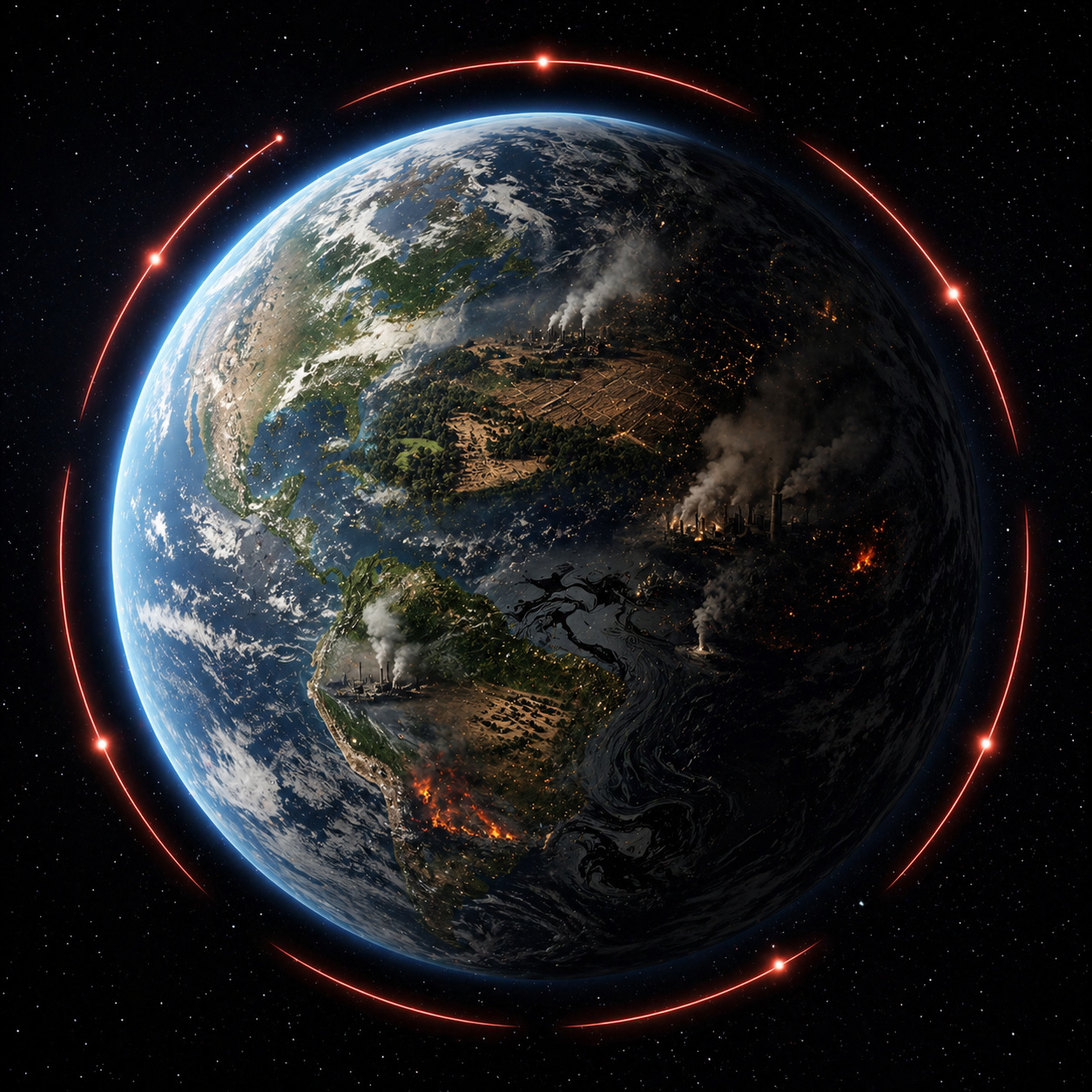

Planetary Health Check 2025 points to 7 planetary boundaries exceeded and warns of increasing risk of Earth destabilization.
According to the Potsdam Institute for Climate Impact Research, the Planetary Health Check 2025, the second annual report assessing the state of the nine systems that regulate the planet’s stability, resilience, and life-support functions, was published on September 24, 2025, with a diagnosis that surpasses any previous edition. Seven of the nine planetary boundaries have been exceeded, and all seven show a trend of increasing pressure. None are stabilizing. None are improving. The planet is now at the upper end of the “danger zone,” approaching the “high-risk zone,” where the risk of triggering catastrophic tipping points becomes very high. “More than three-quarters of Earth’s support systems are not in the safe zone.
Humanity is pushing beyond the limits of a safe operating space, increasing the risk of destabilizing the planet,” said Johan Rockström, director of the Potsdam Institute and co-creator of the planetary boundaries framework.
The window to return to the safe space remains open, but it is closing rapidly. The report’s central warning is not just climatic. It is systemic: it involves the atmosphere, oceans, forests, freshwater, biodiversity, agriculture, chemical pollution, and the physical and biological mechanisms that keep Earth habitable for complex human societies.
-
Canada Builds 6.2-Hectare Containment Box to Trap 615,000 Cubic Meters of Toxic Sediment in Lake Ontario

-
NASA Plans Telescope That Can Be Repaired by Robots 1.5 Million Kilometers from Earth
-
U.S. City Faces Dilemma as Study Warns of Sinking Land and Rising Seas: Invest in Flood Defenses, Restore Wetlands, or Relocate?
-
4,000-Year-Old Stone Towers Discovered Across Sardinia, Puzzling Archaeologists About This Mysterious Civilization


What are planetary boundaries and why do they define the safe zone that has sustained 10,000 years of human civilization
In 2009, Johan Rockström and 27 other scientists published a paper in the journal Nature that proposed a new way of understanding the relationship between humanity and the biosphere.
Instead of only addressing average temperature and carbon emissions, the group identified nine fundamental biophysical processes that, together, maintain Earth in the relatively stable state that allowed the emergence and expansion of human civilizations over the past 10,000 years, the geological period called the Holocene.


For each of these nine processes, scientists defined quantitative limits, values beyond which the risk of irreversible destabilization of the Earth system begins to grow significantly. These limits are not points of immediate collapse. They are safety margins. Exceeding them does not mean instant end, but entry into a region of increasing risk of abrupt and irreversible changes, known as tipping points.
The metaphor used by Rockström is that of an immune system. As long as the planet operates within its limits, it maintains resilience, meaning the ability to absorb disturbances and recover. When the limits are exceeded, this resilience decreases.
When multiple boundaries are transgressed simultaneously, the systems begin to influence each other in ways that can amplify disturbances instead of dampening them.
Seven of the nine planetary boundaries are already in the red and all continue to move in the wrong direction
The seven currently exceeded boundaries are climate change, biosphere integrity, land-system change, freshwater use, biogeochemical flows, novel entities, and, for the first time in 2025, ocean acidification.
The first edition of the Planetary Health Check, published in 2024, had documented six exceeded boundaries. The 2025 edition added the seventh and raised the alert about the integrated state of the Earth system.
Climate change is the best-known boundary. Atmospheric CO₂ is at 424.69 ppm, 74 parts per million above the safe limit defined at 350 ppm, and at its highest level in at least 15 million years.

Biosphere integrity, considered by the report one of the two core system boundaries along with climate, is also in a critical situation. The extinction rate is above 100 extinctions per million species per year, ten times the safe limit of 10 extinctions per million.
The change in the Earth’s system reflects the loss of global native forest cover, especially in tropical regions. Freshwater use has exceeded the limit with the extraction from rivers, lakes, and underground aquifers beyond natural recharge rates. More than 4 billion people face severe water scarcity for at least one month per year, directly connecting the planetary crisis to urban supply, food production, energy, and public health.
Nitrogen, phosphorus, plastics, pesticides, and new synthetic substances increase pressure on rivers, soils, and oceans
The biogeochemical flows of nitrogen and phosphorus, driven mainly by industrial agriculture, represent the most severely violated limit of all. Nitrogen is more than 200% above the value considered safe.
This excess contaminates rivers, creates dead zones in the oceans, acidifies soils, and alters entire ecological chains, affecting everything from microscopic organisms to food production systems.
The synthetic entities include plastics, pesticides, industrial chemicals, nanoparticles, and genetically modified organisms that escape into the environment.

The critical point is that the biosphere has never encountered these substances on this scale and at this speed. Many of these compounds are persistent, circulate through water, soil, and air, accumulate in organisms, and can produce effects that are not yet fully known.
Ocean acidification, a new limit exceeded in 2025, has entered the danger zone mainly driven by the burning of fossil fuels, aggravated by deforestation and land-use change. The ocean has become between 30% and 40% more acidic since the beginning of the industrial era. Corals, mollusks, and crustaceans depend on calcium carbonate to form their structures, which dissolve more easily in more acidic water.
Why the simultaneous exceeding of planetary boundaries makes the global risk greater than each isolated crisis
The most disturbing aspect of the Planetary Health Check 2025 is not just the list of seven exceeded limits. The central point is what happens when multiple limits are transgressed at the same time. The nine systems are not independent. They are connected by feedback mechanisms that make the deterioration of one system amplify the deterioration of others.
The report documents a specific chain that illustrates this risk. The advancement of climate change can trigger tipping point dynamics in the Atlantic Meridional Overturning Circulation, the AMOC. This disturbance alters precipitation patterns in the Amazon rainforest, also leading to tipping point dynamics in the Amazon and degrading the integrity of the biosphere.
The sequence is systemic: climate change destabilizes the AMOC, the disturbed AMOC dries the Amazon, the drier Amazon loses biomass and can become a carbon source, and the released carbon accelerates climate change.
This cascading mechanism is what makes the “high-risk zone” so critical, because the problem ceases to be the crisis of each isolated system and becomes the possibility of one system triggering another irreversibly.
What climate models still cannot simulate on a planet with seven limits exceeded at the same time
An admission that runs through the report implicitly, and that Rockström made explicit in interviews, is that the climate and Earth system models available today were calibrated and validated for a planet that no longer exists.
This observation does not invalidate the models. It shows the unprecedented scale of the scientific challenge in front of a planetary system operating outside the historical conditions that served as the basis for projections.
The models were developed and adjusted with historical data from a planet that operated within the planetary boundaries or close to them.
They have never simulated a planet with six or seven limits simultaneously exceeded, all worsening at the same time, with feedback systems operating under conditions of temperature, atmospheric composition, and ecological degradation that have not existed at any time in the Holocene.
This has direct implications for the reliability of projections. Models may be underestimating the speed and intensity of future changes simply because they have never been tested against conditions analogous to those the planet is now creating. The scientific terra incognita is not a confession of ignorance, but an accurate description of a planetary state unprecedented in the last 10,000 years of human civilization.
Ozone layer recovery shows that the window for action still exists when there is global political decision
The report is not just a risk diagnosis. It also serves as an argument against fatalism. This argument relies on one of the two boundaries that still remain in the safe zone: stratospheric ozone depletion. The ozone hole over Antarctica was one of the greatest environmental crises of the 20th century and became a symbol of humanity’s capacity to damage entire planetary systems.
The Montreal Protocol, signed in 1987, banned chlorofluorocarbons responsible for ozone depletion and has come to be considered one of the most successful environmental agreements ever implemented. The ozone layer is recovering and may be completely restored in about 50 years.
“The drop in aerosol pollution and the healing of the ozone layer show that it is possible to change the direction of global development. Even if the diagnosis is serious, the window for healing is still open. Failure is not inevitable, failure is a choice. A choice that must and can be avoided,” Rockström stated when presenting the report.
Ozone and aerosols have something in common that distinguishes them from the other seven boundaries: there was clarity about what caused the problem, alternative technologies were available, and there was sufficient international political will to act in a coordinated manner. For the other seven boundaries, the equation is more complex.
They involve energy, agriculture, chemical industry, land use, material consumption, and global production patterns, but the principle indicated by the report is the same: degraded planetary systems can respond to consistent policies.
What the five-year timeframe cited in the report on planetary boundaries and risk of systemic collapse means
The reference to “five years” in the report does not appear as a catastrophe date. It appears as the horizon within which system trajectories need to start reversing for the window to return to the safe operating space to remain viable.
The distinction is essential: it is not about stating that the planet will collapse in five years, but about indicating that, in the next five years, real reversal trends will need to be observed to prevent the risk of collapse from becoming dominant.
Earth.org cited the report stating that humanity has five years to reverse planetary boundary trends, with 50% cuts in climate emissions needed before the end of the decade. This number, 50% by 2030, is consistent with what the IPCC establishes as the minimum condition to keep warming below 1.5 °C.
The Planetary Health Check, however, adds a broader layer to the debate: it is not just the climate that needs a trend reversal, it is all seven transgressed systems simultaneously.
A world that cuts carbon emissions by 50%, but continues to deforest, overload rivers with fertilizers, and introduce plastics, pesticides, and persistent chemicals into ecosystems, will still be pushing multiple planetary boundaries in the wrong direction. The strength of the Planetary Health Check lies precisely in forcing the reading of the planet as an integrated system, not as a list of independent environmental problems.
Why the Holocene is the central reference for understanding the risk of leaving Earth’s safe operating space
Rockström, concluding the report presentation in September 2025, revisited a central image from his work on planetary boundaries: the Holocene was the only planetary state in which human civilizations demonstrated their ability to thrive. It was during this period of relative stability that organized agriculture, cities, states, infrastructure, global trade, modern science, and complex economic systems emerged.

Leaving this state, as humanity is doing, means entering an experiment without historical precedent. Climate is just one of the nine boundaries.
The other eight also matter for the stability of the system that sustains human civilization. Biodiversity, forests, freshwater, oceans, chemical cycles, and synthetic pollution form a support network that cannot be treated as an accessory to climate policy.
Unprecedented experiments have, by definition, results that no model can guarantee. Given this scenario, the direct question remains: will humanity still treat planetary boundaries as distant scientific warnings or as the real map of the stability that sustains everything we call civilization?