






 Portuguese
  Spanish


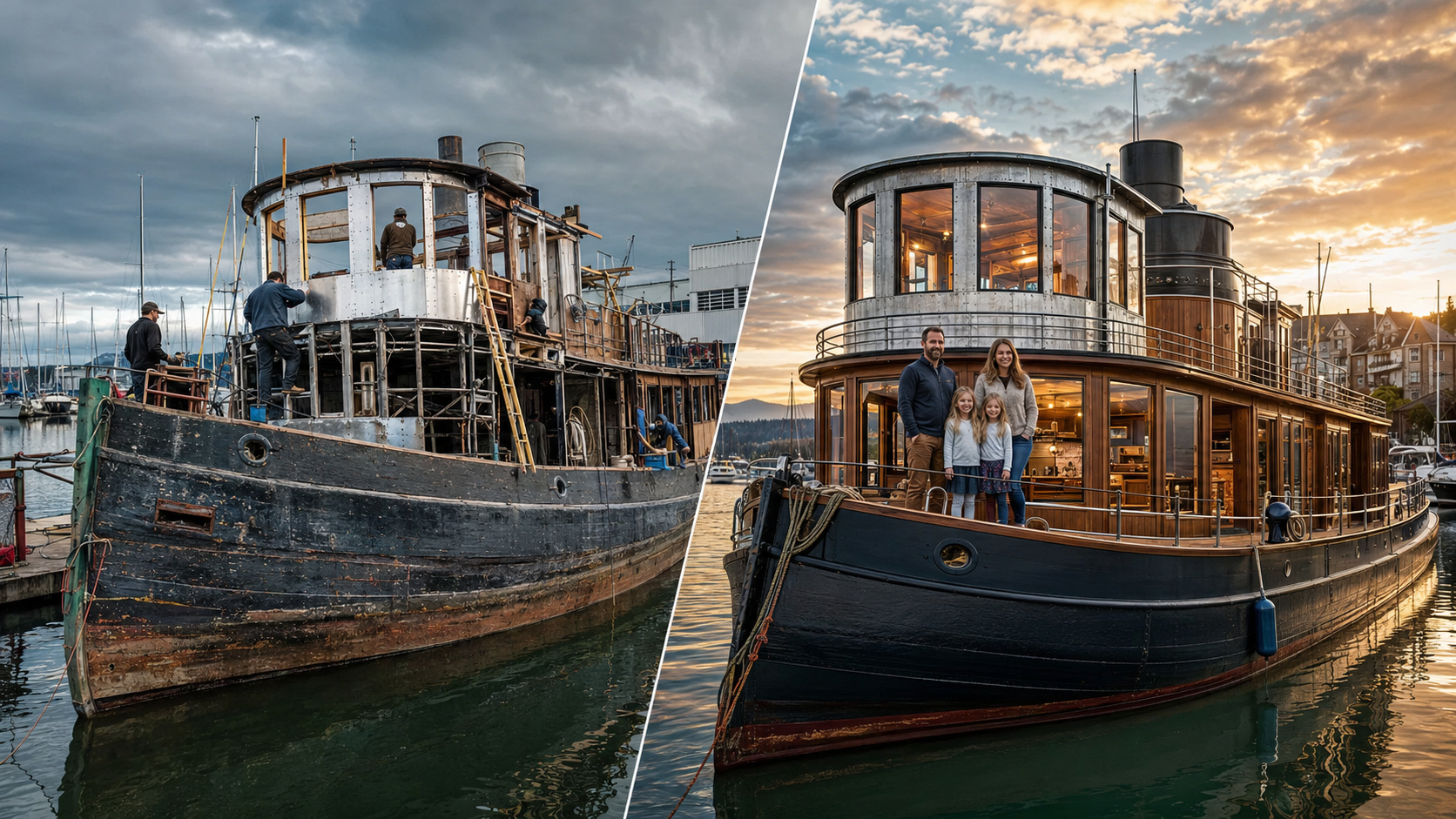

The conversion of the tugboat into a floating house took 21 months, replaced degraded parts with naval aluminum, and created a 17-meter dwelling with four bedrooms, two bathrooms, and three levels, but maintained challenges such as maritime insurance, controlled energy, and search for marina docking.
Pamela and Ulrich bought the old tugboat in 1995 and spent 21 months rebuilding much of the vessel. The 17-meter, 60-ton boat gained residential spaces and became the permanent home where the couple raised two daughters.
The information was published by Auto Evolution, a digital publication about vehicles, transportation, and mobility. The work required the removal of rotten wood, the reconstruction of the upper level, and the use of naval aluminum.
The work went far beyond a change in decoration. The couple had to reorganize an old vessel to accommodate bedrooms, bathrooms, kitchen, living areas, heating, and water and electricity connections.
-
New R$ 62 million viaduct is inaugurated with 355 meters, eliminates railway crossing, and promises to improve traffic in São João de Meriti

-
New application of Styrofoam on walls draws attention for offering efficient thermal insulation with low investment, helping families keep environments cooler, save electricity, and transform ordinary constructions with a simple and functional solution.

-
For 50 years, this concrete giant stored grain at the Copenhagen port, until it gained new floors, a metal facade, and panoramic windows to house 38 apartments of up to 400 m².
-
Built in 1867 to guide mobile gas tanks, three giant frames were dismantled piece by piece and reassembled around 145 circular apartments in London.


1926 Vessel Went from Sailboat to Tugboat
The Zenia Sofia was built in 1926 and was initially named Edward A Young. At that time, it was a two-masted sailboat, a structure quite different from what it has as a floating house.


The vessel worked as a tugboat for approximately four decades. This type of boat helps to pull, push, and position other vessels, an activity that requires a construction prepared to withstand great efforts.
After the maritime work phase, the boat passed to private owners and began functioning as a permanent residence in 1969, still under the name Crusader. The purchase made by Pamela and Ulrich initiated a new stage of family renovation and adaptation.
The name Zenia Sofia was adopted in 2010 and combines the names of the couple’s two daughters. They grew up inside the vessel, using the bedrooms built in the lower part of the boat.
Rotten Wood Revealed the Extent of the Naval Renovation
The condition of the wood showed that the transformation could not be limited to creating furniture and partitions. Degraded parts needed to be removed before the new environments were assembled.
Pamela and Ulrich personally carried out much of the 21-month naval renovation. After removing the masts, they rebuilt the entire upper level and used naval aluminum in the new structure.

Naval aluminum is a material used in maritime applications. Its use allowed for the creation of the upper part necessary to expand the residential area without repeating the entire old wooden construction.
Ulrich’s experience with sculptures and metalwork helped in the execution. Being part of the services reduced the reliance on external professionals, something important because a conversion of this size can be costly.
Floating house gathers four bedrooms in 17 meters
The Zenia Sofia is 17 meters long, weighs 60 tons, and is organized into three levels. These dimensions allowed for the creation of a dwelling larger than many compact floating houses.
The vessel includes four bedrooms, two bathrooms, two living rooms, a full kitchen, pantry, and a command cabin lined with wood. The upper level also functions as an open area during favorable weather periods.
Auto Evolution, a digital publication on vehicles, transportation, and mobility, gathered details of the internal distribution. The daughters’ bedrooms were located on the lower part and shared a bathroom.
After they left the house, these former bedrooms began to be used as storage. The change shows how the internal spaces continued to be adapted to the residents’ routine.
Kitchen and heating required custom solutions for the boat
The kitchen uses gas for cooking and heating water. During the cold months, the vessel has wood stoves and a heater that uses compacted wood fuel.
These solutions help keep the house running, but electricity needs to be controlled in some situations. Consumption does not occur in the same way as in a regular residence directly connected to the urban grid.
The distribution of the spaces also needed to consider the narrow and long shape of the vessel. Bedrooms, bathrooms, kitchen, and living rooms were fitted in without eliminating the necessary areas for circulation and operation of the boat.
The command cabin was maintained, while the residential spaces occupied different parts of the structure. Thus, the Zenia Sofia preserved elements of a vessel and began to meet the daily needs of a family.
60-ton Residence Depends on Marina Infrastructure
When the internal visit was recorded, the Zenia Sofia was docked at the Shilshole marina in Seattle, United States. The boat remains there for most of the time and can sail during the summer months.
The water and electricity used by the residents come from the marina. Therefore, even while floating and maintaining navigation capability, the house depends on external infrastructure to function more comfortably.

Finding a suitable docking spot is among the main challenges faced by Pamela. A 17-meter and 60-ton boat cannot occupy just any available space in a marina.
Marine insurance represents another important point. A floating house is still a vessel and needs to deal with different risks and needs than those found in properties built on land.
Renovation Does Not Eliminate the Demands of an Old Vessel
The rotten wood found during the work shows that conservation directly interferes with residential use. In a boat, a compromised structural part can cause bigger problems than a simple finishing flaw.
The age of the vessel, continuous contact with water, and the size of the structure increase the importance of maintenance. The house also needs to maintain kitchen, heating, energy, storage, and circulation systems within a space originally created for another function.
The total cost of the renovation was not disclosed. Therefore, it is not possible to safely compare the investment made in the Zenia Sofia with the price of a conventional house.
The case shows that repurposing an old vessel can extend its useful life but requires technical knowledge, structural work, and permanent access to marina services.
The Zenia Sofia ceased to fulfill its former function as a tugboat and received a residential structure with four bedrooms, two living rooms, and two bathrooms. The renovation preserved a vessel from 1926 and allowed its continuous use as a family home.
At the same time, the 21 months of work, the replacement of wood, and the reconstruction with naval aluminum show that a floating house of this size is not born merely from a creative idea. It depends on engineering, maintenance, and infrastructure.
Would you trade a conventional house for an adapted tugboat even knowing you would have to take care of the vessel, insurance, and docking?


