






 Portuguese
  Spanish


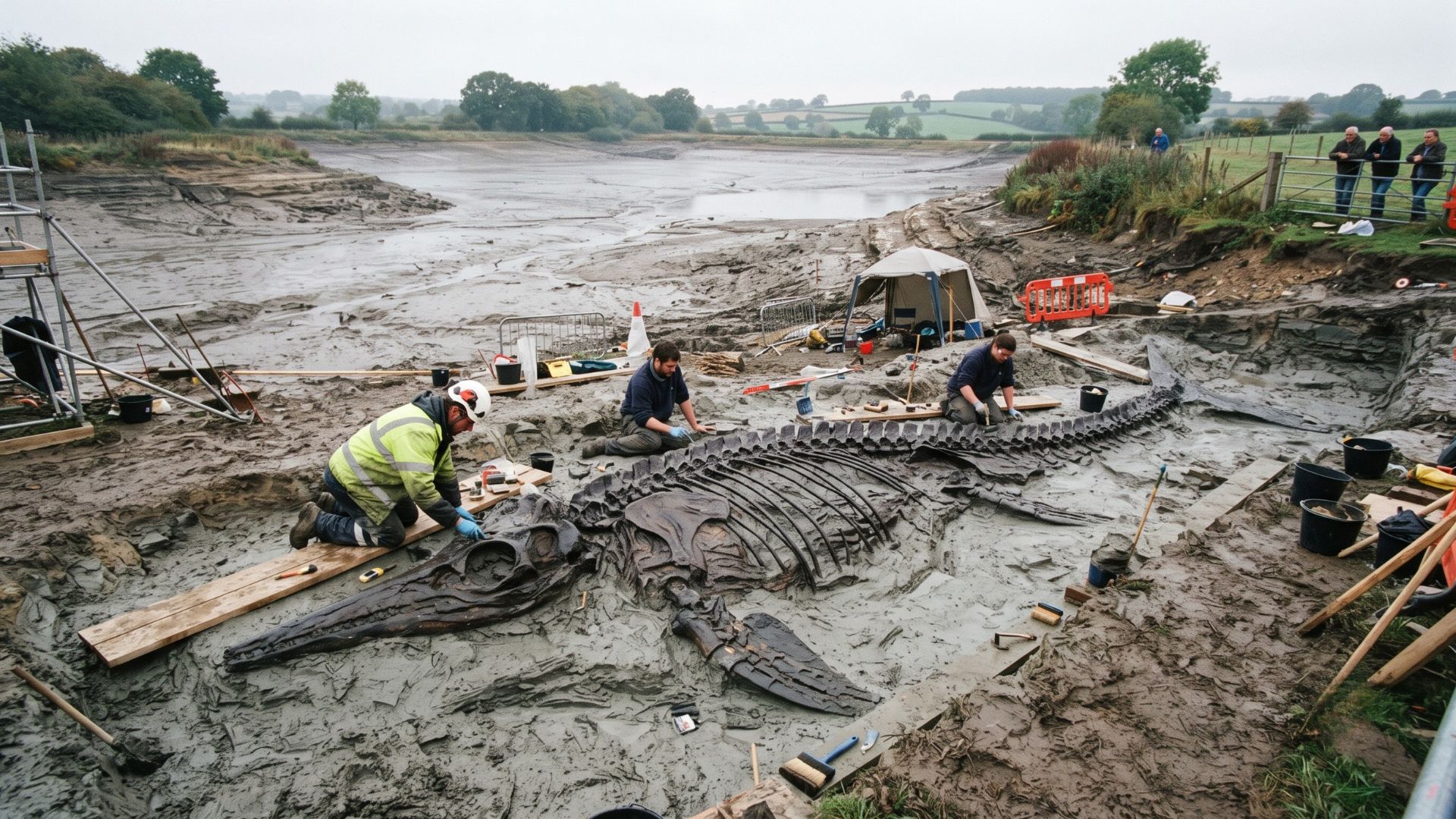

An employee was draining a pond in England when he found the almost complete skeleton of a 10-meter “sea dragon” that swam 180 million years ago.
What was supposed to be just another day of maintenance at a pond in the English countryside turned into one of the most important paleontological discoveries in the country’s recent history. While overseeing the routine drainage of a pond at the Rutland Water nature reserve in February 2021, conservation team leader Joe Davis noticed an unusual sequence of large bones emerging from the mud.
At first, they seemed like just a few isolated vertebrae. Soon after, however, it became clear that he had found something extraordinary. Beneath the pond bed was the almost complete skeleton of a huge ichthyosaur, a marine reptile popularly known as a “sea dragon.” About 10 meters long and estimated to be 180 million years old, the animal became the largest and most complete ichthyosaur ever found in the UK.
According to the Leicestershire and Rutland Wildlife Trust, studies indicate that the fossil likely belongs to the species Temnodontosaurus trigonodon. The discovery also represents the first record of this species in British territory.
-
A college in Peru turned a street billboard into a ‘factory’ for drinking water that pulls moisture from the air: in three months, the panel produced almost 9,500 liters in one of the driest capitals on the planet.

-
The coast of Pernambuco has more than a dozen deliberately sunken ships at the bottom of the sea, and what started as a junkyard has become one of the largest wreck diving parks in Brazil, a refuge for turtles and schools of fish.
-
A woman left São Paulo to help her 88-year-old father in the hinterland of Paraíba, found the abandoned family farm, switched cassava and cattle for organic fruits, and harvested 24 tons of melon and watermelon in the semi-arid region, proving that tradition, irrigation, and planning can transform forgotten land into a sustainable business.

-
A network of cameras created to hunt down stolen cars recorded over 1 million alerts in a single American city in one year, overwhelmed the police, and forced the department to disable precisely the feature that was supposed to be the system’s strong point.



A find that started with a few vertebrae in the mud
The discovery happened during conservation work carried out at the Rutland Water nature reserve, located in Rutland County, in central England. With the pond partially emptied for maintenance, parts of the ancient seabed were exposed. It was at this moment that Joe Davis noticed a row of circular structures aligned on the ground.


Upon closer investigation, he concluded that these pieces resembled fossilized vertebrae. Shortly after, another team member found a large jaw almost entirely preserved. Experts were called to the site and quickly confirmed that it was one of the most important fossils ever found in the country.
The “sea dragon” was not a dinosaur
Despite the popular nickname, the discovered animal was not a dinosaur. Ichthyosaurs belonged to a group of marine reptiles that lived between approximately 250 million and 90 million years ago. They evolved for aquatic life long before modern dolphins and developed extremely hydrodynamic bodies, with fins, elongated snouts, and a powerful tail adapted for high speeds.
Visually, they resembled a cross between a dolphin and a crocodile, although they were not closely related to either. During the Jurassic, these animals occupied the top of the oceanic food chain.
One of the Largest Predators of the Jurassic Sea
Scientists believe the fossil belongs to a specimen of Temnodontosaurus trigonodon, one of the largest ichthyosaurs ever known. At approximately 10 meters in length, this marine reptile was a large-scale hunter. Its long snout housed dozens of sharp teeth, ideal for capturing fish, squids, and even other smaller marine reptiles.
The enormous eyes also draw attention. Some closely related species had eyes among the largest ever recorded in any vertebrate, an adaptation that allowed hunting even in deep waters with low light.
An Impressively Preserved Skeleton
The state of preservation of the fossil surprised even the paleontologists. Much of the vertebral column remained articulated, as well as ribs, fins, and a good part of the skull. The head alone is almost a meter wide and weighs about a ton.
Before removing the bones, researchers spent months carefully recording every detail of the animal’s original position. Thousands of photographs and three-dimensional models were produced to digitally preserve the skeleton exactly as it was found. Only after this work did the delicate removal of the pieces begin.
The First Specimen of the Species Found in the United Kingdom
Another important aspect of the discovery is the identification of the species. Studies indicate that the animal belongs to Temnodontosaurus trigonodon, an ichthyosaur known mainly from fossils found in Germany. If the classification is definitively confirmed, this will be the first record of this species in the United Kingdom.
The discovery expands knowledge about the distribution of these large predators during the Jurassic period and helps scientists reconstruct what the seas covering Europe were like about 180 million years ago.
When That Region Was Covered by the Ocean
Today, Rutland Water is far from the coast. But during the Jurassic, that entire region was part of a shallow, warm sea teeming with marine life. It was in this environment that the ichthyosaur lived, hunted, and died. After sinking to the ocean floor, its body was quickly covered by sediments.
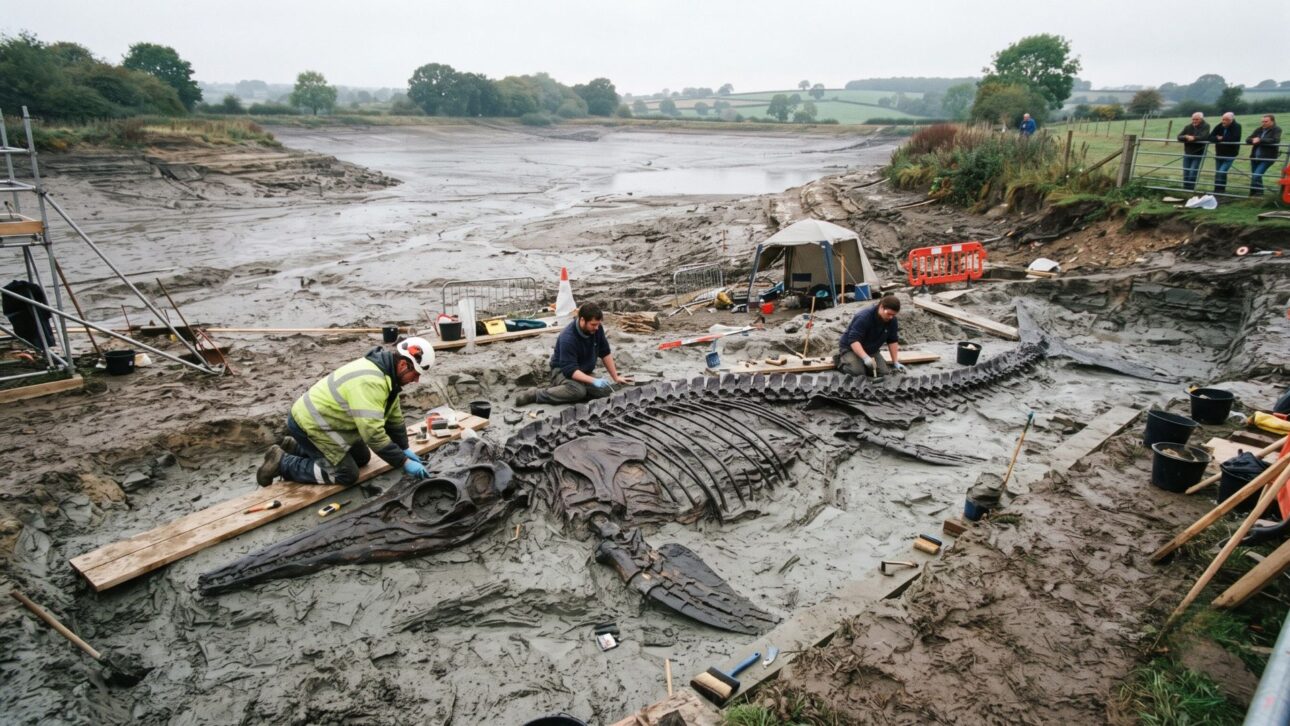
Over millions of years, these sediments turned into rock, preserving the almost complete skeleton until it was rediscovered by chance during a simple lagoon drainage.
A discovery that shows how much is still hidden beneath our feet
Paleontologists classified the find as one of the most important ever made in the United Kingdom. Besides the exceptional size, the state of preservation will allow the study of details of the anatomy, evolution, and lifestyle of the large marine reptiles with a level of precision rarely possible.
The discovery also shows that extraordinary fossils do not always appear in planned excavations or in regions famous for paleontology. Sometimes, a simple maintenance work in a lagoon is enough to reveal an animal that dominated the oceans when dinosaurs still walked the Earth.


