Portuguese
  Spanish


Technology that eliminates the need for calibration and does not suffer punctures has begun operating on a 4.8 km public route, mainly used by the elderly in a mountainous region. The commercial debut occurs at low speed and is still far from private cars, but it will allow measuring wear, comfort, and costs outside the laboratory.
Bridgestone has started the first regular operation of its AirFree airless tire in Japan. The technology is now equipping a small autonomous electric vehicle that transports residents between rural communities in Higashiomi, Shiga Prefecture.
The service began on July 8, 2026, following a ceremony held the previous day. Unlike the temporary demonstrations held in recent years, the tires are now part of the normal routine of municipal transport.
The choice of location has a practical reason. In the mountainous district of Okueigenji, more than 60% of the population is elderly, while the lack of drivers and operators makes it difficult to maintain conventional lines.
-
Couple buys 1905 colonial house, plans to tear down walls to unite three rooms, but finds hidden service staircase and rethinks the entire renovation to preserve details that have survived for over a century.

-
Couple receives a quote of $50,000 to install a built-in refrigerator, decides to do the work themselves, spends $6,000, and claims to have saved over $100,000 by renovating the house.
-
At 77 years old, an elderly woman lives alone in an almost ghost village in the French Alps, at an altitude of 1,000 meters, where there is a town hall, a mayor, and an entrance sign, but only she lives there every day in a place destroyed by a landslide and almost erased from the map.

-
India excavates a 28 km artificial lake in the Thar Desert, lines the bottom with a giant plastic sheet to prevent 1.41 million tons of water from disappearing into the sand, and attempts to supply 5 million people throughout the year.


According to the joint statement from Bridgestone and the Higashiomi city hall, the AirFree was installed on the autonomous vehicle “Okueigenji Keiryu Car” to reduce stops caused by punctures, eliminate periodic calibration, and facilitate fleet maintenance.
The first commercial use begins where a flat tire can interrupt an essential service
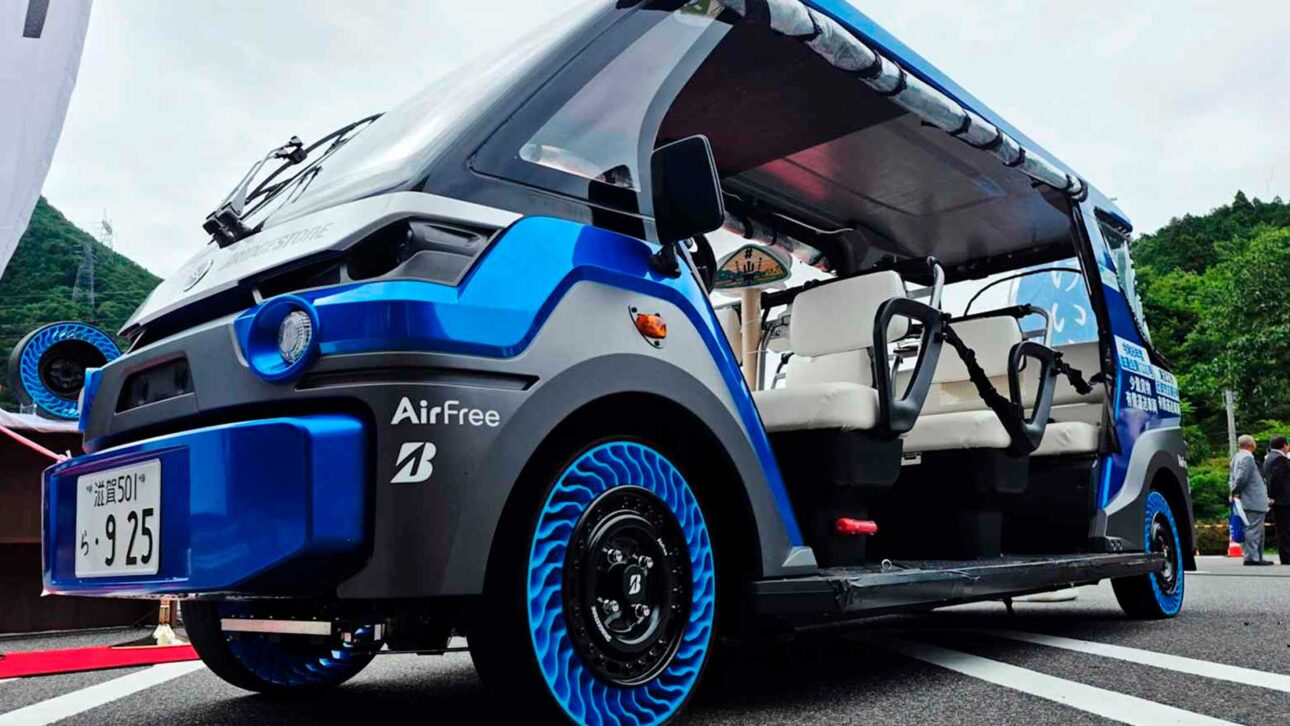
The vehicle used in the operation resembles an elongated golf cart. It travels through an area with local roads, small communities, and few transport services, connecting residents to the Okueigenji Keiryu no Sato bus station, which also houses administrative, commercial, and public service activities.
In this type of operation, a simple puncture can take the vehicle out of circulation and leave some passengers without an immediate alternative. The main benefit of AirFree is not to increase speed, but to prevent the transport from stopping due to loss of pressure.
The commercial implementation was preceded by an agreement signed on January 15, 2025, between the city and the manufacturer. As Bridgestone reported at that time, the project aimed to test the tire in a service facing concrete problems related to population aging, labor force reduction, and the isolation of rural communities.
Instead of air, blue resin spokes support the vehicle’s weight
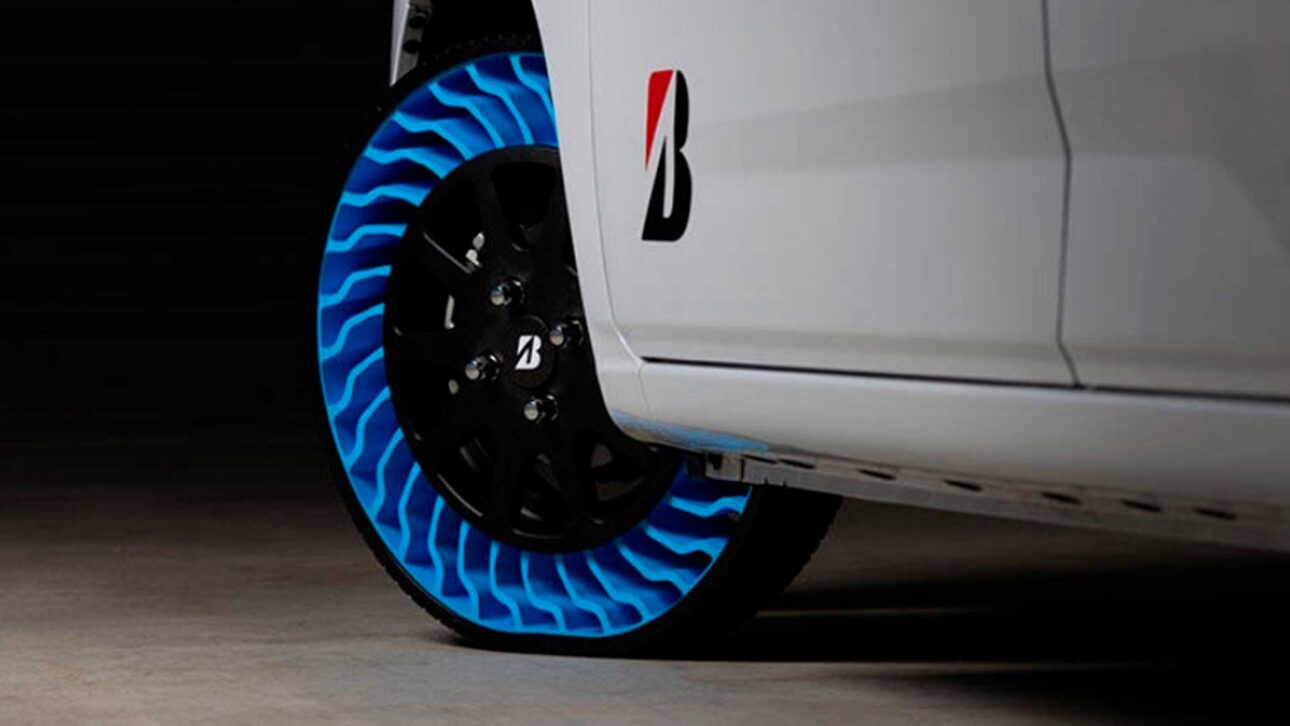
A conventional tire relies on compressed air to support the vehicle and absorb road irregularities. In the AirFree, this function is performed by a side structure made of flexible thermoplastic resin spokes, mounted between the wheel and the rubber tread that touches the asphalt.
When the tire bears the vehicle’s weight, the spokes deform and distribute the load. Since there is no pressurized chamber, nails, pieces of glass, and small cuts do not cause deflation that would require the trip to be interrupted.
The resin needed to combine strength and flexibility. An excessively rigid structure would support the weight but transmit road impacts to the passengers. A very soft material, on the other hand, could deform beyond necessary and compromise stability and durability.
According to the manufacturer’s technical page, the rubber tread can be retreaded, while the spokes can be shredded, melted, and reshaped. The blue color, called Empowering Blue, was chosen to increase the visibility of the set between day and dusk.
The 4.8 km route helps to understand why the debut was restricted to low speed
The Keiryu Car travels approximately 4.8 kilometers per round trip. The service operates every weekend and also on certain weekdays, according to the schedule released by the municipality.
The fare costs 150 yen per segment, 300 yen for a round trip, and 350 yen for a daily ticket. The city hall also offers a monthly pass and small cargo transport, which expands the use of the vehicle for residents who need to pick up purchases or carry objects between communities.
The AirFree was installed in a service classified in Japan as “green and slow mobility.” The Ministry of Land, Infrastructure, Transport, and Tourism defines this category as a small-scale, electricity-powered transport authorized to circulate on public roads below 20 km/h.
This limitation reduces heating, vibration, lateral stress, and prolonged deformations in the resin spokes. It also allows Bridgestone to monitor the tire’s behavior in a predictable routine, with a known route, low load, and centralized maintenance.
Eighteen years of adjustments changed the material, design, and comfort
The manufacturer has been working on the concept since 2008. The first generation, developed until 2012, focused on discovering how to support the vehicle’s weight without using air while maintaining the possibility of recycling.
Between 2013 and 2022, the company began studying structures capable of better distributing deformation. The goal was to reduce the stiffness perceived by passengers and bring the behavior of the set closer to that found in pneumatic tires.
The third generation emerged in 2023 with more advanced simulations, new materials, and a design capable of controlling where each spoke should flex. The shape of the components also began to be optimized with machine learning techniques.
Public road tests were expanded from 2024. Before implementation in Higashiomi, the technology underwent trials in locations such as Toyama, Kurume, Suginami, and areas near the city of Kodaira.
Regular operation still does not bring AirFree close to private cars
The commercial debut represents progress, but it does not mean that the tire is ready to run on regular cars. A passenger car faces higher speeds, faster turns, intense braking, potholes, long trips, and wide variations in temperature and load.
In airless tires, the exposed structure also needs to control vibrations and noises caused by the repetition of the spokes during movement. Studies on non-pneumatic tires indicate that durability, stiffness, and vibration at high speed remain among the main development challenges for passenger vehicles.
The chosen application itself shows the company’s strategy. Instead of immediately trying to replace millions of conventional tires, Bridgestone started with a small, slow, monitored fleet with repetitive routes.
The specialized publication European Rubber Journal classified the operation in Higashiomi as the first commercial deployment of AirFree in Japan. The project leaves more demanding markets, such as private cars and vehicles that travel on highways, for a later stage.
Maintenance and recycling will be evaluated along with tire wear
The tires installed on the Japanese vehicle use summer tread. An all-season version may be developed if the operation shows demand, but there is no confirmation of large-scale production yet.
As reported by the Japanese site Car Watch, the central resin structure can be reused, and the rubber part allows for retreading. This would allow the worn surface to be replaced without discarding the entire set, provided the process proves to be technically and economically viable in daily use.
The next results should show how long the spokes maintain elasticity, how the tire reacts to temperature changes, and what the real cost per kilometer is. It will also be necessary to compare the savings obtained with calibration and repairs to the manufacturing and recycling cost of the new set.
The AirFree starts small, running slowly and in just one Japanese community. Even so, daily operation will provide data that a prototype sitting at a fair or used for a few days cannot produce.
Would you use an airless tire on your car, or do you still prefer the conventional structure? Leave your comment and tell us if the absence of punctures would outweigh possible limitations in price, comfort, and speed.