Portuguese
 Spanish


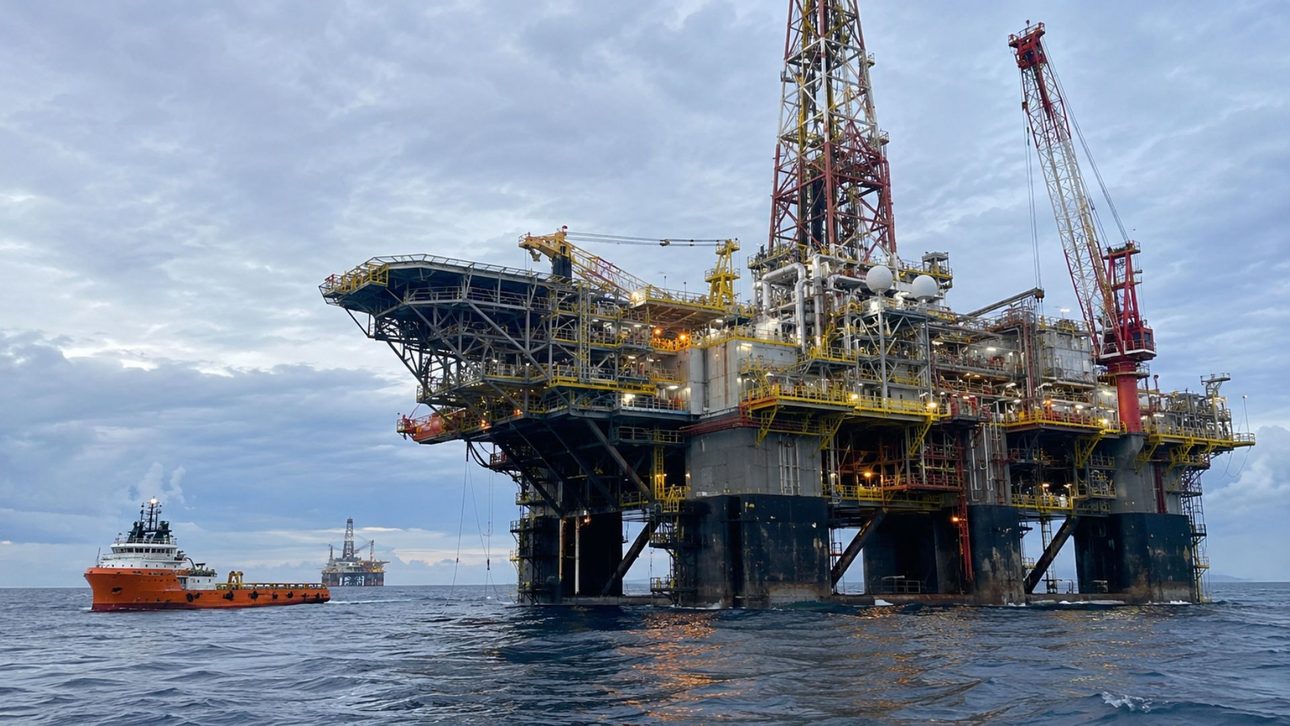

The deal involves an offshore concession awarded for R$2.82 billion in 2018, where two exploratory wells were drilled. Although hydrocarbons were identified in one of the wells, the area remains in the exploration phase, with commercial production yet to begin.
Petrobras plans to acquire ExxonMobil and QatarEnergy’s stakes in the C-M-789 exploration block in the Campos Basin, in a transaction under review by Brazilian authorities.
The purchase and sale agreement was signed on August 26 this year, the news site MegaWhat reported Friday (27).
-
Petrobras plans to clean subsea pipelines with a slotted pig that pulls coiled tubing

-
Petrobras keeps Sergipe platforms operational until 2030 and 2031, while gas route remains under review

-
Equinor extends Seven Viking contract through 2028 for subsea well inspection and repair in Norway
-
Oil-storage vessel planned 82 km off Quissamã sparks debate over support routes and Espírito Santo fishing grounds

The deal is under review by the Administrative Council for Economic Defense (CADE), Brazil’s antitrust agency, and the National Agency of Petroleum, Natural Gas and Biofuels (ANP), Brazil’s oil and gas regulator.
ExxonMobil holds the largest individual stake in the concession, at 40%, while Petrobras and QatarEnergy each hold 30%.
If the deal is approved and completed, the Brazilian state-controlled company will take on the remaining 70% of the rights and obligations under the concession agreement. The transaction’s financial terms were not disclosed.
Petrobras plans to take full control of the Campos Basin concession
Under the concession regime, oil companies assume the risks and investments required for exploration, including the costs of seismic surveys, geological studies, well drilling and reservoir evaluation.
When a block is awarded to a consortium, those costs can be shared among its members in proportion to their respective stakes and under the agreements governing operations.
Full ownership would concentrate in Petrobras the financial commitments tied to its stake in the concession, as well as the corresponding economic rights if the area eventually produces oil or natural gas commercially.
A change in the consortium’s composition does not remove the exploration obligations set out in the agreement or, by itself, authorize production to begin.
Oil block was awarded for R$2.82 billion in 2018
C-M-789 was included in the ANP’s 15th Round of Bids for exploration blocks, held in March 2018, when the consortium of the three oil companies submitted the auction’s highest individual signature-bonus offer.
The Ministry of Mines and Energy said the companies offered approximately R$2.82 billion for the concession, while the entire round raised R$8.01 billion in signature bonuses.
The amount allocated to the Campos Basin block represented about 35% of all the revenue raised through this type of payment in the auction.
A signature bonus is the amount companies offer to obtain the rights set out in a concession agreement, separate from the investments later required to investigate the area’s oil potential.
For that reason, the amount recorded in 2018 does not necessarily reflect the asset’s current value or the price Petrobras is negotiating to acquire the other two companies’ stakes.
Drilling found indications of oil and natural gas in 2021
ExxonMobil drilled two exploratory wells in block C-M-789, which the company calls Opal, to investigate the presence of hydrocarbons in the region.
MegaWhat reported that the first well, designated Opal-1, had to be permanently abandoned because of operational problems.
Work continued with drilling at Opal-1A, where fluids containing oil and natural gas were identified in 2021.
Although this result provides information about the geological characteristics of the area under investigation, the presence of hydrocarbons in an exploratory well does not confirm a commercial reserve.
Assessing a discovery involves determining the extent of the accumulation, the properties of the rocks that hold the fluids, and the conditions required to extract oil from the reservoir.
Not all the hydrocarbons present in geological formations can be extracted with available technologies or under economically viable conditions.
For offshore projects, the economic analysis also considers the costs of drilling production wells, installing subsea equipment, processing the fluids, and building the infrastructure needed to transport production.
Assessing these factors makes it possible to determine whether the potentially recoverable volume justifies the investment required to commercially develop the discovery.
Exploration period for the block extended through 2027
The concession contract for C-M-789 was signed in September 2018, and ExxonMobil remains the area’s operator.
Brazil’s oil regulator, the ANP, extended the period for exploration activities in the block. The extension means this phase of the contract now runs through December 11, 2027.