






 Portuguese
  Spanish


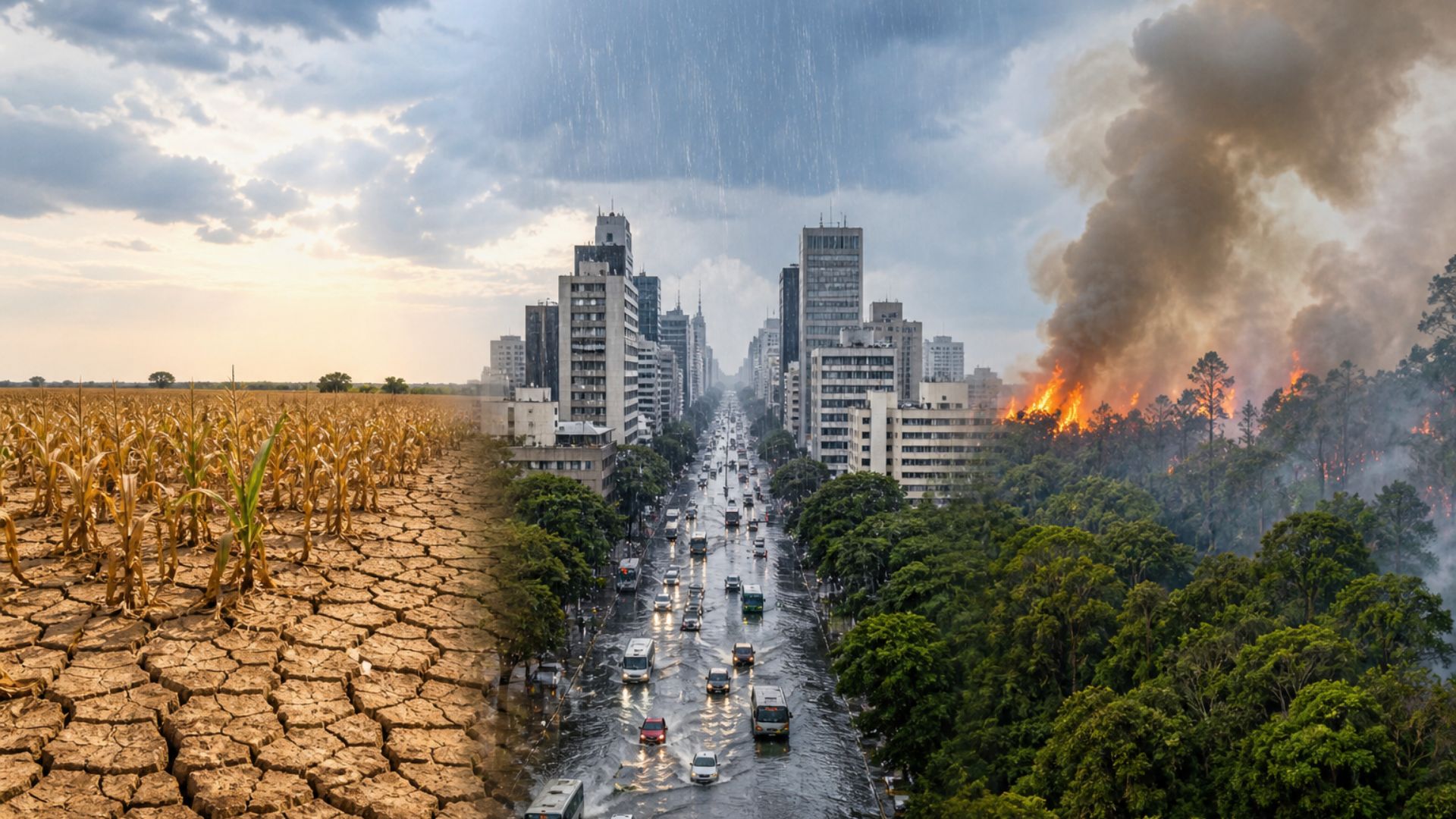

Scientific study indicates that extreme impacts can emerge in a concentrated manner even in scenarios considered moderate, with simultaneous effects on food production, dense cities, and forest ecosystems, challenging the traditional interpretation based solely on the global average warming.
A study published in Nature magazine on March 25, 2026, indicates that a global warming of 2 °C above pre-industrial levels can still produce severe climatic extremes in regions strategic for food, forests, and large population concentrations.
The research shows that the risk does not depend solely on the global average temperature, but also on the unequal way in which droughts, intense rainfall, and conditions favorable to fires can concentrate in vulnerable areas of the planet.
According to the authors, impacts projected for a 2 °C warmer world can, in some models, exceed averages normally associated with 3 °C or 4 °C scenarios.
-
Crab Trapped in Plastic Bottle for 62 Days Near Okinawa Highlights Little-Known Impact of Marine Pollution on Small Animals

-
Esperanza’s Bamboo Barrier in Oaxaca Redirects River and Reduces Erosion by 85% in Five Years

-
Family Builds Homemade Wind Turbine to Power Off-Grid Home, Video Reaches 555,000 Views on Ngô Thị Huyền’s Channel
-
Indian Brand Creates Sneakers from Recycled PET Bottles and Discarded Tires, Repurposing Over 1 Million Bottles and Raising $4 Million for Expansion



This does not mean that 2 °C is as severe as greater warming across the planet, but it indicates that critical sectors may face extreme shocks sooner than expected.
Climate risk beyond the global average
The analysis used CMIP6 simulations, a set of climate models used in IPCC assessments.
Instead of considering only the average among models, the researchers examined individual projections to identify plausible high-impact outcomes.
This approach alters the interpretation of climate risk.


When communication relies solely on the average, some of the most severe scenarios can remain hidden, even if they appear consistently in models used by the scientific community.
The team evaluated three main fronts: droughts in large agricultural regions, extreme precipitation in densely populated areas, and “fire weather” extremes, an indicator associated with atmospheric conditions that favor forest fires.
Droughts threaten food-producing regions
In areas known as “breadbaskets,” important for global food production, the variation among models was especially wide.
Some of the projections indicated droughts at 2 °C more severe than the multi-model average calculated for 4 °C.
The study reports that 10 out of 42 models analyzed for agricultural droughts presented, under 2 °C of warming, results superior to the average projected for a 4 °C warmer world.
This data draws attention because it involves regions linked to international supply.
When droughts hit large agricultural zones simultaneously, the impact can exceed local losses and affect distribution chains, stocks, and prices.
The research, however, does not quantify direct economic effects nor estimate specific crop failures.
Extreme rainfall increases risks in populous areas
In densely populated regions, the study evaluated precipitation extremes, a phenomenon associated with flooding and inundations when urban infrastructure cannot absorb intense volumes of rain in a short period.
Some projections for 2 °C exceeded the average expected for 3 °C, especially when the analysis considered the exposure of large populations.
In these cases, the risk is not only in the increase in rain, but in the number of people and services concentrated in the affected areas.
The research highlights that this type of assessment helps bring climate science closer to urban planning.

Cities exposed to more intense rainfall need to consider drainage, land use, housing, and alert systems as parts of the same adaptation strategy.
Fire conditions increase pressure on forests
In forests, the authors analyzed meteorological conditions linked to fire risk, such as heat, dryness, and other atmospheric factors favorable to fire spread.
The focus was not on predicting specific fires, but on measuring the likelihood of environments more prone to them.
The article states that the four most severe models for 2 °C indicated “fire weather” extremes higher than the multi-model average projected for 3 °C.
This reinforces that moderate increases in global average temperature can still create dangerous combinations in forest ecosystems.
Forests play a relevant role in climate regulation, biodiversity protection, and hydrological cycles.
Therefore, meteorological conditions more favorable to fires represent environmental, climatic, and social risk, even without automatically equating to wildfires in all locations.
Climate planning requires looking at severe scenarios
The study’s main message is that limiting global warming remains essential, but it does not eliminate the possibility of intense extremes.
A 2 °C world remains less risky than 3 °C or 4 °C scenarios, although it still carries relevant risks.
The authors argue that climate assessments and adaptation policies should include plausible high-impact scenarios, not just the average or most likely outcome.
This approach can help governments, businesses, and communities prepare for rare, but potentially severe events.
The research also reinforces that uncertainty does not mean absence of risk.
Differences between models and natural climate variability can produce extreme results in essential sectors, even when the global average seems to indicate a less severe picture.
The interpretation proposed by Nature shifts the debate from the isolated warming number to the concrete effects on food, cities, and ecosystems.
On a planet already approaching high levels of warming, the margin of safety increasingly depends on reducing emissions and anticipating impacts in critical areas.


