






 Portuguese
  Spanish
  6 min of reading
  0 comments


The problem is that these places have less public transport than central London. Therefore, many residents see the charge as a rule that weighs more heavily on those with fewer alternatives.
The financial pressure also matters. Inflation exceeded 11% at the end of the previous year mentioned in the case, and changing vehicles is not a simple decision for families already living on a tight budget.
“This will make the poor even poorer,” said Anna Austen, who states she relies on her 15-year-old diesel car to go to work and take her children to school.
-
Survivor of 1966 SS Daniel J. Morrell Shipwreck in Lake Huron Recounts 38-Hour Ordeal in Extreme Cold

-
The Greatest Hoax in World Cup History? The Film That Denied Brazil’s 1958 Victory and Exposed How Fake Evidence Can Seem Convincing on TV
-
Fake South Korean Online Stores Offer Shopping Thrill Without Spending Money or Receiving Products
-
The War of Jenkins’ Ear: How a Severed Ear Sparked One of the 18th Century’s Most Unusual Conflicts


“I don’t have money to pay the fines, I don’t have money to buy a new car,” Austen stated.
Associated Press, international news agency, showed that the dispute moved from traffic to politics
Associated Press, the international news agency, detailed how the dispute over ULEZ began to influence British politics. The charge became a national issue after a by-election in July, in the outer London borough of Uxbridge.
The Conservatives won the dispute with a campaign against the charge linked to Mayor Sadiq Khan, of the Labour Party. The result drew attention because the Labour Party had an advantage in national polls.
British Prime Minister Rishi Sunak criticized the charge. He stated that the new vehicle tax “will affect working families. I don’t think that’s the right priority.”
The Labour Party recalls that ULEZ was originally announced in 2015 by Boris Johnson, then Mayor of London for the Conservative Party.
The city wants to breathe better, but the extent of ULEZ’s effect is still debated
London was once known as the Great Smoke because of pollution. The city’s air is cleaner, but there is still debate about how much ULEZ contributes to this result.
A 2021 study by Imperial College London suggested that the zone had a relatively small effect on air pollution in the 12 weeks after its launch in the city center.
Another study published by the mayor’s office in February indicated that harmful nitrogen oxide emissions were 26% lower in the ULEZ area since 2019 than they would have been without the measure. Particulate matter emissions were 19% lower.
“We know that low emission zones work,” said Simon Birkett, director of the Clean Air in London group. He also stated that “big problems require big solutions.”

The case shows why traffic cameras can become a symbol of control for part of the population
The revolt in London doesn’t just involve old cars. It also shows how public equipment can take on another meaning when the population feels it is being watched or overcharged.
For some residents, cameras are tools to enforce an environmental rule. For others, they have become a sign that the government monitors every movement and punishes those who cannot afford to change their cars.
This is what makes the case so strong. A policy created to reduce pollution has come to be seen by some as a threat to the freedom to drive.
In the protests, direct criticisms of Sadiq Khan appeared, as well as accusations linked to social control. Khan told LBC radio that the opposition had been “instrumentalized” by “people who believe in conspiracy theories.”
Other cities also face the same dilemma between cars, health, and urban life
London is not alone in this discussion. Madrid has a similar low emission zone. Paris is trying to move forward with restrictions for older diesel and petrol cars, but the plan faces delays.
The dilemma is easy to understand. Cities want to reduce pollution and improve people’s health. At the same time, many residents depend on cars because they have no other practical option.
Professor Tony Travers, from the London School of Economics, called the issue a “classic and divisive political question.”
“The use of cars, the freedom to use them, and the places where people can drive have a huge impact, in a way that many other issues do not,” said Travers.
The story of the Blade Runners in London continues to draw attention because it brings together elements that don’t age: street cameras, charges on old cars, fear of surveillance, cost of living, and the dispute over who pays the pollution bill.
Ultimately, the big question is not just whether polluting cars should pay more. The question is how far a city can go to clean the air without turning an environmental measure into a punishment for those who depend on cars to live.
Do you think it’s fair to charge those who drive old cars to reduce pollution, even when many drivers say they don’t have money to replace their vehicles, or should the city offer a real alternative before imposing this type of charge? Share your opinion.
London’s ULEZ charges older, more polluting cars, has become the target of protests in the suburbs, and has brought traffic cameras to the center of a dispute mixing clean air, tight budgets, and fear of street control
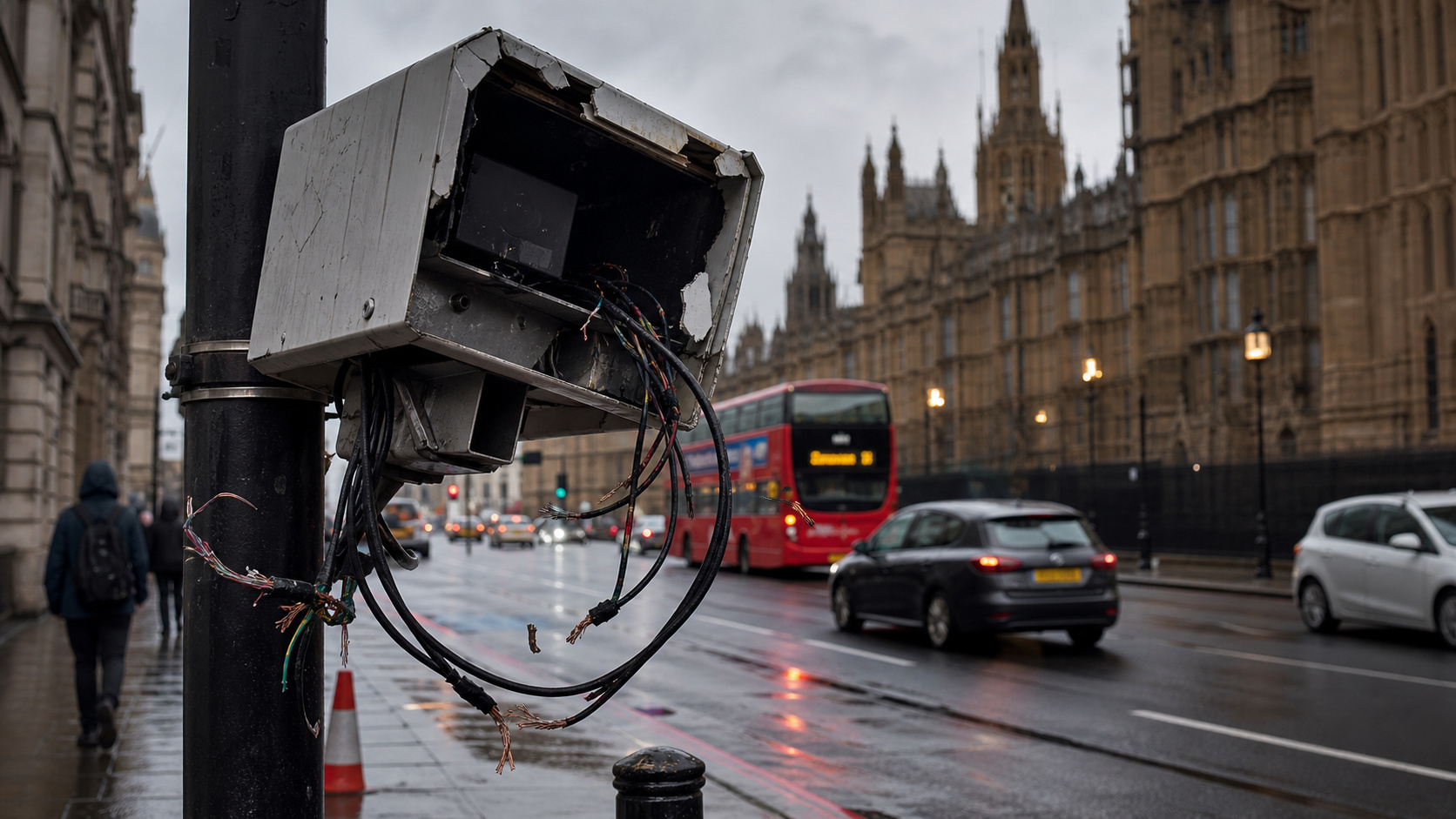
A group called Blade Runners in London has started attacking environmental cameras used to monitor polluting cars. The case gained traction because a rule created to improve air quality ended up becoming a reason for protest, political infighting, and street sabotage.
The charge is part of ULEZ, London’s Ultra Low Emission Zone. It imposes a daily fee of £12.50, about US$16, for most petrol cars and vans manufactured before 2006 and diesel vehicles manufactured before 2015.
The investigation was published by Associated Press, an international news agency. The case is noteworthy because it shows how a clean air policy can turn into a dispute over money, cameras, freedom to drive, and trust in the government.
The anti-polluting car charge, which seemed like a technical matter, turned into a war against cameras on London’s streets
London’s ULEZ began in the city center in 2019. In 2021, it was expanded to areas near the center. Later, it came to cover all of Greater London, including suburbs where more than half of the British capital’s 9 million inhabitants live.
The rule works simply. Older, more polluting cars must pay to circulate within the monitored area. Cameras read license plates and help identify the vehicles affected by the charge.


Mayor Sadiq Khan defends the measure as a way to reduce air pollution. He states that the expansion allows “more than 5 million Londoners to breathe cleaner air.”
Khan also declared: “It was a difficult decision, but it is vital and correct.”
Who are the Blade Runners and why did they start targeting environmental cameras
The name Blade Runners began to be used to identify opponents who attack ULEZ cameras. Police state that hundreds of cameras have been damaged, disconnected, or stolen.
These cameras became a symbol of something larger. For proponents of the measure, they help protect public health. For some critics, they represent surveillance, charges, and control over those who need to use a car every day.
“The cameras will continue to be removed,” predicted Nick Arlett, an organizer of protests against the clean air charge. He states that he neither approves nor condemns the sabotage.
“People are angry.”
The point that most angered residents was the financial impact on those who rely on older cars
The outrage grew mainly in the suburbs. In these areas, more residents depend on cars for work, taking children to school, and daily tasks.
The problem is that these places have less public transport than central London. Therefore, many residents see the charge as a rule that weighs more heavily on those with fewer alternatives.
The financial pressure also matters. Inflation exceeded 11% at the end of the previous year mentioned in the case, and changing vehicles is not a simple decision for families already living on a tight budget.
“This will make the poor even poorer,” said Anna Austen, who states she relies on her 15-year-old diesel car to go to work and take her children to school.
“I don’t have money to pay the fines, I don’t have money to buy a new car,” Austen stated.
Associated Press, international news agency, showed that the dispute moved from traffic to politics
Associated Press, the international news agency, detailed how the dispute over ULEZ began to influence British politics. The charge became a national issue after a by-election in July, in the outer London borough of Uxbridge.
The Conservatives won the dispute with a campaign against the charge linked to Mayor Sadiq Khan, of the Labour Party. The result drew attention because the Labour Party had an advantage in national polls.
British Prime Minister Rishi Sunak criticized the charge. He stated that the new vehicle tax “will affect working families. I don’t think that’s the right priority.”
The Labour Party recalls that ULEZ was originally announced in 2015 by Boris Johnson, then Mayor of London for the Conservative Party.
The city wants to breathe better, but the extent of ULEZ’s effect is still debated
London was once known as the Great Smoke because of pollution. The city’s air is cleaner, but there is still debate about how much ULEZ contributes to this result.
A 2021 study by Imperial College London suggested that the zone had a relatively small effect on air pollution in the 12 weeks after its launch in the city center.
Another study published by the mayor’s office in February indicated that harmful nitrogen oxide emissions were 26% lower in the ULEZ area since 2019 than they would have been without the measure. Particulate matter emissions were 19% lower.
“We know that low emission zones work,” said Simon Birkett, director of the Clean Air in London group. He also stated that “big problems require big solutions.”
The case shows why traffic cameras can become a symbol of control for part of the population
The revolt in London doesn’t just involve old cars. It also shows how public equipment can take on another meaning when the population feels it is being watched or overcharged.
For some residents, cameras are tools to enforce an environmental rule. For others, they have become a sign that the government monitors every movement and punishes those who cannot afford to change their cars.
This is what makes the case so strong. A policy created to reduce pollution has come to be seen by some as a threat to the freedom to drive.
In the protests, direct criticisms of Sadiq Khan appeared, as well as accusations linked to social control. Khan told LBC radio that the opposition had been “instrumentalized” by “people who believe in conspiracy theories.”
Other cities also face the same dilemma between cars, health, and urban life
London is not alone in this discussion. Madrid has a similar low emission zone. Paris is trying to move forward with restrictions for older diesel and petrol cars, but the plan faces delays.
The dilemma is easy to understand. Cities want to reduce pollution and improve people’s health. At the same time, many residents depend on cars because they have no other practical option.
Professor Tony Travers, from the London School of Economics, called the issue a “classic and divisive political question.”
“The use of cars, the freedom to use them, and the places where people can drive have a huge impact, in a way that many other issues do not,” said Travers.
The story of the Blade Runners in London continues to draw attention because it brings together elements that don’t age: street cameras, charges on old cars, fear of surveillance, cost of living, and the dispute over who pays the pollution bill.
Ultimately, the big question is not just whether polluting cars should pay more. The question is how far a city can go to clean the air without turning an environmental measure into a punishment for those who depend on cars to live.
Do you think it’s fair to charge those who drive old cars to reduce pollution, even when many drivers say they don’t have money to replace their vehicles, or should the city offer a real alternative before imposing this type of charge? Share your opinion.





Be the first to react!