





Passed down through generations of specialized carpenters, the kigumi technique combines hand-carved joints, structural flexibility, and deep knowledge of wood to preserve Japanese temples and shrines without relying on nails, screws, or modern metal supports.
In Japan, the restoration of centuries-old temples still challenges common logic in modern construction. Instead of resorting to nails, screws, or metal plates to join beams and pillars, master carpenters continue to use an ancient technique based on wooden joints produced with extreme precision.
As published by the Times of India, in content produced by the TOI Science Desk, the method is known as kigumi and has been passed down between generations for more than 1,000 years. The report also uses detailed information from the Ministry of Foreign Affairs of Japan about the different types of joints used in the country’s traditional architecture.
The technique transforms pieces of wood into a complex system similar to a puzzle. Each end is carefully carved to fit into another, allowing beams, columns, and crosspieces to remain firmly connected without the need for metal elements.
-
Family buys a house in Ohio, USA, with an abandoned pool, removes the cover and finds green and black water, torn tarp, and a renovation costing over $11,000, transforming the forgotten backyard into a leisure area that went viral on TikTok with 1.3 million views.

-
They seem like just crooked and curious walls, but the wavy walls used since Ancient Egypt conceal an engineering solution capable of reducing brick consumption, reinforcing constructions, better withstanding wind pressure, and benefiting crops thanks to the heat accumulated in their curves.

-
After painting six black cows with white stripes and turning them into “zebras,” scientists saw fly landings drop by almost half and found a practical clue to reduce the use of insecticides on livestock.

-
Eike Batista opens a giant mansion at the foot of the Christ the Redeemer, surrounded by the Tijuca Forest, with a pool, field, gym, sauna, jacuzzi, industrial kitchen, and even a Lamborghini V12 engine in the living room.


More than a tradition preserved out of respect for the past, kigumi offers practical advantages for a region marked by earthquakes, typhoons, heavy rains, and strong humidity variations.
Kigumi allows joining large structures without nails or screws

Traditional Japanese construction uses joints carved directly into the pieces of wood. Thus, the very geometry of the cut keeps the components together and distributes the loads throughout the structure.
The work is carried out by miyadaiku, the name given to carpenters specialized in the construction and restoration of temples and shrines.
These professionals do not cut all pieces following an identical industrial standard. Before deciding where each element will be installed, they carefully observe the type of wood, the direction of the fibers, the natural curves, the resistance, and even small peculiarities of the trunk.
The analysis determines whether a piece will be more suitable to function as a beam, pillar, crosspiece, or another structural component.
Among the traditional joints are the so-called tsugite, used to connect two pieces of wood and form longer beams or pillars. The shiguchi, on the other hand, join beams and columns at different angles, helping to form the main structure of the building.
Each joint needs to be executed with great precision. A small gap can reduce the structure’s resistance or cause unwanted movements over time.
Despite performing an essential function, many of these joints are completely hidden once the building is assembled. Those observing a finished temple can hardly perceive the complexity within the beams and pillars.
Wood follows humidity and helps temples withstand earthquakes
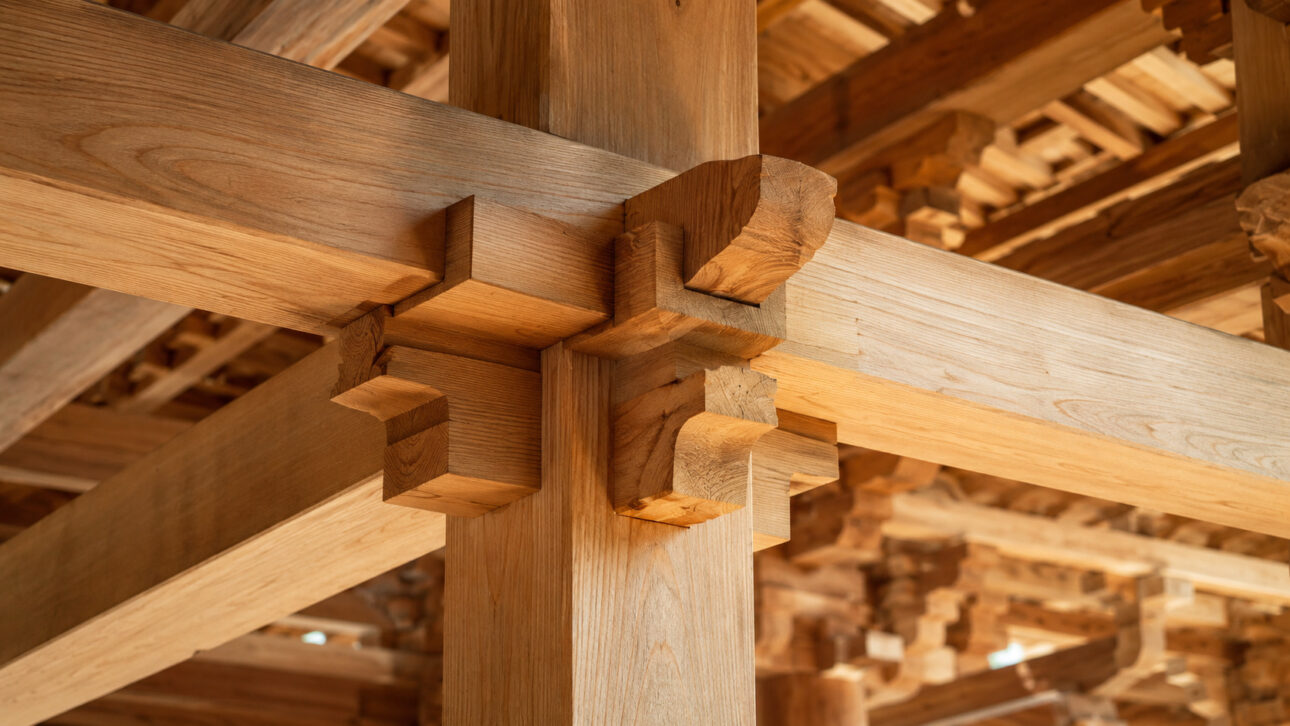
The use of wooden joints is not limited to an aesthetic preference. It is also directly linked to Japan’s climatic and geological conditions.
During humid summers, the wood absorbs moisture and expands. In drier periods, it loses some of this moisture and contracts.
When the structure uses traditional joints, this natural movement can occur without producing the same pressure caused by rigid connections. The pieces remain connected but retain a small capacity for accommodation.
Nails and other metallic elements, on the other hand, can rust when moisture reaches the interior of the wood. Over the years, corrosion can weaken the joint and damage the surrounding material.
Moreover, rigid metal connections do not always follow the natural movements of the wood in the same way.
Flexibility also becomes important during earthquakes.
Instead of remaining completely still, the traditional structure can move slightly during seismic activity. The joints absorb and distribute part of the vibrations to different points of the building, reducing the concentration of forces in a single region.
This does not make the temples indestructible. Nevertheless, it helps explain why various historical wooden structures have remained standing after successive earthquakes, storms, and periods of heavy rain.
While an excessively rigid connection can break in the face of sudden movements, the traditional system works with the natural ability of wood to yield moderately and return to position.
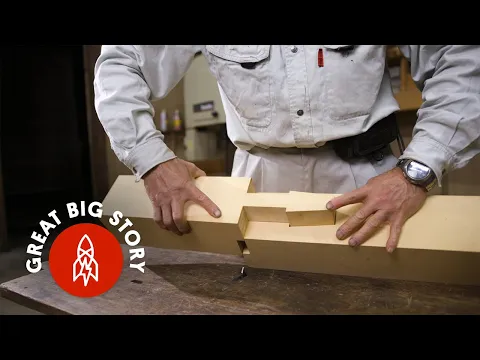

Training of a miyadaiku requires years of practice and knowledge
Learning to produce these joints takes years.
Future miyadaiku undergo long training periods alongside more experienced professionals. During the learning process, they not only study cutting and assembly techniques but also develop the ability to interpret the natural characteristics of each piece of wood.
The knowledge is usually transmitted directly in the work environment. Masters teach apprentices how to use tools, select materials, identify imperfections, and understand the behavior of the structure.
This artisanal training is necessary because each project may require different solutions.
Ancient temples do not always have standardized pieces, perfectly regular measurements, or elements that can be replaced by industrial components. In many cases, the carpenter needs to reproduce a joint made hundreds of years earlier and adapt it to the current condition of the building.
The goal is not simply to remove an old piece and install a modern one. The work seeks to preserve the original construction logic, respecting the weight, flexibility, and the way loads are distributed throughout the temple.
In this sense, the miyadaiku acts as a carpenter, restorer, and connoisseur of the construction’s history.
Tradition dates back to constructions started in the year 593
Japan has more than 150,000 temples and shrines, many of them built with traditional wooden construction methods.
Some of the oldest traditions of Japanese religious carpentry are associated with the construction of the Shitenno-ji Temple, founded in the year 593.
Therefore, the knowledge accumulated by these craftsmen spans approximately 1,400 years of political, technological, and social transformations.
Throughout this period, structures were dismantled, repaired, and reassembled. In many cases, deteriorated components could be replaced without requiring the complete reconstruction of the building.
This possibility represents another advantage of kigumi.
Since the parts are connected by joints, certain sections can be carefully removed. After replacement or restoration, the elements are reinstalled without causing widespread damage to the structure.
The process extends the lifespan of temples and reduces wood waste, making the technique relevant also from a sustainability perspective.
Instead of discarding an entire construction when a part shows wear, the craftsmen can focus the work on the affected component.
The wood that remains in good condition continues to be used, preserving not only natural resources but also part of the building’s material history.
Ancient technique still offers lessons for modern engineering

The persistence of kigumi shows that innovation does not necessarily mean abandoning everything that came before.
Although contemporary construction has steel, concrete, industrial fasteners, and digital tools, the Japanese method continues to offer efficient solutions for problems of durability, maintenance, and seismic resistance.
Its main strength lies in the combination of precision, flexibility, and understanding of the material.
The joints do not try to completely prevent the movements of the wood. On the contrary, they work with these natural characteristics to maintain the stability of the assembly.
Moreover, the system has been perfected over centuries of practical observation. Generations of carpenters analyzed how different structures reacted to earthquakes, rains, typhoons, and the wear caused by time.
Today, the result can be observed in temples and shrines that have spanned centuries without relying on the metallic solutions considered indispensable in much of modern construction.
The technique also reinforces the importance of continuous maintenance. These constructions have survived not only because they were well designed in the past but because successive generations preserved the knowledge necessary to repair them correctly.
Thus, the longevity of Japanese temples is not only in the wood or the joints. It depends on a human chain of knowledge that remains alive through the miyadaiku.
In a period marked by the search for more sustainable and resilient constructions, kigumi shows how a method developed over a thousand years ago can still inspire architects, engineers, and restorers.
Would you trust a large structure built only with wooden joints, without nails, screws, or metal supports?


