





 Portuguese
 Spanish


Indian refineries are expected to receive about 230,000 barrels per day of Brazilian oil in November 2026, a record for the route, according to an analysis published Thursday, Nov. 19. The increase comes as Russian oil gets more expensive and freight rates fall.
India is expected to import about 230,000 barrels per day of Brazilian oil in November 2026, a monthly record. That is more than double the average for the previous three months.
The estimate was published Thursday, Nov. 19, 2026, by the specialized website OilPrice.
The author is commodities analyst Natalia Katona, who is based in the United Arab Emirates. The article examines the growth of Brazilian exports to Europe and Asia.
-
EU delays methane compliance for imported oil and gas to 2029, giving Brazil two more years as Europe’s top buyer in September

-
Russia’s refinery throughput drops 45% after Ukrainian drone strikes, impacting Brazil’s diesel imports
-
U.S. diesel inventories remain 7% below the five-year average at 104.9 million barrels as U.S. suppliers provided 74% of Brazil’s diesel imports in September
-
Sulgás cuts natural gas rates by up to 35% for free-market industrial customers in Rio Grande do Sul, up to 15% for residential customers and 4.8% for CNG


Brazilian oil shipments bound for India’s west coast reached 340,000 barrels per day in October. In the previous months, they had ranged from about 100,000 to 120,000 barrels per day.
The Indian market also matters more to Brazil as China buys less.
Brazil’s share of China’s oil imports fell from 15% in July to 9% in October, the same analysis said.
Why Indian refineries are buying more Brazilian oil
Katona cites three reasons. Brazil is closer to India than to China. Indian refineries have increased purchases over the past two months.
Oil processing also rises at this time of year, while Russian barrels have become more expensive.
India buys about 5 million barrels of oil per day, Petrobras says. The country imports nearly 90% of the oil it consumes.
This WION video, from an Indian TV network, covers India’s bet on Brazilian oil:


Russia loses ground in India’s oil purchases
The shift in suppliers was already evident in October.
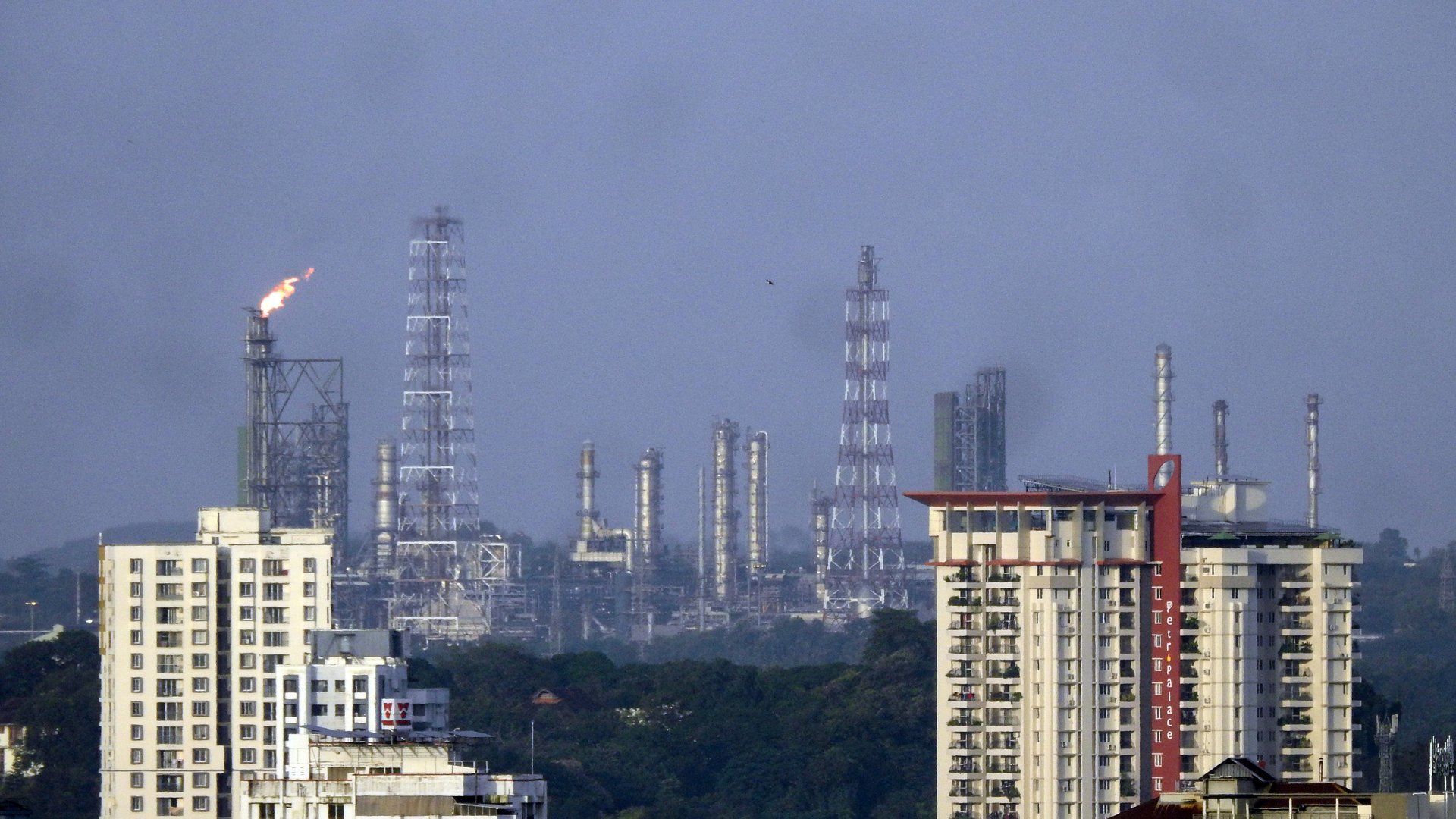
On October 26, 2026, Reuters reported, in an article republished by Baird Maritime, that Indian state-owned Bharat Petroleum (BPCL) had sharply reduced Russian oil shipments for November.
BPCL Chief Financial Officer Vetsa Ramakrishna Gupta spoke with analysts after the quarterly earnings report.
He said Middle Eastern oil grades are more commercially viable than Russian oil. He cited higher freight costs as the reason.
Russian oil accounted for about 37% of BPCL’s purchases from July through September.
The same report says the premium for Russian oil shipments for December delivery fell to $1 to $2 per barrel, from $12 to $13 in October.
In the first weeks of November, India received more oil from the Persian Gulf than from Russia. The estimate was 2.1 million barrels per day from the Gulf and 1.8 million from Russia.
Those figures came from data provider Kpler, were cited by Bloomberg, and were republished by OilPrice on November 12, 2026, in an article by Tsvetana Paraskova.
OilPrice posted Kpler’s figures on X:
Before the war in Iran, Indian imports through the Strait of Hormuz totaled about 2.8 million barrels per day.
In April, flows from the Gulf to India fell to 247,000 barrels per day.
The recovery came through ship-to-ship cargo transfers conducted closer to the Indian coast. The shorter route from the Gulf also supported purchases from the region.
What changes for Petrobras and Brazil’s oil
Petrobras had already signed contracts to sell more oil to India.
On January 28, 2026, Agência Gov, Brazil’s government news agency, citing information from Petrobras, announced agreements with three Indian state-owned refineries, signed at India Energy Week in Goa.
The official video for India Energy Week 2026 in Goa introduces the event:

Under the contract with Indian Oil Corporation (IOC), the company can sell up to 24 million barrels over 12 months, with a possible extension for an equal period.
For BPCL and Hindustan Petroleum (HPCL), the ceiling for each contract rose from 6 million to 18 million barrels.
The three contracts run through March 2027. Together, they represent potential sales of up to 60 million barrels of oil.
The total value could exceed US$3.1 billion, depending on market conditions.
At the time, Petrobras Director of Logistics, Trading and Markets Cláudio Schlosser said the contracts strengthen the company’s presence in the Indian market.
The company described India as a strategic market for diversifying its overseas customer base.
For Brazilians, the impact is in the state-owned company’s export sales. Petrobras is controlled by the government, and every shipment sold to Indian refineries generates export revenue.
The export tax weighs more heavily on sales to India
Selling to Asia carries an additional cost for exporters in Brazil.
In March 2026, the government introduced a 12% tax on oil exports, calculated on the value of the shipment at loading.
The tax has already been extended three times, most recently through December 31.
The provisional trade agreement between the European Union and Mercosur was signed in January and has been in effect since May 1.
It requires Brazil to cut by at least half this type of tax on sales to Europe.
With oil priced at about US$77 a barrel at the time of shipment, the tax on sales to the European Union comes to US$4.62.
On sales to China or India, it reaches US$9.24 a barrel.
Despite the difference, India is among the growing destinations for Brazilian oil in November.
Falling freight rates favor long-haul shipments
On November 11, 2026, Reuters reported in a story republished by CNBC Africa that freight rates for VLCC, Suezmax and Aframax tankers had fallen about 50% from the previous month’s peak.
The data comes from the Baltic Exchange, which tracks the shipping market.
In a November 9 note, consultancy Energy Aspects said lower freight rates make Atlantic oil grades more attractive.
Wanying Zhang, an analyst at ship-tracking firm Vortexa, attributed the improvement to a larger supply of vessels after October’s exceptional squeeze.
The cost of delivering Brazilian and African oil to China fell by US$5 to US$10 a barrel.
Tupi oil from the pre-salt area of the Santos Basin traded at a premium of US$7 to US$8 a barrel over December-dated Brent for January delivery.
The premium had been close to US$20 the previous month.
On the route from Brazil to China, freight for a VLCC rose from US$6 a barrel in February to US$36 in October, according to OilPrice’s analysis.
By mid-November, it had fallen to US$13 to US$14 a barrel.
Over the same period, Tupi’s discount to Brent traded on the ICE exchange narrowed, from about US$25 a barrel in mid-October to about US$15.
Record Brazilian production supports sales
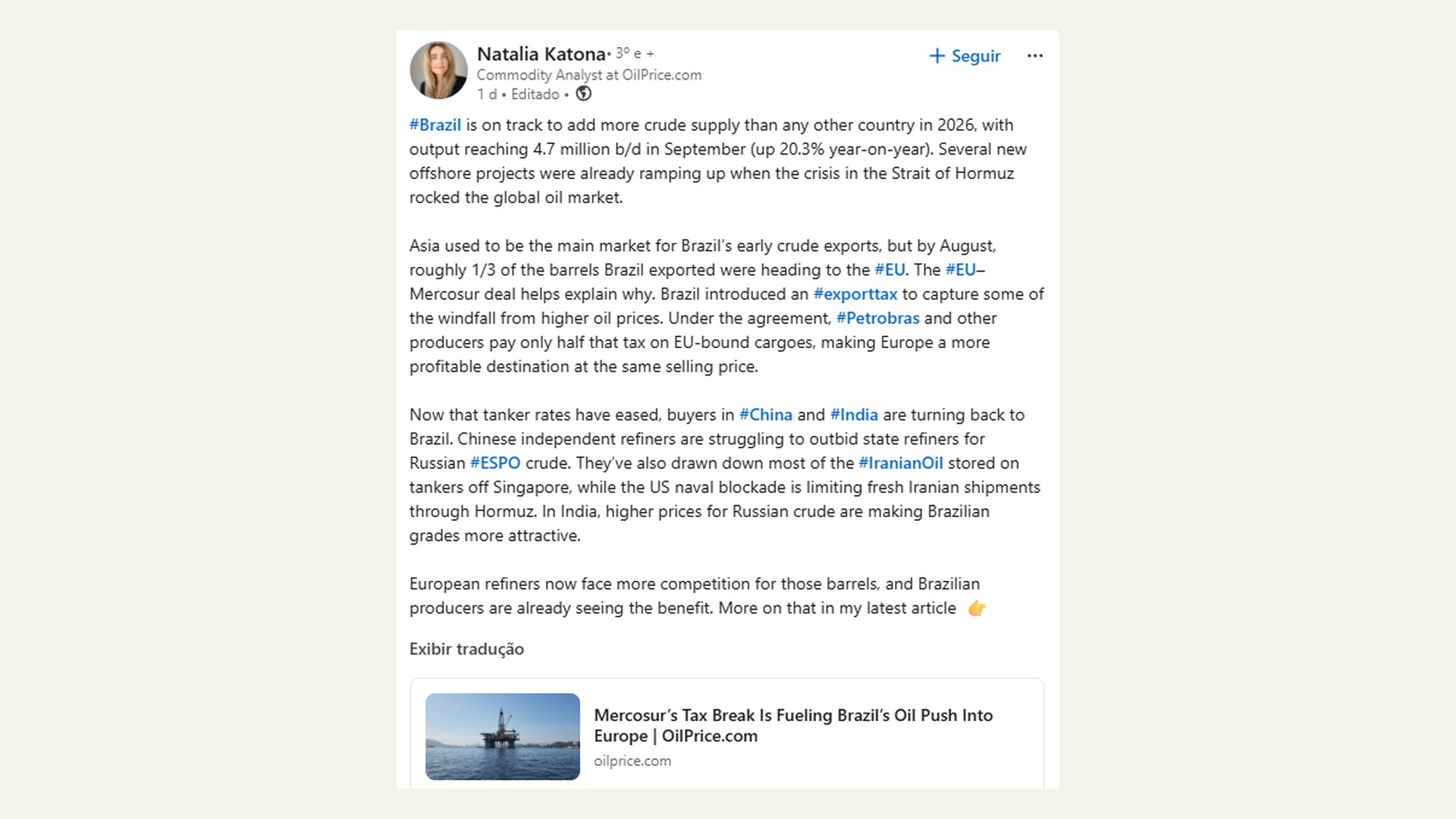
Brazilian supply has grown. The country’s oil production hit a record 4.7 million barrels per day in September, up 20.3% from the same month in 2025.
OilPrice highlighted the record on X:
Exports fell to 2.80 million barrels per day in September before recovering to 2.95 million in October.
Since October 2024, Petrobras has brought six major projects online, including new units at the Búzios and Mero fields.
Together with Equinor’s Bacalhau field, these projects add about 1.3 million barrels per day of capacity. Some of them are still ramping up production.
Output from the Mero field has nearly tripled since 2024, reaching 570,000 barrels per day. Two Petrobras platforms for Búzios, P-80 and P-82, are expected to start producing in 2027.
Europe is also competing for Brazilian oil
India is not the only destination gaining ground. Shipments to the European Union reached 975,000 barrels per day in August, nearly double the 490,000 barrels per day recorded in February.
They fell to 400,000 barrels per day in September, then rose to 640,000 in October. The European Union’s share of Brazilian exports increased from 22% to about 34%.
India’s imports hit a record in October
In October 2026, the country’s imports reached a record 5.6 million barrels per day, based on Kpler data published by Indian website Construction World on November 5.
That month, the Middle East supplied about 2.3 million barrels per day, while Russia supplied nearly 2 million.
Energy analyst Anas Alhajji commented on the record on X:
The post forecast a moderation in Russian shipments in November and December because of attacks in the Black Sea that are driving up freight costs.
What remains uncertain
The November volume is an estimate made before the end of the month. The total volume of India’s oil imports from Brazil will depend on shipments that arrive by the 30th.
The 12% export tax is in effect through December 31, and Petrobras’ contracts with Indian refineries run through March 2027.
What happens to the tax starting in January still depends on a new government decision.


