






 Portuguese
  Spanish


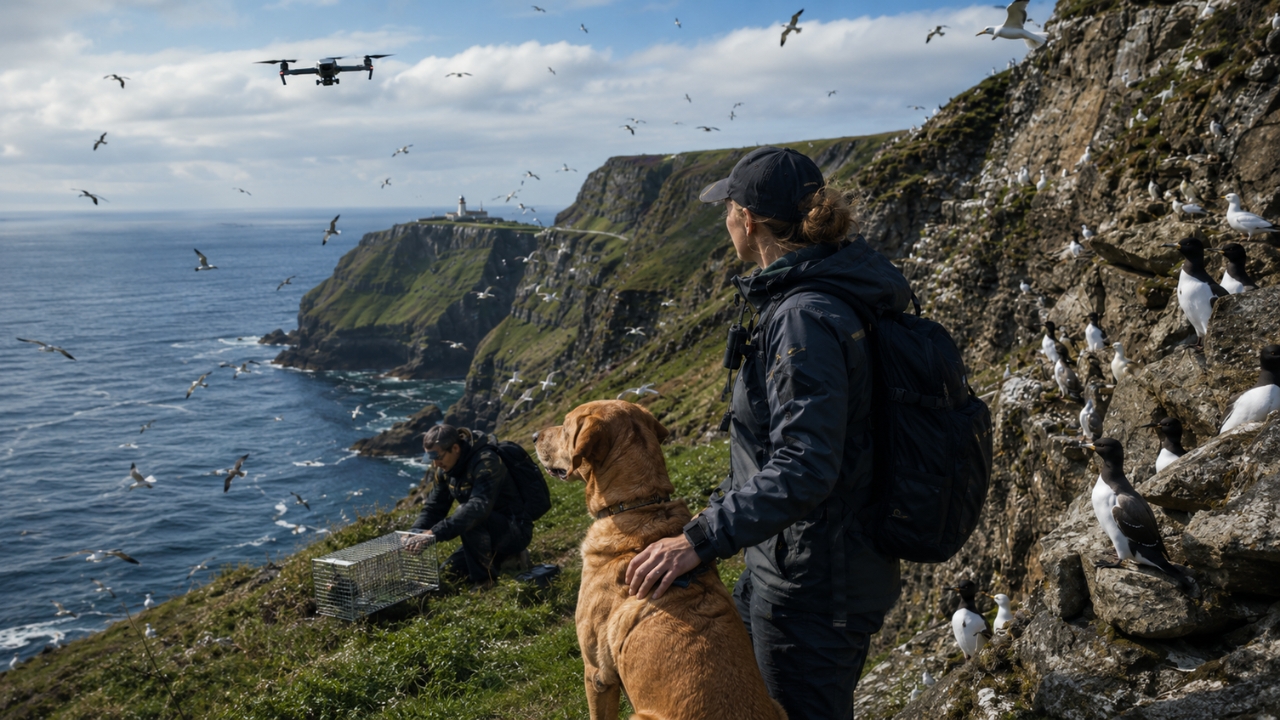

After decades of nest attacks and an 83% decline in puffin population, a small community in Northern Ireland mobilized residents, experts, and technology to restore environmental balance and give the birds a new chance to breed.
Silence returned to the nests.
For years, broken eggs, missing chicks, and dead adult birds revealed the presence of a predator that should never have reached the island. In just two days, a single ferret killed 27 adult birds.
The scenario occurred in Rathlin, the only inhabited offshore island of Northern Ireland. About 150 people live there, and it is home to a colony of over 250,000 seabirds.
-
The United Kingdom pumps more than one million tons of gravel removed from the sea onto a beach, doubling the width of the coastal strip and creating a barrier capable of reducing wave force, containing erosion, and helping to protect over 10,000 properties from flooding.

-
Meta announces a data center worth R$ 47 billion in Canada with 1 GW capacity, which will consume energy equivalent to 800,000 homes.
-
Researchers create material that changes color upon touch and reproduces even the details of a fingerprint.
-
Brazil has never consumed so much electricity: energy consumption has reached a record high and entered a new level, driven by a heated economy, the explosion of data centers, and air conditioning running in homes.


In March 2026, after an operation that brought together residents, experts, thermal drones, hundreds of traps, cameras, and a sniffer dog, Rathlin was declared free of feral ferrets.
According to RSPB Northern Ireland, a British organization dedicated to bird protection, it was the first eradication of its kind completed on an inhabited island.
Animals released in the 1980s became a permanent threat

Ferrets were not part of the local ecosystem. They were released in the mid-1980s, apparently to control rabbits. The plan got out of control when males and females began to reproduce.
Nests installed on the ground, between rocks, or inside burrows became easy targets. Puffins, guillemots, razorbills, and shearwaters were exposed during incubation and after the chicks hatched.
The puffin population fell by about 83% between 1985 and 2021. Before the arrival of the detector dog, only one in three chicks would have survived long enough to leave the nest.
The problem also reached homes. Ferrets invaded properties and killed chickens, while about 70% of visitors cited birds and nature as the main reason for traveling to the island.
A network of 600 traps surrounded Rathlin

The reaction gained scale with the LIFE Raft, a project formally initiated in 2021 after almost a decade of studies and dialogue with the community.
The program received over 4.5 million pounds and also included actions against rats, another invasive species that threatened eggs, chicks, and adult birds.
The traps began operating in October 2023. First, more than 400 units were installed. In the most intense phase, the network reached about 600 points, separated by approximately 250 meters.
The captures were accompanied by alerts for technicians to arrive quickly. By May 2024, 98 ferrets had already been removed. But capturing the animals was not enough. It was necessary to prove that none remained hidden.
Drones, cameras, and Woody followed the last traces

Parts of Rathlin have cliffs, rocks, dense vegetation, and areas accessible only by boat or climbing. Thermal drones were used to locate heat sources in difficult spots.
A network of approximately 110 cameras reinforced the monitoring. Residents reported suspicious movements and allowed teams to enter fields, gardens, sheds, and properties.
In May 2024, Woody, a trained Labrador, began searching for feces, latrines, and scent trails. He did not chase the ferrets but helped confirm if any animal had passed through a certain area.
The last verified sighting occurred in November 2023. Even so, the island remained under surveillance for more than two years before the official declaration.
The return of a bird revealed the change

In 2025, monitoring confirmed the breeding of the Manx shearwater in Rathlin for the first time in more than two decades.
The record does not mean that all populations have already recovered, but it showed what can happen when the pressure of an invasive predator disappears.
The island has not yet been declared rat-free, and controls at ports, vessels, and cargo remain essential. A single animal brought back to the site could put decades of work at risk.
The story of Rathlin goes beyond drones, traps, and sniffer dogs. It shows how a decision made in the 1980s altered an entire ecosystem and how technology, investment, and community participation needed to work together to begin to repair the damage.


